Independent comparisons. We may earn from shop links. More info

Jasmine vs star jasmine: leaves, winter, and a bare wall

Updated: 22 October 2026

You are choosing a scented climber for a fence, and both plants are sold as jasmine. One is usually deciduous and a step hardier. The other keeps its leaves in January. This jasmine vs star jasmine page is that pair. Leaves in January point to star jasmine, Trachelospermum jasminoides, on a sheltered wall. Evening scent and a harder frost point to Jasminum officinale. The [jasmine plant comparison](/hub/ornamental-plants/jasmine-plant) sells neither. It sells Jasminum × stephanense, a Madagascar jasmine hoop, and a cape jasmine. Peter F. used RHS profiles on 20 October 2026. A qualifying purchase can earn a commission at no extra cost to you.

You are choosing a scented climber for a fence, and both plants are sold as jasmine. One is usually deciduous and a step hardier. The other keeps its leaves in January. This jasmine vs star jasmine page is that pair.

Our top picks

On this page

They are not the same plant

True jasmine is Jasminum, in the olive family. Star jasmine is Trachelospermum jasminoides, a different family, with fragrant white summer flowers. The RHS lists it among the names that are not jasmine. Common jasmine twines, is generally deciduous, and has white flowers about 2 cm wide. The RHS rates it H5. The profile says 4–8 metres and also up to 12 metres. The English Garden puts the scent in the evening. Star jasmine is evergreen and can reach 4 metres or more. It holds an RHS Award of Garden Merit. This amazon.co.uk set sells neither plant. Crocus, on 20 October 2026, listed a 9 cm star jasmine at £14.39 and a 3 litre common jasmine around £28. Pot size is on the jasmine plant buying guide.

Leaves, winter and a bare wall

In January the difference is obvious. Common jasmine has usually dropped its leaves. A bare framework is the habit, unless the stems are brittle and brown to the base. Star jasmine keeps its leaves, and they often bronze or turn red in cold weather. Jasminum officinale is H5, about -15 to -10°C, in the ground. Trachelospermum jasminoides is H4, about -10 to -5°C, and the growing guide says to protect it where the site stays below about -5°C. Pots are colder than the ground for both. Neither plant grips bare brick. The RHS says star jasmine needs wires or trellis. BBC Gardeners' World has a line that it is self-clinging once established. Where those two disagree, follow the RHS and put the wires in first. Spacing off the wall is on the how to grow jasmine page.

Where the pink climber fits

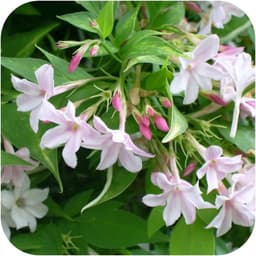
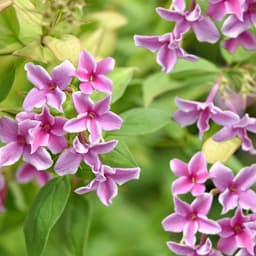
Jasminum × stephanense is the true jasmine this comparison lists, and it is not the winner of a star-jasmine contest. It is a deciduous hybrid with fragrant pale pink summer flowers, rated H5, with a growing-guide warning to bring pots indoors or mulch a sheltered planting. The titles do not print Ganmin 1701. Choose stephanense for a pink flower and a pot you can protect. Choose common jasmine when the flower should be white and you can accept a leafless winter. Choose star jasmine when January leaves matter and the site is sheltered. Do not add the stephanotis hoop. That plant is H1B and is a houseplant.

A pot is a colder place

Star jasmine in a container needs more than a 9 cm nursery pot. BBC Gardeners' World says a container at least 45 cm across with John Innes No. 3. Drainage holes matter, and the pot will need water through a dry summer. In a hard winter, group the pot against the house or wrap the container. The RHS treats pot-grown plants as more vulnerable than the same plant in the ground. Common jasmine can take a lower air temperature in the ground, and it still suffers if the rootball freezes solid. Stephanense is the one the growing guide names for bringing indoors. A 45 cm pot is a fair minimum once you are past the mail-order 9 cm stage.

Common questions

Is star jasmine a true jasmine?
No. Star jasmine is Trachelospermum jasminoides. True jasmine is the genus Jasminum. They share a sweet flower and a common name. The RHS lists star jasmine among the plants that are not Jasminum. A label that only says jasmine does not tell them apart.
Which one keeps its leaves in winter?
Star jasmine is evergreen, and the leaves often bronze or turn red in cold weather. Common jasmine and Jasminum × stephanense are usually deciduous, so a bare plant in January can be resting. Green tissue under the bark is a better check than the absence of leaves. Winter browning on star jasmine is not the same as a deciduous jasmine's leaf drop.
Which one is hardier?
Common jasmine is RHS H5, about -15 to -10°C. Star jasmine is H4, about -10 to -5°C, and the growing guide says to protect it where frosts are hard or the site stays below about -5°C. Those bands are for plants in the ground. A pot is colder. A mild London fence is not a forecast for an inland frost pocket.
Do both need a trellis?
Yes. Common jasmine twines and needs wires, trellis, or an arch. The RHS says star jasmine will not grip a bare wall and needs support too. BBC Gardeners' World has called star jasmine self-clinging. Plan the wires anyway, and fit them before you plant.
Can star jasmine live in a pot?
Yes, if the pot is large enough and the site is sheltered. BBC Gardeners' World suggests at least 45 cm across and John Innes No. 3. Water it in summer, and protect the container in a hard winter. A 9 cm mail-order pot is a start, not the finished container, and that plant is not an ASIN in this set.
Does this comparison sell star jasmine?
No. The five listings are three Jasminum × stephanense plants, a Stephanotis hoop, and a gardenia pair. Star jasmine and common jasmine have to be bought elsewhere. The pink stephanense is not a substitute for an evergreen H4 climber, and the hoop is not a substitute for either.

Related pages

Sources

Public UK sources used for this comparison, last checked on 20 October 2026. Shelf prices, stars and review counts are the stored amazon.co.uk figures. The price band is this set, not a market average. These plants were not grown as a trial.

  1. RHS: jasmine growing guide (retrieved 20 October 2026)
  2. RHS: jasmine plant guide (retrieved 20 October 2026)
  3. RHS: Jasminum × stephanense (retrieved 20 October 2026)
  4. RHS: Trachelospermum (retrieved 20 October 2026)
  5. RHS: Stephanotis floribunda (retrieved 20 October 2026)
  6. BBC Gardeners' World: how to grow stephanotis (retrieved 20 October 2026)
  7. RHS: how to grow gardenia (retrieved 20 October 2026)
  8. GOV.UK: plant passports for trade in Great Britain (retrieved 20 October 2026)
  9. Which?: houseplants in the post (retrieved 20 October 2026)