Independent comparisons. We may earn from shop links. More info

Work light with tripod

Updated: 16 October 2026

You want the beam above your head so you are not cutting in your own shadow. A work light with tripod is that raised lamp, and the first job is whether a tripod is in the included line or only in the title. We did not measure a stand. A qualifying purchase can earn a commission at no extra cost to you. The rows are on the [work lights comparison](/hub/occupational-safety/work-lights). If the stand is real, the next problem is the lead across the door, which can trip you even when the head says IP66.

You want the beam above your head so you are not cutting in your own shadow. A work light with tripod is that raised lamp, and the first job is whether a tripod is in the included line or only in the title.

Our top picks

On this page

Check the included line before you assume a tripod

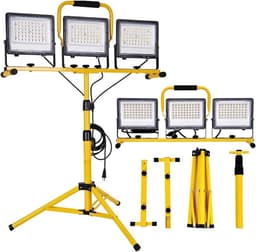
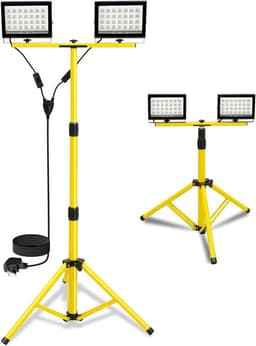
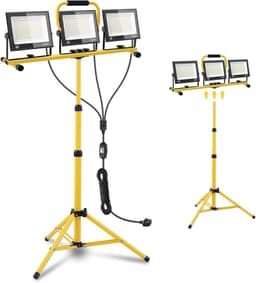
With stand hides two boxes. The cheaper T-SUN at about £22.34 offers a bracket, a magnetic base, a hook and screw holes, and it says the tripod is not included. Bought for height, it is a bracket. The Bellanny at about £42.99 is a handle and stand for wall or table, with a 3 m cord, not a telescopic pole. Kits that name a tripod are the dual T-SUN at about £47.49, the wowspeed at about £64.99, the Yofuly at about £65.69 and the EOTO at about £79.99. EOTO’s included line lists the light, the cord and the stand. Wowspeed’s 60–150 cm is a bullet, with no included-components cell. Yofuly’s line says 110–160 cm, beside a 12 V AC cell and no reviews. Other brands’ accessory stands are not in this set.

Height is a bullet, and sometimes a stuck pole

The dual T-SUN’s bullets say 24–61.3 inches. A UK review thought it had stopped at about 1.2 m until an inner pole was released. About 1.2 m is inside the printed range and short of 61.3 inches while that pole stays stuck. We did not measure it. The cable bullet says 13 ft, and a review measured about 2.5 m. The other bullet ranges are wowspeed 60–150 cm, Yofuly 110–160 cm and EOTO 80–140 cm. The EOTO title also says 47–68 inches, so that page gives two ranges. A wowspeed review says the head comes off the stand.

Put the lead up, not across the door

HSE says temporary lighting leads should run at high level, and HSG141 says to keep them off the walkway. Run the lead along the skirting or up with the stand, not across the doorway. Lock the legs and keep the plug out of the rain. About 2.5 m on the dual T-SUN, against a 13 ft bullet, needs an extension to cross a garage, and that extension is the trip. IP66 on the head does not rate the plug or the inline switch. One review would not trust the dual T-SUN switches in the rain. The stop conditions are on the how to use a work light safely page.

Skip the tripod when you are moving

A tripod fits when the lamp stays put and the lead stays off the floor. Carrying it from the bonnet to the bench drags the cable. If the stand rocks, do not cut under it. PUWER 1998 regulation 6 is the employer’s duty to inspect after assembly. Two of five captured UK reviews of the wowspeed describe arcing or a buzzing plug. Unplug that before anyone leaves it at 150 cm. Yofuly’s 110–160 cm bullet does not cancel a 12 V AC cell and a file with no reviews. If you have not chosen a type, start at the how to choose a work light page.

Common questions

Does work light with stand include a tripod?
Only when the included line says so. The cheaper T-SUN at about £22.34 offers screw holes and states that the tripod is not included. You get a bracket, a lead and the lamp. The Bellanny is a handle and stand for wall or table mounting. The EOTO included line does list a tripod. The wowspeed describes one in the bullets and has no included-components cell, so confirm it in the box.
How high do the tripods in this set claim to go?
The dual T-SUN bullets say 24–61.3 inches, and a review found the stand stuck near 1.2 m until an inner pole moved. Wowspeed’s bullets say 60–150 cm, Yofuly’s 110–160 cm, and EOTO’s 80–140 cm, with 47–68 inches also in the EOTO title. Those are claims. This comparison did not measure them. A stuck pole can leave you well short of the top figure.
Where should the cable go?
Off the floor, and not across the doorway. HSE says temporary lighting leads should run at high level, and HSG141 says to keep cables where they will not be walked on. Take the lead along the skirting or up with the stand. A review measured about 2.5 m on the dual T-SUN against a 13 ft bullet, so an extension is its own trip if you lay it across the threshold.
The stand seems too short. What did reviewers find?
On the dual T-SUN, one UK review thought the stand had stopped at about 1.2 m, then released a second pole inside it. Another called the height short. The listing range is 24–61.3 inches, so a stuck section can look like a short product. That is one account, not a measurement of every unit. If the pole will not move without bending, stop and treat it as a fault.
Does IP66 cover the plug and the inline switch?
IP66 on the head is an enclosure claim for that head, not for the plug or a switch in the lead. A dual T-SUN review would not trust the in-line switches in the rain. A cheaper T-SUN review says the switch near the plug is not waterproof, beside an IP66 bullet and an IP65 cell. Keep the plug under cover. The listing has not shown that the switch shares the head’s code.
When is a cordless light the better way to light a room I keep walking through?
When every move would drag a lead across your route. A tripod that stays put, with the cable off the floor, is the raised light. A rechargeable lamp is the one you carry from the car to the bench until the charge runs out. The wowspeed arcing reviews are a reason not to solve the walking by leaving a suspect corded head up high. Keep the tripod for the job that stays in one place.

Related pages

Sources

Public UK sources used for this comparison, last checked on 16 October 2026.

  1. HSE HSG38, Lighting at work (retrieved 16 October 2026)
  2. HSE, Site lighting (retrieved 16 October 2026)
  3. Workplace (Health, Safety and Welfare) Regulations 1992, regulation 8 (retrieved 16 October 2026)
  4. CDM 2015, regulation 35 (retrieved 16 October 2026)
  5. HSE HSG141, Electrical safety on construction sites (retrieved 16 October 2026)
  6. Electrical Equipment (Safety) Regulations 2016, regulation 35 (retrieved 16 October 2026)
  7. Electrical Safety First, Plugs and fuses (retrieved 16 October 2026)
  8. HSE INDG236, Maintaining portable electric equipment (retrieved 16 October 2026)