Independent comparisons. We may earn from shop links. More info

Rechargeable or mains work light

Updated: 16 October 2026

You have a 13 A socket on the garage wall, a yellow transformer on a plot, or neither. A rechargeable or mains work light is that choice for one named place. Mains fits when the lead is acceptable and the plug matches. Cells fit when the lead is what you would trip on. A bare 18 V light fits only if the pack is already yours. We did not measure runtime. A qualifying purchase can earn a commission at no extra cost to you. The rows are on the [work lights comparison](/hub/occupational-safety/work-lights). If a voltage cell fights the bullets, read the plate.

You have a 13 A socket on the garage wall, a yellow transformer on a plot, or neither. A rechargeable or mains work light is that choice for one named place. Mains fits when the lead is acceptable and the plug matches.

Our top picks

On this page

Use mains when the socket is the right kind

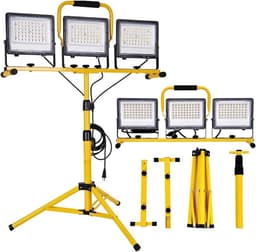
At home the right socket is 230 V with a BS 1363 plug. Only the EOTO cell, at about £79.99, says 230 V. Bellanny’s cell says 220 V. Wowspeed’s 220–240 V line is a bullet, not a photo of the plug. A corded flood stays on for as long as that socket does, if you can live with the lead. HSG141 wants the lead where it will not trip anyone. A 3 m Bellanny lead, or about 2.5 m measured on the dual T-SUN, may need an extension. On a site, HSG141 prefers batteries or 110 V reduced low voltage, about 55 V to earth, and still allows 230 V with a 30 mA RCD you test. A failed RCD leaves full mains voltage. Earlier questions are in the how to choose a work light.

Use a battery when the lead is the problem

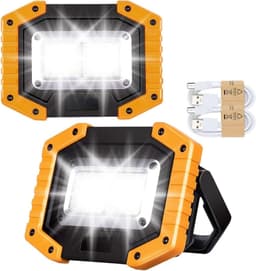
Rechargeable rows drop the lead and add a runtime that is a new-battery claim. Edasion’s bullets, at about £23.98, say about 5 hours on high and 9 on low. We did not time that. WL013’s included line names a UK plug, while the battery cell says a C battery. ST68’s bullets claim 8,400 mAh, with USB and no UK plug named. LETOUR’s title says 7,500 mAh, and one review saw the charge fall from 100% to 37% in 3 hours on low. USB in the box is not a UK plug in the box. Both SYLSTAR star lines are 4.5 from 2,073 with the same captured text, so count them once. When the cells die, the lamp waits on a charger.

Use a tool battery only if you already own it

The DeWalt DCL050-XJ at about £38.67 is a bare 18 V area light, not a mains lamp. Bullets say 250 and 500 lumens. Without an XR pack you already own, it does not switch on. The water cell says not water resistant. HSG141 treats batteries, or a real centre-tapped 110 V supply, as good practice on a harsh site. That is not a cell that merely says 110 V. The person who runs the site chooses. The look-over is on the how to use a work light safely page.

If the cells disagree, do not guess

The cheaper T-SUN cell says 110 V, and a UK review describes a domestic plug. The Yofuly cell says 12 V AC, the bullets say mains, and there are no reviews. Regulation 5 of the General Product Safety Regulations 2005 is why you read the plate instead of trying both sockets. If the plate is unreadable, send it back. In a garage with a sound 13 A socket, use a corded flood when you accept the lead and the plate says 230 V. The EOTO is the only corded listing here that already prints 230 V, and it still says 100 W and 300 W. Use the bare DCL050 only with XR packs you own. On a site, the person who runs it chooses batteries or a real 110 V system.

Common questions

Should a garage work light be rechargeable or plug-in?
If the garage has a sound 13 A socket and the lead can stay off the floor, a plug-in flood has no charge limit. If the lead would cross the doorway, a rechargeable lamp is the nuisance to accept, and its runtime is still a listing claim. In this set the EOTO is the corded light whose voltage cell says 230 V. The Edasion pair is the rechargeable option under £25. Read the plate either way.
What is a 110 V site light, really?
In UK site practice it is reduced low voltage from a centre-tapped transformer, about 55 V to earth, with BS EN 60309 connectors. HSG141 prefers that, or batteries, for portable kit and temporary lighting. A cell that only says 110 V, as on the cheaper T-SUN, is not proof of that system. A review of that lamp describes a domestic plug. Read the plate before you call it a site light.
Can I use a 230 V flood on a building site if I have an RCD?
HSG141 allows 230 V with extra care and an RCD, and it still prefers batteries or 110 V reduced low voltage. A 30 mA device you never test is not that care. A failed RCD leaves you at full mains shock voltage. The person who runs the site decides. A consumer flood with a 230 V cell does not decide it for them.
How long do the rechargeable lights in this set claim to run?
Edasion’s bullets say about 5 hours on high and 9 hours on low. LETOUR’s cell says 6 hours, the bullets say 4–8, and one review saw 100% fall to 37% in 3 hours on low. WL013’s bullets claim 4,400 mAh. ST68’s claim 8,400 mAh and 2–8 hours. The DeWalt bullets say up to 10 hours on a pack that is not included. None of those times was measured here.
Is the DeWalt a mains light?
The DCL050-XJ is a bare 18 V area light at about £38.67. The included line is one torch, the bullets say 250 and 500 lumens, and the water cell says not water resistant. It runs from a DeWalt 18 V XR pack you already own. It does not plug into a 13 A socket and it is not a 110 V site lamp. With no pack, the price does not switch on.
What if the voltage cell and the bullets disagree?
Do not average them and do not try both sockets. The cheaper T-SUN cell says 110 V while a UK review describes a house plug. The Yofuly cell says 12 V AC while the bullets say mains, and there are no reviews. Read the rating plate. If you cannot read a voltage there, you do not have a safe guess. Send the lamp back rather than experimenting.

Related pages

Sources

Public UK sources used for this comparison, last checked on 16 October 2026.

  1. HSE HSG38, Lighting at work (retrieved 16 October 2026)
  2. HSE, Site lighting (retrieved 16 October 2026)
  3. Workplace (Health, Safety and Welfare) Regulations 1992, regulation 8 (retrieved 16 October 2026)
  4. CDM 2015, regulation 35 (retrieved 16 October 2026)
  5. HSE HSG141, Electrical safety on construction sites (retrieved 16 October 2026)
  6. Electrical Equipment (Safety) Regulations 2016, regulation 35 (retrieved 16 October 2026)
  7. Electrical Safety First, Plugs and fuses (retrieved 16 October 2026)
  8. HSE INDG236, Maintaining portable electric equipment (retrieved 16 October 2026)