Independent comparisons. We may earn from shop links. More info

How to use work gloves

Updated: 16 October 2026

The pair you tried on is either crushing your fingers or folding at the palm, and the title only said large. This is how to use work gloves from this amazon.co.uk set: measure the hand, translate the letter on the listing, wash only what that listing allows, and stop when the palm is holed. There is no ranking here. Prices and codes stay on the [work gloves comparison](/hub/occupational-safety/work-gloves). The Products Compared editorial team updated this page on 16 October 2026 from those listings and HSE’s size notes. We did not lab-test the gloves. A purchase through our links can earn a commission at no extra cost to you.

The pair you tried on is either crushing your fingers or folding at the palm, and the title only said large.

Our top picks

On this page

Measure the hand you will actually use

Measure the dominant hand. HSE’s point is that a tight glove fatigues the hand and a loose glove folds and catches. Use a tape below the knuckles, thumb held out, then measure to the tip of the middle finger. HSE’s chart puts size 9 at about 229–254 mm around the hand and about 192 mm of finger length, and size 10 at about 254–279 mm and 204 mm. If you fall between bands, these sellers say take the larger. The code to check before sizing is on the work gloves buying guide. Make a fist around the tool. An empty fingertip means that size is wrong.

What large means on these listings

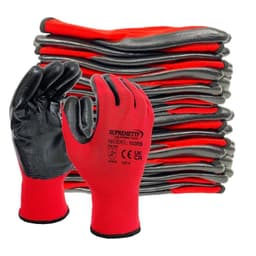
Large is a word these sellers do not share. Velway’s PU pack is size L / 9, 25 cm long, and the bullet says order the next size up. Supreme calls size 9 large and size 10 XL. Rainberg’s medium and large are separate ASINs, and reviewers of both say the label feels small. DIY Doctor is one size for 8–11 inch palms, and the seller’s 95 percent claim is untested until the gloves are on. One Straame reviewer found a repeat order a different size.

Wash only what that listing allows

There is no single 40°C rule. Follow the listing you bought. Rainberg’s 12-pair bullets say hand wash in water not exceeding 40°C for 5–10 minutes. Velway says lukewarm water below 40°C for 5–10 minutes. KAYGO’s bullet caps the wash at 40°C and tumble drying at 60°C, while the care field says machine wash. Stay inside the cooler bullet. Supreme, RUFTUF, and Straame say hand wash and print no temperature. DIY Doctor says warm soapy water and a wipe. Mechanix’s bullet says machine washable, and one UK reviewer says to skip that. A clean hole is still a hole. Washing does not put a coating back.

When the pair is finished

Stop when the palm is holed, the coat has peeled, or the glove is soaked with something you would not want on skin. These reviews show the end: Velway’s PU wearing off after a day or two, Rainberg holes on cardboard shifts, Supreme pairs lasting about a day on block laying, and Mechanix fingers that rip within a week. At home you open the next pair. At work you report it. HSE expects the employer who provided the gloves to keep replacements. A bramble through a PU palm means the glove was wrong before it holed.

What to do with the tape and the hole

Match the millimetres to that seller’s letter, and order up when you sit on the top of the band. Wash only on the line for the ASIN you opened. Throw the pair away at the first hole. At work, report the defect before the next shift.

Common questions

How do I measure for a work glove?
Measure around the dominant hand below the knuckles, thumb held out, and measure finger length to the tip of the middle finger. HSE puts size 9 at about 229–254 mm and 192 mm, and size 10 at about 254–279 mm and 204 mm. If you fall between sizes, the sellers in this set say take the larger. Then make a fist around the tool you will use. A number that fights the job is still the wrong size.
Is size 9 the same as large?
On Velway, size 9 is labelled L, with a stated length of 25 cm. On Supreme, size 9 is large and size 10 is XL. Rainberg sells medium and large as separate ASINs and does not print those millimetre bands. Size 9 and the word large meet on some titles and part on others. Use the tape, then the seller’s own letter.
What if the seller says order the next size up?
Velway says it on the size 9/L pack, and Straame says to take the larger size between fits, with a 0.5 cm tolerance. Reviews on several of these knits say the labelled size feels small, and some say the fit is true. Order up when your measurement sits on the top of the band, or when a previous pair from that brand was tight. A 24-pair crate is an expensive way to discover a short finger.
Can I machine-wash every glove in this set?
Mechanix is the listing whose bullet says machine washable, and one reviewer disagrees. KAYGO’s care field says machine wash while the bullet caps the water at 40°C and tumble drying at 60°C. Rainberg, Velway, Supreme, RUFTUF, Straame, and DIY Doctor are hand wash or wipe lines. Use the line on the pair you bought. A 40°C poster for a different brand is not a licence for these ASINs.
What temperature is actually printed?
Rainberg and Velway print about 40°C, with a 5–10 minute wash. KAYGO prints not more than 40°C and tumble drying not above 60°C. Supreme, RUFTUF, and Straame print hand wash and no temperature. DIY Doctor says warm soapy water and a wipe. If the listing is silent, do not invent 40°C or a machine cycle to fill the gap.
When do I throw a pair away?
Throw it away when you can see a hole, a peeled coat, a tear, a thin spot that is about to open, or saturation with a chemical. A washed hole is still finished. At home, take the next pair from the pack. At work, report the defect so the replacement is there before the next shift. Light surface wear can stay while the barrier is complete.

Related pages

Sources

Public UK sources used for this comparison, retrieved on 16 October 2026.

  1. HSE: choosing gloves (retrieved 16 October 2026)
  2. HSE: PPE regulations 2022 (retrieved 16 October 2026)
  3. HSE: product safety and supply (retrieved 16 October 2026)
  4. HSE: PPE maintenance (retrieved 16 October 2026)
  5. HSE: latex allergies (retrieved 16 October 2026)
  6. GOV.UK: UKCA and CE by sector (retrieved 16 October 2026)
  7. SATRA: EN 388 (retrieved 16 October 2026)
  8. SATRA: EN ISO 21420 (retrieved 16 October 2026)