Safety glasses vs goggles
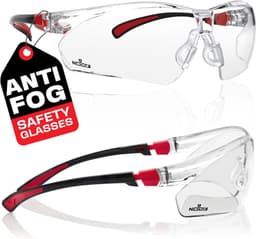
You are looking at a title that says goggles, and the photo shows temples and a gap under the lens. Safety glasses vs goggles is that mistake. Spectacles cover the front and the side for flying chips. Goggles use a strap and a rim that meets the face when splash or fine dust would go around a spectacle. The [safety glasses comparison](/hub/occupational-safety/safety-glasses) only ranks the spectacle listings in this set, captured on 19 October 2026. How to read the letters before you buy is on the [safety glasses buying guide](/hub/occupational-safety/safety-glasses/sub/safety-glasses-buying-guide). The saw, where chips and lung dust get confused, is on [safety glasses for woodworking](/hub/occupational-safety/safety-glasses/sub/safety-glasses-for-woodworking). A qualifying purchase can earn a commission at no extra cost to you.
You are looking at a title that says goggles, and the photo shows temples and a gap under the lens. Safety glasses vs goggles is that mistake. Spectacles cover the front and the side for flying chips.
You are looking at a title that says goggles, and the photo shows temples and a gap under the lens. Safety glasses vs goggles is that mistake. Spectacles cover the front and the side for flying chips. Goggles use a strap and a rim that meets the face when splash or fine dust would go around a spectacle. The safety glasses comparison only ranks the spectacle listings in this set, captured on 19 October 2026. How to read the letters before you buy is on the safety glasses buying guide. The saw, where chips and lung dust get confused, is on safety glasses for woodworking. A qualifying purchase can earn a commission at no extra cost to you.
Our top picks
| Badge | Product | Form | Mark on listing | Seal | Note | Price | Offer |
|---|---|---|---|---|---|---|---|
| Best overall |  NoCry NoCry clear wrap, black and green | Close wrap | Not in the table | Gap under the lens | 8.0 | about £13.99 | View offer |
| Alternative |  NoCry NoCry clear wrap, black and red | Close wrap | ANSI d3 line | Gap under the lens | 6.0 | about £13.99 | View offer |
| Best value |  Ansell Ansell KleenGuard Nemesis | Wrap, 1 pair | CSA, not EN 166 | No sealed rim | 6.7 | about £8.14 | View offer |


On this page
Three shapes, not two words
What each shape is allowed to claim
How that lands on this amazon.co.uk set
When you cannot tell the hazard
Common questions
When is a goggle worth the fog?
Can a spectacle be marked for chemical splash?
Why do these amazon titles say goggles?
Do vents stop misting?
Can goggles go over prescription glasses?
Related pages
Sources
Public UK sources from the research digest, last checked on 19 October 2026. Shelf prices and star lines are the amazon.co.uk figures captured with these twelve listings. The price bands are this set, not a market average.
- HSE: PPE overview (retrieved 19 October 2026)
- HSE: using the right type of PPE (retrieved 19 October 2026)
- HSE L25: guidance on the PPE at Work Regulations (retrieved 19 October 2026)
- HSE: PPE regulations 2022 (retrieved 19 October 2026)
- SI 2022/8: PPE at Work (Amendment) Regulations (retrieved 19 October 2026)
- GOV.UK designated standards notice 0112/25 (retrieved 19 October 2026)
- BSI: understanding EN ISO 16321 (retrieved 19 October 2026)
- JSP: how to read eye protection markings (retrieved 19 October 2026)
- uvex UK: guide to EN ISO 16321-1:2022 (retrieved 19 October 2026)