Men's S1 or S1P safety shoes
You are choosing between S1 or S1P safety shoes because the floor might hide a nail, a screw, or a sharp offcut, and the two codes look almost the same on a chart. They share the toe cap. Only the S1P family adds a penetration-resistant insert. If your risk assessment does not need that insert, plain S1 can be the class. If a nail is possible, the mark needs P, PL, or PS. The eight amazon.co.uk listings in the [main comparison](/hub/occupational-safety/men-s-s1-safety-shoes) print neither code, and two of them only mention puncture or Kevlar inside review text. This page is that one decision. The fuller class chapter is on the [men's S1 safety shoes buying guide](/hub/occupational-safety/men-s-s1-safety-shoes/sub/men-s-s1-safety-shoes-buying-guide). A qualifying purchase can earn us a commission at no extra cost to you. Peter F. checked the listings and public UK guidance. We did not lab-test the shoes.
You are choosing between S1 or S1P safety shoes because the floor might hide a nail, a screw, or a sharp offcut, and the two codes look almost the same on a chart. They share the toe cap.
You are choosing between S1 or S1P safety shoes because the floor might hide a nail, a screw, or a sharp offcut, and the two codes look almost the same on a chart. They share the toe cap. Only the S1P family adds a penetration-resistant insert. If your risk assessment does not need that insert, plain S1 can be the class. If a nail is possible, the mark needs P, PL, or PS. The eight amazon.co.uk listings in the main comparison print neither code, and two of them only mention puncture or Kevlar inside review text. This page is that one decision. The fuller class chapter is on the men's S1 safety shoes buying guide. A qualifying purchase can earn us a commission at no extra cost to you. Peter F. checked the listings and public UK guidance. We did not lab-test the shoes.
Our top picks
| Badge | Product | Class stated | Puncture claim | Toe claim | Note | Price | Offer |
|---|---|---|---|---|---|---|---|
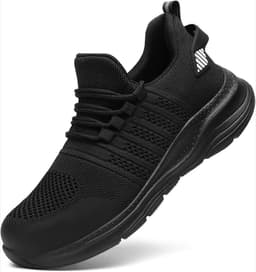
| Best overall |  Unbranded Unbranded steel-toe trainer | Not printed | Not stated | Steel, title | 8.4 | about £25.49 | View offer |
| Best value |  LUPWEE LUPWEE UK-6799 | Not printed | Not stated | Steel, title | 7.5 | about £30.99 | View offer |
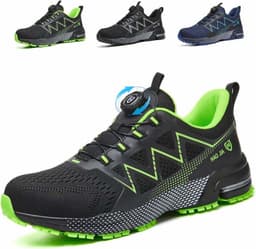
| Alternative |  AFJYG AFJYG swivel-buckle trainer | Not printed | Reviews only | Steel, title | 5.5 | about £39.99 | View offer |

On this page
The midsole letters
When plain S1 fails the job
Review text is not the code
Common questions
What does the P add to S1?
Is S1 enough on a building site?
What are S1PL and S1PS?
Does a Kevlar line in a review count as S1P?
Can an employer specify S1P even on a dry floor?
Related pages
Sources
Public UK sources from the research digest, last checked on 20 October 2026. Shelf prices and star lines are the amazon.co.uk figures captured with these eight listings. The price band is this set, not a market average.
- HSE: construction PPE FAQ (retrieved 20 October 2026)
- PPE at Work Regulations 1992 (retrieved 20 October 2026)
- HSE: using the right type of PPE (retrieved 20 October 2026)
- HSE: slip-resistant footwear (retrieved 20 October 2026)
- HSE: PPE supply (retrieved 20 October 2026)
- GOV.UK: product marking, UKCA and CE (retrieved 20 October 2026)
- BSI: BS EN ISO 20345:2022+A1:2024 (retrieved 20 October 2026)
- HAIX UK: safety footwear classes (retrieved 20 October 2026)