Independent comparisons. We may earn from shop links. More info

How to use an oscilloscope

Updated: 22 October 2026

You have a passive probe, a low-voltage board, and a screen that is either blank or showing a line you do not trust. How to use an oscilloscope, for the first hour, is mostly the connection: ground clip, 10X matched on the probe and the channel, then a square wave that is actually flat, then a trigger that waits for the edge you mean. Peter F. followed maker how-to guides and the review notes on the listings in our [oscilloscope comparison](/hub/measuring-equipment/oscilloscope). We did not film a lab session. If you buy through our amazon.co.uk links, we may earn a commission at no extra cost to you.

You have a passive probe, a low-voltage board, and a screen that is either blank or showing a line you do not trust.

Our top picks

BSIDE BSIDE two-channel handheld

Best overall

BSIDE BSIDE two-channel handheld
7.9/10about £79.99
BSIDE BSIDE OT3

Best value

BSIDE BSIDE OT3
7.3/10about £39.99
On this page

Connect the probe before you trust a number

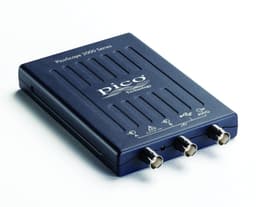
Put the ground clip on a ground point of the circuit first. On a USB scope the reference follows the computer. The clip is not a second signal wire. Start on a known low-voltage point and leave mains and ignition until the last section. Which box to buy is on the oscilloscope buying guide. Set the probe to 10X unless you have a reason to use 1X. A 10X probe loads the circuit less than a 1X probe. The channel has to say 10X as well. If the probe says 10X and the channel says 1X, the volts per division are wrong by about ten. Several BSIDE boxes include an alignment screwdriver because the probe has a compensation trimmer. The PicoScope 2204A has no probes in the box. Follow the probe you added, and do not invent a square-wave terminal the photograph does not show.

Compensate the probe

Compensation is the shape of a square wave. A flat top is the aim. A peaked top means the trim is high. A rounded shoulder means the trim is low. An uncompensated probe corrupts the rise time, so the edge you blame on the circuit may be the lead. Turn the trimmer a little and watch the top. Not every listing describes a front-panel calibrator.
BSIDE BSIDE two-channel handheld

Testsieger

BSIDE BSIDE two-channel handheld
7.9/10about £79.99

Auto, Normal, and Single

Auto keeps drawing even when the trigger is missed. Normal waits for the level you set. Single arms one capture and stops. Trigger the channel the probe is on. On a BSIDE OT3, Auto gave one buyer a flat line, so a dead-looking trace was not proof the board was dead. Another OT3 stuck in calibration and shut itself off after about 20 seconds, which is a failed unit rather than a trigger lesson. On the £79.99 two-channel BSIDE, Normal and Single did nothing until the seller sent firmware, while Auto already showed a stable trace. If Auto works and Normal stays blank, update the firmware before you condemn the circuit.

The ground clip is not a spare wire

The ground clip ties the scope's reference to the point you chose. On a bench scope with a mains lead, that reference is tied to protective earth. HSE's INDG354 says not to remove the protective earth to float a Class I oscilloscope. Do not pull the earth pin. This page will not give a procedure for floating a scope. Low-voltage, ground-referenced hobby work is the honest job for the 2204A and for these battery handhelds. USB oscilloscope vs handheld is the form-factor page. None of the listings prints a CAT rating. Stop for mains and consumer units, EV traction, secondary ignition and airbags, and any instrument that shows a live conductor as dead. Reviews on two OWON CMS101 listings describe a false zero or a nonsense voltage on a live wire. If the goal is to prove a 230 V conductor is dead, put the scope down.

Common questions

Where does the ground clip go?
On a ground point of the circuit you are measuring, before you trust the trace. It is the reference for that channel, not a second signal wire. On a mains-powered scope that reference is tied to protective earth. On the PicoScope 2204A it follows the computer. Do not clip it to a live mains conductor, and do not lift the earth pin to make a floating measurement work. HSE INDG354 says not to float a Class I scope that way.
Should the probe be on 1X or 10X?
Use 10X for ordinary hobby work, because it loads the circuit less than 1X, and set the channel to 10X as well. If the probe and the channel disagree, the volts per division are wrong by about ten and the trigger will not fix the number. Switch to 1X only when you have a reason, such as a very small signal, and change the channel setting in the same step. Several BSIDE boxes include a screwdriver for the probe trimmer, which is a separate job from this switch.
How do I know the probe is compensated?
Look at a square wave, if the scope or the software provides a test terminal. A flat top is the aim. A peaked top means the trim is high. A rounded shoulder means it is low. Turn the trimmer a little and watch the top. An uncompensated probe changes the rise time, so an ugly edge may be the lead rather than the circuit. Not every listing here describes a front-panel calibrator, so do not invent a terminal the instrument does not have.
What is the difference between Auto, Normal, and Single?
Auto keeps drawing even when the trigger condition is missed, which is how you find out whether anything is there. Normal waits until the signal crosses the level you set. Single arms one capture and stops, which is how you keep a one-off event. On one OT3, Auto showed a flat line. On the £79.99 BSIDE, Normal and Single did nothing until firmware arrived, while Auto already had a stable trace. Update the instrument before you blame the board.
When should I stop and get a competent person?
Stop for mains and consumer units, EV traction, secondary ignition, airbags, and any meter or scope that shows a live conductor as dead. Reviews on two CMS101 listings describe that false zero. A stable trace on a 3.3 V or 5 V board is a fair thing to learn at home. Proving a 230 V cable is dead is not, and none of these listings prints a CAT rating.

Related pages

Sources

Public UK sources last checked on 21 October 2026. Shelf prices and star lines are the amazon.co.uk figures captured with these ten listings. The price bands are this set, not a market average.

  1. HSE GS38: Electrical test equipment for use on low voltage electrical systems (retrieved 21 October 2026)
  2. HSE INDG354: Safety in electrical testing at work (retrieved 21 October 2026)
  3. Electricity at Work Regulations 1989 (retrieved 21 October 2026)
  4. Consumer Rights Act 2015, section 9 (retrieved 21 October 2026)
  5. GOV.UK: Electromagnetic Compatibility Regulations 2016, Great Britain (retrieved 21 October 2026)
  6. Pico: oscilloscope tutorial (retrieved 21 October 2026)
  7. PicoScope 2204A series data sheet (retrieved 21 October 2026)
  8. Rohde & Schwarz UK: oscilloscope buyer's guide (retrieved 21 October 2026)