Independent comparisons. We may earn from shop links. More info

Oscilloscope buying guide

Updated: 22 October 2026

You have a circuit that a multimeter will only summarise as one number, and you want the shape of the voltage before you spend. An oscilloscope buying guide for this set starts with bandwidth, then how many signals you must see together, then sample rate and memory as a pair, then the probe and the earth clip. Shelf prices on the [oscilloscope comparison](/hub/measuring-equipment/oscilloscope) run from £25.19 to £215.99 on amazon.co.uk, and none of the ten listings prints a CAT rating. Peter F. used those listing fields on 21 October 2026, not a lab measurement. If you buy through our links, we may earn a commission at no extra cost to you.

You have a circuit that a multimeter will only summarise as one number, and you want the shape of the voltage before you spend.

Our top picks

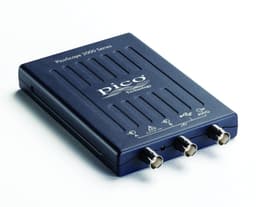
Pico Technology PicoScope 2204A

Best overall

Pico Technology PicoScope 2204A
8.3/10about £126
BSIDE BSIDE OT3

Best value

BSIDE BSIDE OT3
7.3/10about £39.99
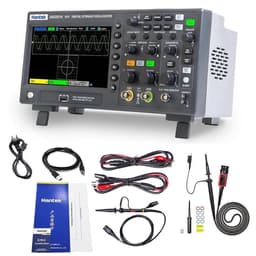
Hantek Hantek DSO2D15

Alternative

Hantek Hantek DSO2D15
7.9/10about £215.99
On this page

What the bandwidth number actually measures

The figure in the title is usually the −3 dB point. Pico Technology's tutorial describes that point as the frequency where a sine on screen is about 29% low, not the frequency of a clean square edge. Pico and Tektronix both publish a rule of thumb near five times the frequency you care about. Rohde & Schwarz, on its UK buyer's guide, talks about sample rate rather than that five-times line. In this set the claims run from 200 kHz at £25.19 to a 150 MHz title on the Hantek at £215.99. A generator frequency is a different number. The Hantek bullet describes a 25 MHz generator, while the title bandwidth is 150 MHz. Do not read that figure as the measurement bandwidth. Who each box is for is on best oscilloscope for beginners.

Channels, sample rate, and memory

One channel can tell you that a signal exists. Two channels are the minimum when a clock and a data line, or CAN high and CAN low, have to be on screen together. UK reviews of the OT3 treat it as one channel. The £79.99 BSIDE, the OT9, the Hantek, and the PicoScope 2204A are the two-channel listings here. Sample rate and memory belong in the same sentence. A fast rate with a tiny buffer is a short capture. Equivalent-time sampling does not catch a one-off glitch. The 2204A listing pairs a maximum of 100 MS/s with 8 kS of capture memory, so the fast rate does not last. The Hantek title says 1 GSa/s and does not state memory depth. A serial frame you must scroll through will not fit a short buffer.

Probes, input limits, and earth

Match 1X or 10X on the probe and on the channel, then compensate a 10X probe. How to use an oscilloscope walks through that first hour. The buying decision is whether a probe is in the box. The £79.99 two-channel BSIDE lists one probe for two channels. The Pico listing says the 2204A-D2 is without probes. The Hantek title includes a P4100 probe, and UK reviews disagree about whether one or two arrived. None of these listings prints a CAT rating. A voltage bullet is not that mark. UK mains are 230 V. HSE's INDG354 says not to lift the protective earth of a Class I scope to float the measurement. If the job is live mains, or anything that must be proved dead, these boxes are the wrong tools.

What the amazon.co.uk listings in this set cost

Shelf prices on 21 October 2026 run from £25.19 to £215.99. Four-channel Rigol and Siglent models discussed in UK guides are not in this table. The clamps are not the same instrument. They do not state bandwidth or sample rate. Two of the CMS101 listings include reviews of a false zero, or a nonsense voltage, on a live conductor.

Common questions

What bandwidth do I need for hobby electronics?
For many 3.3 V and 5 V boards, a listing in the 10 MHz to 50 MHz range is what this set sells, if you treat the number as a −3 dB point and leave margin for square edges. Pico and Tektronix publish a rule of thumb near five times the frequency you care about. That is a maker guide, not a law. The £25.19 listing at 200 kHz is only for a slow wave.
Is sample rate the same thing as bandwidth?
No. Bandwidth is how high a sine can be before the amplitude on screen is about 29% low. Sample rate is how often the scope stores a point, and memory is how long it can keep doing that. Rohde & Schwarz's UK guide starts from a sample rate of at least about 2.5 times the bandwidth, then asks about record length. The PicoScope 2204A pairs 100 MS/s with 8 kS, which is a short capture even though the rate looks fast beside a pocket scope.
Do I need two channels?
You need two when two signals must be seen together, such as a clock and data, or the two wires of a CAN pair. One channel is enough to see that a single wire is moving. In this set the OT3 and the OT5 are treated as one channel in reviews. The £79.99 BSIDE, the OT9, the Hantek, and the 2204A are two-channel listings. A second channel you cannot connect, because only one probe was in the box, does not finish the job.
Why is there no CAT number on these listings?
None of the ten extracts prints one. A voltage range in a bullet, including ±400 V or the OT9's ±4000 V scope line, is not a CAT mark. HSE GS38 expects electrical test probes to meet BS EN 61010-031, show a CAT rating, and keep a short bare tip. If your work is live mains or proving a conductor dead, this set does not document that rating, and a ground clip is the wrong way to invent one.
What should I budget before a four-channel bench scope?
Inside this set, about £25 to £60 is the slow and single-channel end, about £80 to £150 covers the two-channel handheld, the PicoScope 2204A, and the clamps, and £215.99 is the Hantek. Four-channel models discussed in UK guides often start in the mid-£200s, and they are not listed here. Add the cost of probes when the listing says they are missing, as the 2204A does at £126.

Related pages

Sources

Public UK sources last checked on 21 October 2026. Shelf prices and star lines are the amazon.co.uk figures captured with these ten listings. The price bands are this set, not a market average.

  1. HSE GS38: Electrical test equipment for use on low voltage electrical systems (retrieved 21 October 2026)
  2. HSE INDG354: Safety in electrical testing at work (retrieved 21 October 2026)
  3. Electricity at Work Regulations 1989 (retrieved 21 October 2026)
  4. Consumer Rights Act 2015, section 9 (retrieved 21 October 2026)
  5. GOV.UK: Electromagnetic Compatibility Regulations 2016, Great Britain (retrieved 21 October 2026)
  6. Pico: oscilloscope tutorial (retrieved 21 October 2026)
  7. PicoScope 2204A series data sheet (retrieved 21 October 2026)
  8. Rohde & Schwarz UK: oscilloscope buyer's guide (retrieved 21 October 2026)