Independent comparisons. We may earn from shop links. More info

Moisture meter for firewood: split, then read

Updated: October 2026

The delivery is in the log store, the stove is cold, and you want to know whether tonight's wood is fit to burn. A moisture meter for firewood answers that as a household check: split a log, read the fresh face, and in England use 20% as the figure to aim for. It does not certify the supplier, and it does not make the same sales rule in every UK nation. Products Compared used GOV.UK, Woodsure, HETAS and the amazon.co.uk extracts on 16 October 2026. We did not oven-dry a sample. The meters themselves are on the [moisture meter comparison](/hub/measuring-equipment/moisture-meter).

The delivery is in the log store, the stove is cold, and you want to know whether tonight's wood is fit to burn.

Our top picks

RDINSCOS RDINSCOS MT19

Best overall

RDINSCOS RDINSCOS MT19
9.2/10about £20.99
Valiant Valiant FIR421

Alternative

Valiant Valiant FIR421
9.2/10about £17.99
COCZOW COCZOW PM6811A

Preis-Tipp

COCZOW COCZOW PM6811A
9.0/10about £17.99
On this page

The 20% figure

In England, wood sold for domestic burning in volumes under 2 cubic metres must be Ready to Burn, at 20% moisture or less. That rule is England's. This page does not say that burning wetter wood is illegal in Scotland, Wales or Northern Ireland. Your meter is not the test that certifies a supplier. The 2020 regulations point supplier certification to ISO 18134-1 or ISO 18134-2. The general button craft is on the how to use a moisture meter page.

Split, then measure

Do not meter the bark or the unsplit end. Split the log and read the fresh face immediately. Woodsure's steps are: take logs from different parts of the store, put the pins across the grain, measure at once, and wipe surface water off first. Forest Research uses three readings on that face, about 5 cm from each end and one in the middle, then an average. One dry log on the top of a wet pile is how a single reading flatters the delivery. A pinless pad on the round exterior reads the outside.
RDINSCOS RDINSCOS MT19

Testsieger

RDINSCOS RDINSCOS MT19
9.2/10about £20.99

Wet basis and a warm log

Fuel moisture is usually talked about on a wet basis: water as a share of the wet weight. Some timber meters use a dry basis, water as a share of the oven-dry weight. HETAS warns that some dual-use meters may be reading dry basis, and that you should check the manual. If your meter is on dry basis, a reading of 20 is not the England fuel figure. An amber colour band is not a reason to burn a log still above 20% on a wet-basis wood scale.

A meter shaped for logs

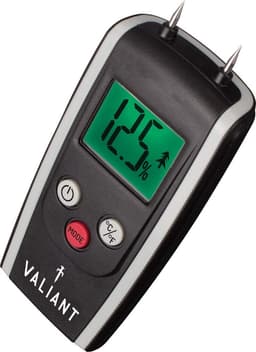
The Valiant FIR421 is the listing in this set built around that job. The bullets name a colour code for whether wood is suitable to burn. No numeric moisture range is printed, so the colour is a hint, not a certificate. Ready to Burn's consumer page says Woodsure auditors use a Valiant and that such meters cost around £20. That does not mean your reading is an audit. The buying guide is where you choose pin versus pad. The best moisture meter page says who should skip the Valiant. A qualifying purchase through our links can earn a commission at no extra cost to you.

What a pass does not mean

A log at 18% on your meter does not mean the whole store matches it. Average several logs from different parts of the pile. Woodsure notes that stored wood can reabsorb moisture: keep it covered, off the ground, with air moving, or test again before you burn. Do not burn a wetter log because the stove still lights.

Common questions

What moisture should firewood be in England?
Aim for 20% or less on a freshly split face. That is the Ready to Burn level for small domestic sales in England, and it is the figure in the customer notice for sales of 2 cubic metres or more. Your household meter is a check, not the supplier's certification test. Wet wood is a poor fuel even where that sales rule does not apply. This page does not extend the England offence to the other UK nations.
Is Ready to Burn the same as my own meter reading?
No. Ready to Burn is a supplier scheme. Certification uses ISO 18134 methods, not the pin meter in your kitchen drawer. Your reading tells you about the logs you split today, including wood that has taken on moisture in a damp store. A logo on a bag and a number in your hand can disagree. Believe the split log if you are about to light the stove, and take the logo up with the seller if a fresh delivery is wet.
How many logs should I test?
More than one. Woodsure suggests logs from different parts of the store. Forest Research wants three points on each fresh face and then several logs averaged. A single log from the top of the pile is how a wet delivery looks acceptable. If the first three disagree wildly, test more before you decide the load has failed or passed. Write the average down.
What is wet basis versus dry basis?
Wet basis is water as a share of the wet log, which is the fuel convention HETAS describes. Dry basis is water as a share of the oven-dry weight, which some timber meters use. The same log can look like a different percent. An Irish COFORD table puts 20% wet basis next to 25% dry basis. That table is not UK law. Check your manual. If the basis is not stated, compare logs with each other and do not treat a lone 20 as a legal pass.
Can I burn at 25% if the stove still lights?
The stove lighting is not the test. In England the figure used for domestic wood sales is 20% or less. A log at 25% on a wet-basis scale is above that, even if a colour band looks uncertain and even if the fire catches. COFORD's 25% dry-basis equivalent of 20% wet basis is an Irish note, not permission to burn wetter fuel. Let the wood dry, store it so it stays dry, and test a fresh split again.

Related pages

Sources

Public UK sources on timber moisture, Ready to Burn in England, and damp readings in buildings. Prices, stars, and review counts are the amazon.co.uk listing figures in this set. Prices move. There was no laboratory test and no oven-dry calibration. Last checked 16 October 2026.

  1. GOV.UK, selling wood for domestic use in England (retrieved 16 October 2026)
  2. SI 2020/1095, domestic solid fuels standards in England (retrieved 16 October 2026)
  3. Property Care Association, code of practice for dampness in buildings (January 2023) (retrieved 16 October 2026)
  4. Property Care Association, use of moisture meters to diagnose dampness (retrieved 16 October 2026)
  5. BS EN 13183-2:2002, moisture content of sawn timber by electrical resistance (retrieved 16 October 2026)
  6. BS 5250:2021, management of moisture in buildings (retrieved 16 October 2026)
  7. Approved Document C, resistance to contaminants and moisture (retrieved 16 October 2026)
  8. Forest Research, a simple method for testing moisture content (retrieved 16 October 2026)