Independent comparisons. We may earn from shop links. More info

How to use a thermal camera

Updated: 22 October 2026

You have the camera out of the box and a patch of blue has you ready to book a builder. How to use a thermal camera, for any of the models in the [FLIR thermal camera comparison](/hub/measuring-equipment/flir-thermal-camera), starts with what the sensor can actually record. The picture is a map of infrared from surfaces. The number beside a spot is only as honest as the emissivity, the focus, and the scale printed next to the colours. What those specifications were worth at the till is the [buying guide](/hub/measuring-equipment/flir-thermal-camera/sub/flir-thermal-camera-buying-guide). When a UK house and the weather make a fabric walk worth doing, use the [heat-loss survey](/hub/measuring-equipment/flir-thermal-camera/sub/flir-thermal-camera-heat-loss). A qualifying purchase can earn a commission at no extra cost to you.

You have the camera out of the box and a patch of blue has you ready to book a builder.

Our top picks

GOYOJO GOYOJO GW192A

Best value

GOYOJO GOYOJO GW192A
6.4/10about £129
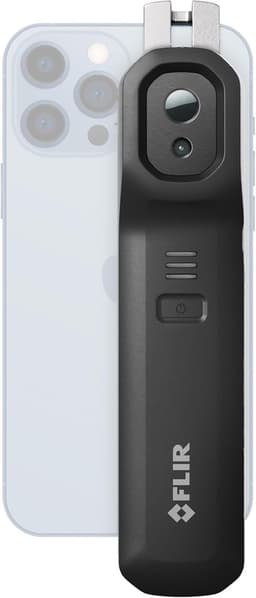
FLIR FLIR Edge

Alternative

FLIR FLIR Edge
5.5/10about £304.80
On this page

A surface, not a view through the wall

The sensor collects infrared radiation coming off the surface in front of it. Which? describes that as a surface map: the camera does not see through plaster, brick, or a fridge door, and it does not measure the air in the room. A cold patch can be missing insulation, a thermal bridge, damp that is evaporating, or a surface the heating has not yet warmed. The colour does not name the cause. On the FLIR Edge the stated accuracy is ±3°C or ±5%, and only when the camera is between 15°C and 35°C and the scene is between 5°C and 120°C. Thor reviews in the captured set include drift of 6°C to 10°C after a few minutes.

Emissivity, especially on metal

Emissivity is how readily a surface gives off infrared, on a scale that runs up to 1. FLIR’s emissivity note puts flat paint around 0.90, and skin and water around 0.98. Polished metal often sits below 0.10. A factory setting near 0.95 assumes something dull and non-metallic, which is a fair starting point for painted plaster and a poor one for foil, a stainless sink, or a bare switch. On a low-emissivity surface the camera is often showing a reflection of you, the window, or the sky. In this set the BSIDE HX3 states that emissivity and distance can be adjusted. If yours has no such menu, tape a dull patch onto the metal and measure the tape after it has settled.

Read the scale, not the palette

The colours are a key, and the key changes from one frame to the next. NHBC’s report guide points out that the same rainbow can span 11°C on one image and 4°C on the next. Before you react, read the numbers at the ends of the bar. Auto-scale will stretch a nearly even wall until it looks dramatic. Lock the scale when you are comparing two parts of the same room, if the camera allows a lock. One Thor review notes that the unit they had would not lock the temperature scale. Fifteen colour sets, as on the BSIDE, do not add temperature information.

Focus and the visual overlay

A soft thermal image makes the spot number cover a smear of surfaces. The FLIR Edge is fixed focus, so you cannot sharpen a distant fuse board by twisting a ring. The C5 bundle listing says autofocus and also says autofocus no, with a fixed aperture. If the image looks soft, step in until the edges crisp up. UKTA treats that close look as outside electrical thermography. MSX, named on the Edge, the C5, and the ONE listings, lays visual edges over the thermal grid. It does not add thermal pixels. An 80×60 detector with a sharp outline is still an 80×60 detector. A spot gun, which returns one number rather than this grid, is thermal camera vs infrared thermometer.

Common questions

What is the camera actually measuring?
It measures infrared from the surface it can see, and it turns that into a temperature using the emissivity you, or the factory, assumed. It does not measure air, and it does not see through the wall. Which? and NHBC both put that limit in plain terms. A cold patch is a surface that looks colder, with more than one possible cause.
Why does foil or a metal switch look wrong?
Polished metal often has an emissivity below 0.10, so the camera records a reflection more than the metal’s own temperature. A setting near 0.95 fits painted plaster better than foil or steel. Tape a dull patch onto the metal and measure the tape after it has settled, or stay on painted surfaces if there is no emissivity menu.
What does a factory 0.95 setting assume?
It assumes a dull, high-emissivity surface, in the region FLIR associates with flat paint, skin, and water. That is reasonable for emulsion and many fabrics. It is a poor assumption for bare metal. The BSIDE is the listing here that states you can change emissivity and distance. Without that menu, treat shiny metal as a picture only.
Why can two similar colour pictures mean different gaps?
The scale is part of the picture. NHBC notes that one rainbow may cover 11°C and the next only 4°C. Read the numbers at the ends of the bar before you compare frames. Auto-scale will exaggerate a small difference. A locked scale, where the camera allows one, keeps the meaning stable.
Does MSX add temperature pixels?
MSX lays visual edges over the thermal grid so a socket or a joint is easier to recognise. The temperature still comes from the thermal detector. An outlined 80×60 image remains 80×60. Processed counts on the Thor and the Edge are a separate enhancement, and they are not extra native pixels either.
What does fixed focus stop me doing?
It stops you focusing for a new distance. The Edge is fixed focus, so a distant board can stay soft, and a soft spot mixes neighbouring surfaces into one number. Step closer until the edges crisp. The C5 listing contradicts itself on autofocus, so check the unit in your hand rather than the bullet alone.
Can I tell damp from a cold patch in the picture alone?
The picture shows a colder surface. Damp is one explanation, and so are missing insulation, a cold bridge, and a room only just heated. Confirm with a moisture meter before you pay for works. These cameras do not turn a blue patch into a damp certificate, and they do not pass or fail building regulations.

Related pages

Sources

Public UK sources are listed below. Shelf prices and star lines are the amazon.co.uk figures captured with these eleven listings. The price bands are this set, not a market average.

  1. FLIR C5 (UK) (retrieved 20 October 2026)
  2. Which?: using a thermal camera (retrieved 20 October 2026)
  3. UKTA: building thermography (retrieved 20 October 2026)
  4. UKTA: electrical thermography for practitioners (retrieved 20 October 2026)
  5. Historic England: thermal imaging (retrieved 20 October 2026)
  6. Approved Document L, Volume 1, dwellings (retrieved 20 October 2026)
  7. NHBC: thermal imaging (retrieved 20 October 2026)
  8. BBC News: sun and reflections (retrieved 20 October 2026)