Independent comparisons. We may earn from shop links. More info

How to read a tape measure

Updated: 22 October 2026

You have the tape in your hand and the cut still comes out short, or the hook will not sit still, or the blade snaps back and kinks. How to read a tape measure, on a 5 m blade, is mostly which mark you meant, plus a hook that is supposed to move by about its own thickness. UK work is usually in millimetres. Inches matter only when they are printed and the instruction is in inches. This page does not rank tapes. The [Tape measure 5m comparison](/hub/measuring-and-marking-tools/tape-measure-5m) does that. Width, class, and standout claims sit in the [5 m tape measure buying guide](/hub/measuring-and-marking-tools/tape-measure-5m/sub/tape-measure-5m-buying-guide). Products Compared editorial team, 20 October 2026, from public UK reading guides and the listings in this set. No lab, and no repair of the spring. A qualifying purchase can earn a commission at no extra cost to you.

You have the tape in your hand and the cut still comes out short, or the hook will not sit still, or the blade snaps back and kinks.

Our top picks

On this page

Millimetres on a 5 m blade

A metric blade is numbered in centimetres, and the small ticks between those numbers are millimetres. There are 10 mm in a centimetre and 100 cm in a metre, so a 5 m tape runs to 500 cm. Trades in the UK usually say the millimetre, not the centimetre: 600 mm rather than 60 cm, 2440 mm rather than 2.44 m. If you convert in your head at the saw, you will drop a zero. Read the millimetre you are going to cut, and write that number down before you rewind. Find the last centimetre number you have passed, then count the small ticks past it. The longer tick in the middle of each centimetre is 5 mm. A mark just after 86 cm, three small ticks on, is 863 mm. Say it as eight six three, not as about 86. A review of the Stanley Powerlock in this set describes red marks at each 10 cm, which is that pattern. They are not a second unit. Look straight down at the mark. If the blade is dual scale, keep your eye on the millimetre edge for a metric plan. Which tapes print inches at all is on the metric-only or dual-scale page.

Inches, only if they are printed

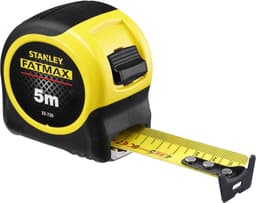
If the blade has no inch marks, do not invent them from memory. The FatMax 0-33-720 and the magnetic FatMax FMHT0-33864 are described by their item names and by reviews as metric only. On a dual blade, inches usually sit on the upper edge and millimetres on the lower edge. Homebuilding describes feet and inches along the top, millimetres below, and a hole in the hook for a nail. That layout is also how people mark the wrong edge along the top of a board. An inch on these blades is split into sixteenths. The longest tick inside the inch is 1/2. The next length is 1/4 and 3/4. The next is eighths. The shortest ticks are sixteenths. Four short spaces is 4/16, which is 1/4. If you are counting sixteenths and you land on a longer tick, you have miscounted. 3/8 is six sixteenths, so it is the eighth-inch tick. Write 3/8, and convert to millimetres only if the cut is metric. 25.4 mm to the inch is exact enough for timber. A foot mark is 12 inches, not 10. If your plan is in millimetres, ignore the inch edge even when it is there.

The hook is meant to move

The metal hook on the end slides. Stanley's support note says the movement equals the thickness of the hook, so an outside hook and an inside push can share the same scale. On an outside measurement the hook pulls out and zero sits at the outer face. On an inside measurement the hook slides in and zero sits at the inner face. If the hook were fixed, one of those readings would be out by the thickness of the metal, often around a millimetre. A small wobble is the design. No play, or a hook that flaps far past its own thickness, is the fault. The Tape Store's care notes put it that way: no movement, or far too much, means the tape is done, and a kink is not something you straighten back into calibration. Check outside and inside on one rigid object. The two readings should agree within about 1 mm. If they differ by 3 mm or more, the hook is bent or the rivets have opened. For a window reveal, push the hook into the far jamb and read at the near jamb. Do not add the case unless the case itself is the stop. The Tape Store uses 7 cm as an example of a case. That is their example. None of these listings states a case length. Measure your own case once.

Rewind and a kink

Let the blade back in under your thumb. A 3 m run that snaps home will whip, and it can cut a finger or crease the steel. Manufacturer advice reported by The Tape Store includes eye protection for that whip. That is advice, not a statute. You still walk the blade home, especially on a self-lock that releases all at once, which is how the Amazon Basics button is described in reviews. A kink is a permanent fold. It adds or hides length at that point. Do not bend it back and keep cutting kitchen doors to it. Replace the tape. This page does not describe opening the case or changing the spring. A professional repair is rare for a £3 to £20 pocket tape. Wipe the blade before it goes back in the case. If two tapes that should match, such as the pair in the OX twin pack, differ by more than about a millimetre on a 1 m board, trust neither for a fine cut until you have found which hook is bent. Standout, in one sentence, is how far the blade stays roughly straight before it folds. It is not a promise that your blade will hold at the number on the box.

Common questions

What is each small mark on a metric blade?
Each small tick is 1 mm. The numbers are centimetres. The mid-tick in each centimetre is 5 mm. Ten millimetres make the next centimetre number, and 100 cm make a metre. Read 863 mm as the 86 cm number plus three ticks, and write the millimetres. UK site talk uses that millimetre figure, not eighty-six and a bit.
How do I read sixteenths if the tape has inches?
Count from the inch number. The shortest ticks are sixteenths, and longer ticks mark eighths, quarters, and the half. Four sixteenths is the quarter-inch tick. If your count lands on a longer tick, start again. Use this only on a blade that prints inches. A metric-only FatMax has nothing to count on that edge.
Is a wobbling hook a fault?
A slide of about the hook's own thickness is the point of the hook. Stanley describes it as the compensation between inside and outside readings. No movement, or a flap much larger than the metal thickness, is the fault. Check outside and inside on the same rigid object. They should agree within about 1 mm.
How do I measure inside a window?
Push the hook against the far jamb so it slides in, keep the blade flat, and read at the near jamb. If you instead butt the case into the near jamb, you must add the case length of the tape you are holding. These listings do not state a case length. Do not add 70 mm from a guide that used 7 cm as an example.
Do I add the case, and how many millimetres?
Only when the case is the stop. Measure that case once with a separate ruler and use your figure. There is no universal case length in this comparison. The ordinary hook method, outside or inside, does not need the case added, because the sliding hook is what keeps zero honest.
What is standout, in one sentence?
Standout is how far the blade stays roughly straight before it folds under its own weight. It is not the 5 m length, and a listing can print two different reach figures for the same tape. Test it with one careful pull, and do not crease the blade to prove a number on the box.
What do I do if the blade is kinked?
Replace it. A kink changes the length at the fold, and bending it flat does not put it back into calibration. The Tape Store's care guidance says not to straighten a kinked blade. Do not open the case to adjust the spring from a web article. A new tape is the repair for this price of tool.
Should I let it snap back?
No. Walk it in under your thumb, especially from 2 m or more, and especially on a button release. A whipping blade can cut and it can kink. Eye protection is manufacturer-style advice for that accident, not a legal requirement this page is laying on you. Control is the whole method.

Related pages

Sources

Public UK sources from the digest first, then the Stanley pages. Shelf prices, stars and review counts are the amazon.co.uk figures in the display file. The score method is dated 20 October 2026. The digest notes a 19 October 2026 scrape. This is not a laboratory test.

  1. Measuring Instruments Regulations 2016, Schedule 1I (retrieved 20 October 2026)
  2. GOV.UK, Measuring Instruments Regulations 2016: Great Britain (retrieved 20 October 2026)
  3. GOV.UK, weights and measures business guidance (retrieved 20 October 2026)
  4. Stanley UK, FatMax 5 m magnetic FMHT0-33864 (retrieved 20 October 2026)
  5. The Tape Store, how to read a tape measure (retrieved 20 October 2026)
  6. The Tape Store, taking care of a tape (retrieved 20 October 2026)
  7. UK Metric Association, dual measuring tapes (retrieved 20 October 2026)
  8. Stanley support, why the hook moves (retrieved 20 October 2026)