Independent comparisons. We may earn from shop links. More info

Pin marking gauge vs wheel

Updated: 22 October 2026

You have torn a line across a rail, or the pin has wandered in the grain. A pin marking gauge vs wheel choice is about the fibres in front of the cutter. A pin is enough with the grain. A wheel is worth the extra when you often cross the grain, and that wheel is still one cutter. The [marking gauge comparison](/hub/measuring-and-marking-tools/marking-gauge) lists the twelve amazon.co.uk gauges. Peter F. used Lee Valley’s UK guide, Paul Sellers, BuildWiz UK, and these listings, on 21 October 2026. A qualifying purchase can earn a commission at no extra cost to you.

You have torn a line across a rail, or the pin has wandered in the grain. A pin marking gauge vs wheel choice is about the fibres in front of the cutter. A pin is enough with the grain.

Our top picks

On this page

When a pin is enough

A pin gauge carries one spur that rides the reference edge. Lee Valley’s UK guide puts that spur on lines with the grain, if you trail it. Held upright, the fibres steer it. For skirtings, hinge leaves, and linings, that is the whole job. In this set the Draper 64440 is £7.99 with 4.3 from 401 reviews, and the Irwin Marples M2049 is £11.54 with 4.4 from 504. The brand is IRWIN, not Joseph Marples of Sheffield. Wider budgets sit on the marking gauge buying guide.

When a wheel is worth the extra

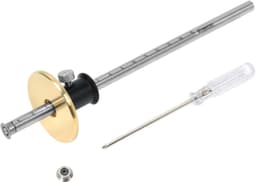
A wheel, or a knife, severs the fibres. Lee Valley describes that as clean across the grain and easier around a corner than a pin you must keep trailing. Pay more when those lines are regular. The grip is on how to use a marking gauge. The limit is end grain: Sellers has gone back to a pin on oak. The Newkiton-worded gauge pairs a bearing wheel for soft wood with a locked wheel for hard wood. One of them is meant to roll.

What these amazon.co.uk listings actually cost

The Draper 64440 at £7.99 is the everyday beech pin if you accept a plastic screw and a material field that also says Plastic. The Amtech at £8.49 is the brass-screw option, with Metal, Plastic in the material field against a hardwood title. Wheels run from the Odorkle at £8.73, 4.4 from six reviews and no spare listed, to the Clarke Brothers at £26.25 with two spare cutters. If the stock will not lock, section 9 of the Consumer Rights Act 2015 is a claim against the retailer.

Pin or wheel for your next line

Stay with a pin when the next line runs with the grain and you will file the spur yourself. Move to a wheel when torn fibres across the grain are usual, and when a spare cutter is in the box. The Clarke Brothers box and the YOSELIN extra blade are those rows. A wheel does not replace two spurs. Two cheeks at chisel width are the mortice gauge page. One disc, even with mortice in the title, gives you one line.

Common questions

Is a wheel marking gauge better than a pin?
A wheel is the better cutter when you often mark across the grain or around a corner, because it severs fibres a pin tends to tear. A pin is enough, and cheaper in this set, when the line runs with the grain, as on skirtings and hinge margins. On end grain a disc can grip, and Paul Sellers has gone back to a pin on oak. Better here is the grain in front of you, not a star rating.
When is a pin enough?
A pin is enough for one line parallel to the edge, with the grain, left set while you fit hinges, linings, or skirtings. Trail the point and use a light pass. In this set that tool is the Draper 64440, the Amtech, the Silverline, or the Irwin Marples M2049, at about £5–£12. File the spur when it dulls. You do not need a spare disc for that week.
Why does a pin tear across the grain?
The spur ploughs the fibres instead of cutting them. Held upright, it digs in and the grain steers the line, which is the fault Sellers describes. Across the grain the same point lifts chips and leaves a furry mark where a knife or a sharp wheel would sever a clean wall. Trailing the pin and taking several light passes reduces the tear on with-the-grain work. It does not turn the pin into a slicing cutter.
Do I still tilt a wheel?
You do not trail a wheel the way you trail a pin. Keep the fence on the whole edge and let the disc meet the surface with light pressure. Push or pull both appear in the teaching sources. If the disc follows a coarse grain line, reverse the direction, which is the Lee Valley suggestion when a wheel tracks. On end grain, be ready to switch to a pin if the disc grabs.
Can I sharpen a pin, and what about a blunt wheel?
File two faces of a pin to a short edge. A cone bruises. That is ordinary maintenance, and BuildWiz spells it out. A wheel is harder to renew at the bench. Reviews on QWORK and on the Newkiton-worded gauge describe cutters that indent on arrival. Fit the spare if the listing included one: YOSELIN’s extra blade, or the two replacement cutters with the Clarke Brothers gauge. QWORK does not list a spare.
Is the £8.73 wheel a fair trial of wheel gauges?
The Odorkle listing is £8.73, with 4.4 from six reviews and one UK text that names no part. Reach, wheel diameter, and a spare cutter are not stated. Six ratings cannot tell you whether a wheel severs fibres better than the Draper pin, or whether the lock holds.

Related pages

Sources

Public sources named in the research digest, plus the amazon.co.uk listings compared on this page. Retrieved October 2026.

  1. BBC Bitesize, Marking-out tools (retrieved October 2026)
  2. Lee Valley, Woodworker's guide to marking gauges (retrieved October 2026)
  3. BuildWiz, Marking gauge (retrieved October 2026)
  4. Paul Sellers, More on the marking gauge (retrieved October 2026)
  5. Draper Tools, Carpenter's marking gauge 64440 (retrieved October 2026)
  6. Draper Tools, Marking and mortice gauge 64458 (retrieved October 2026)
  7. legislation.gov.uk, Consumer Rights Act 2015, section 9 (retrieved October 2026)
  8. Which?, What to do with a faulty product (retrieved October 2026)