Independent comparisons. We may earn from shop links. More info

Folding rule vs tape measure

Updated: 22 October 2026

You have a straight mark on a length of timber, or a wall that runs further than your arm, and the two tools behave in opposite ways. A folding rule stays stiff and stops at its open length. A tape measure reaches further, follows a curve, and can sag if the hook is bent. This page is folding rule vs tape measure for that choice. It is not a tape buying guide. The listings are the [folding ruler comparison](/hub/measuring-and-marking-tools/folding-ruler). Prices are GBP shelf prices. A qualifying purchase can earn us a commission at no extra cost to you.

You have a straight mark on a length of timber, or a wall that runs further than your arm, and the two tools behave in opposite ways. A folding rule stays stiff and stops at its open length.

Our top picks

On this page

Where the folding rule is the better tool

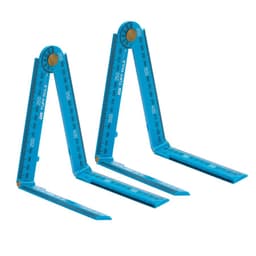
Use a folding rule when you need a rigid straightedge and the distance fits in one opening. You can draw along it. A tape has a spring and a curved blade, so it is a poor fence for a pencil. Wonkee Donkee puts it that way: a rule locked open is rigid, and a poor tool on curves. UK work of this kind is metric. The only site-style row here is the OX Pro twin pack, OX-P507201-E, at £14.99: 600 mm, four 150 mm leaves, cyan ABS, a brass hinge, and a 0–180° swivel. Nine reviews call it useful where a tape is awkward. None of the twelve listings describes a brass slide. The other rows are about 30 cm or do not state a length.

Where the tape is the better tool

Use a tape when the distance is longer than the rule, or when the line is not straight. A wall, a room, a pipe run, or a bowed skirting is a tape job. The rule stops at the last leaf. Wonkee Donkee notes that a tape is longer, harder to lay flat, and needs a sound hook. A bent hook makes the zero wrong. A sagging blade reads long. That is not a reason to step a short rule along the wall. A UK seller page for OX rules, including 1 m and 2 m lengths outside this set, says a rigid rule suits the bench and a tape suits the long span. Do not assign Class III to an unmarked tape or rule.

The mistakes that make either tool lie

A loose hinge makes a folding rule lie. The leaves no longer sit in one line, so a measurement across the joint is long or short and the pencil line kinks. Wonkee Donkee states that. Helix, Akozon, and Guagua reviews describe a gap or a bump around 15 cm. The OX reviews do not describe that snap, but you still sight each brass joint. If it is not straight today, do not use it. A bent hook or a sagging blade makes a tape lie. Butt the tape against a known length, or compare an inside and an outside reading of the same opening. Stepping the OX rule and moving it lets each placement slip. If you cannot span the work, take it once with a tape.

What to use from this comparison

Use a folding rule for a straight mark you can span in one opening, and a tape if you cannot. Here that rule is the OX 600 mm twin pack at £14.99, with 4.6 from 45 reviews. It is not a 2 m rule. Helix J05100 at £4.44 replaces a long ruler in a pencil case. It does not replace a tape. If the job is longer than 600 mm, leave this set. Products Compared read the listings on 20 October 2026 and did not test a tape against these rules.

Common questions

When is a folding rule better than a tape?
When you need a straight, rigid mark and the distance fits in one opening. You can draw along the rule. A tape's blade is a poor straightedge. In this set that job, up to 600 mm, is what the OX pack is listed for. A 30 cm school folder only wins against a tape for a short line on paper or card.
When is a tape the better reach?
When the span is longer than the open rule, or the line curves or sags. A room, a long wall, or a bowed skirting is a tape measurement taken once. The rule stops at its last leaf. Stepping it along the wall adds placement error. Blade width and standout are tape-buying questions, and they are not settled on this page.
Can I measure inside a cupboard with a folding rule?
Yes, if the rule fits in the opening and you read the length it actually spans. None of these twelve listings describes a sliding brass end, so do not add a tip the product does not have. If the cupboard is deeper than 600 mm, the OX pack is too short in one opening. A 30 cm folder is too short for almost any cupboard.
Does a 30 cm school ruler replace a tape?
No. It folds into a pencil case and rules a short straight line. It does not measure a wall, and the reviews in this set show hinges that kink a line past 15 cm. Helix J05100 is the reviewed 30 cm folder here, at £4.44. It is the wrong substitute for a tape on site.
What goes wrong if I step a short rule?
Each move can slip, and a poor hinge adds its own error at every joint. ITS warns that stacking a 1 m rule across a wide opening is where the measurement creeps. The same creep applies to a 600 mm rule and, more so, to a 30 cm folder. If you cannot span the work, use a tape once.
Do I need both?
You need both if you both mark straight edges and measure distances longer than the rule. A folding rule does the first job up to its open length. A tape does the second. In this comparison, do not expect one 30 cm folder to cover both. The OX 600 mm pack covers the short rigid mark. Anything longer is a tape, or a longer rule that is not in the table.

Related pages

Sources

Sources from the research digest. Shelf date 20 October 2026.

  1. Measuring Instruments Regulations 2016, Schedule 1I (retrieved 20 October 2026)
  2. Measuring Instruments Regulations 2016: Great Britain (GOV.UK) (retrieved 20 October 2026)
  3. Weights and measures business guidance (GOV.UK) (retrieved 20 October 2026)
  4. Consumer Rights Act 2015, sections 9 and 11 (retrieved 20 October 2026)
  5. BS 4484-1:1969 record (retrieved 20 October 2026)
  6. Hultafors Folding Rule 59 (retrieved 20 October 2026)
  7. Wonkee Donkee: how to measure accurately with a rule (retrieved 20 October 2026)
  8. amazon.co.uk Folding Rules best sellers (retrieved 20 October 2026)