Independent comparisons. We may earn from shop links. More info

Vernier or digital depth gauge

Updated: 22 October 2026

You can read a line, or you can read a screen that goes blank when the cell is flat. That is the real choice between a vernier or digital depth gauge, and it is narrower than the titles suggest. A display removes the parallax of a vernier. It does not remove a bad zero, and it does not stop you cutting in inches because a button was pressed. This page puts the KATSU vernier against the DML digital, using the seven listings in the [depth gauge comparison](/hub/measuring-and-marking-tools/depth-gauge) and the prices captured on 20 October 2026. Peter F. used those amazon.co.uk pages and the UK review notes. He did not calibrate either gauge. A qualifying purchase can earn a commission at no extra cost to you.

You can read a line, or you can read a screen that goes blank when the cell is flat. That is the real choice between a vernier or digital depth gauge, and it is narrower than the titles suggest.

Our top picks

Digital Micrometers Ltd DML DDG150

Best overall

Digital Micrometers Ltd DML DDG150
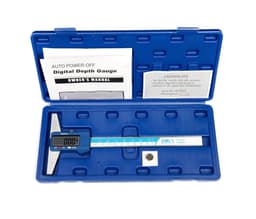
8.6/10about £32.99
KATSU Tools KATSU 200 mm vernier

Alternative

KATSU Tools KATSU 200 mm vernier
7.3/10about £11.99
On this page

What you gain and what you add

A vernier is a main scale, usually in 1 mm steps, plus a small scale for the fraction. You add the skill of finding the one line that meets, and parallax if you look from the side. A vernier is slower and needs no cell. A digital is easier and needs one. A digital swaps the lined-up mark for a number, and adds a cell, a unit button, and a zero you can set in the wrong place. DML says LR44. Buy the cell the listing names. Neither choice repairs a base that rocks. Seating and reading are on the how to use a depth gauge page.

KATSU's scale against DML's display

KATSU B00K1ZB6A2 is £11.99, metric, 0–200 mm, stated ±0.02 mm, no battery in the bullets, 3.9 from 160 reviews. UK reviews like the wide head. The first 25 also include 0.12 mm on a ground flat, 0.3 mm at the beam end, double-printed graduations, and a lock that failed almost immediately. The bullets stay metric. DML B00CA1IOV4 is £32.99, 150 mm, resolution 0.01 mm, stated accuracy 0.02 mm, a 100 mm base and a case, 4.5 from 47. Four UK texts prefer it to plastic gauges and do not repeat a fault. The bullets say two LR44 cells. The battery field says one. You are £21 dearer and 50 mm shorter. Pick the KATSU for 200 mm and no cell, if you will zero it. Pick the DML when 150 mm is enough and those separate lines are worth £32.99. Jobs for each sit on the best depth gauge page. Cetornie has no millimetre accuracy and no UK review text. EETU is 3.6 from 28.

The cell has to match the slot

DML names LR44 and says the cells are supplied. Count them against both lines, because two and one cannot both be the box. A spare LR44 is the answer to a blank screen. Switch it off. These notes do not print an auto-off time. EETU is the warning about guessing the size. Three UK reviews say no battery was included at £28.41, and one CR2032 did not match the slot. A digital you cannot switch on has not delivered the display, which is a description problem under section 9 of the Consumer Rights Act 2015. It does not mean every digital uses the wrong cell. If you want neither a vernier nor a cell, PRAZTECH at £8.99 reads 0–150 mm and 0–6 in, 4.5 from 18, with a stiff slide in one UK text. MachEl at £13.10 is 5.0 from 3 with no review text. A router jaw does not choose between this scale and this screen.

Check the limit you will actually live with

Take the KATSU when 200 mm and no cell matter more than a screen, and you will zero it on a flat. Take the DML when 150 mm is enough and you will keep an LR44 and confirm millimetres. Take the PRAZTECH when you want a dual-scale rule and no display at all. None of these listings shows a certificate against BS EN ISO 13385-2:2020. The useful choice is the tool whose limit you will actually check.

Common questions

Is a digital more accurate than a vernier?
Not on the evidence in this batch. DML states accuracy 0.02 mm and resolution 0.01 mm. KATSU states ±0.02 mm, and UK reviews include zeros of 0.12 mm and 0.3 mm. The digital is easier to read. Ease is not a smaller error. ISO 13385-2 covers both indications and does not pick a winner.
What battery does this batch actually name?
DML names LR44, supplied, with the bullets saying two and the battery field saying one. EETU's UK reviews say none was included, and a CR2032 did not fit. Cetornie does not name a cell, and its review texts are not UK texts. Do not assume an SR44 because a general guide mentions one.
Can I leave the digital in the toolbox?
You can, if you switch it off and you keep a spare of the cell the listing names. A flat cell makes the DML a silent 150 mm gauge. The KATSU and the PRAZTECH rule-head have nothing to go flat. That is the practical case for the vernier if the gauge lives in a box you open once a month.
How bad is a vernier misread?
One division, read from an angle or added twice, is enough to move a rebate by a tenth of a millimetre or more, which shows up in a joint even when the title says 0.02 mm. The cure is a straight look and a single lined-up mark, after a zero on a flat. Smeared KATSU graduations make that harder. They do not make the digital automatically true.
Is the rule-head a third option?
Yes. PRAZTECH at £8.99 reads a dual-scale rule in a locking head. It is not a vernier and it is not a digital. Take it when 150 mm is enough, you want inches as well as millimetres, and you will not miss a screen. The sample is 18 reviews, and one UK buyer had a stiff slide.

Related pages

Sources

Public UK sources and the amazon.co.uk listings compared on this page. Listings captured 20 October 2026.

  1. ISO 13385-2:2020, calliper depth gauges (retrieved 20 October 2026)
  2. BSI BS EN ISO 13385-2:2020 (retrieved 20 October 2026)
  3. ISO 13385-2:2020 preview (retrieved 20 October 2026)
  4. Trend GAUGE/D60, UK product page (retrieved 20 October 2026)
  5. Cutwel, depth gauges guide (retrieved 20 October 2026)
  6. Mitutoyo depth-gauge manual (retrieved 20 October 2026)
  7. GOV.UK, General Product Safety Regulations 2005 (retrieved 20 October 2026)
  8. Consumer Rights Act 2015, section 9 (retrieved 20 October 2026)