Independent comparisons. We may earn from shop links. More info

Synthetic winch rope vs steel cable

Updated: 22 October 2026

You are staring at a frayed steel cable on the roller fairlead and wondering whether a bright synthetic line is lighter, safer, or just different marketing. This synthetic winch rope vs steel cable page compares fibre and wire for your hazard: handling weight, abrasion, fairlead, heat, and rust. It is not a ranking of eight braids. The [winch rope comparison](/hub/lifting-equipment/winch-rope) lists every kept ASIN. The [winch rope buying guide](/hub/lifting-equipment/winch-rope/sub/winch-rope-buying-guide) owns diameter maths. Peter F. read the amazon.co.uk listings and public UK sources on 20 October 2026. There was no lab test. A qualifying purchase can earn a commission at no extra cost to you.

You are staring at a frayed steel cable on the roller fairlead and wondering whether a bright synthetic line is lighter, safer, or just different marketing.

Our top picks

On this page

What each line does under load

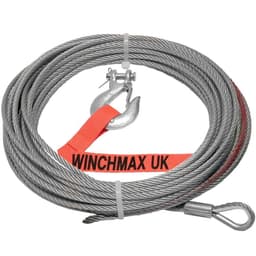
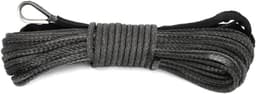
There is no universal winner. Synthetic wins handling on a hawse until grit and a scored roller cut it. Steel wins abrasion until rust and burrs cut your gloves. Synthetic winch rope in this capture, UHMWPE or unnamed synthetic fibre, runs far lighter in the weight fields: Tiardey at 240 g versus WINCHMAX steel at 6 kg for a similar 15 m span. You feel that when you pull line by hand or climb a hill with a spare on the rack. When synthetic fails, it can recoil. Novawinch and Warn both warn that neither material is safe when overloaded. Stored energy still hurts. Steel cable stores energy in the wire and can throw broken strands. HSE's safe lifting page treats kinked wire and frayed fibre as discard conditions. Inspection rhythm differs: look for broken wires and crown wear on steel; look for flattened braid, glazing, and cut fibres on synthetic. English Braids publishes jacketed HMPE winching rope that keeps the core round on a drum. The amazon braids here are not that product. Do not assume the same heat or abrasion numbers.

The fairlead is part of the choice

Synthetic belongs on a smooth hawse. A roller that carried steel for years often has sharp grooves that slice braid on the first recovery. Warn's FAQ is explicit: change the fairlead when you convert to synthetic. Steel expects the roller path WINCHMAX buyers still use. If you will not swap the fairlead, steel may be the honest choice until you budget a hawse and the labour, or you accept early abrasion on fibre. Fitting order sits on how to fit winch rope. This section only ties material to hardware.

Heat, UV, and dirt

Hire-industry articles note UV, heat, and chemicals for fibre, and rust plus burrs for steel. LGH's fibre-versus-steel piece mentions capability loss around 65 °C in their account. English Braids cites higher temperatures for jacketed SK78 in their datasheet. Do not merge 65 °C and 150 °C into one rule for these consumer listings. Grit in the braid abrades synthetic from the inside when you winch over mud-caked rollers. Steel resists cut-through on sharp edges but rusts in a UK winter if you store wet cable on the drum. STEGODON titles mention Dyneema while bullets say UHMWPE and the material field says alloy steel and nylon. Treat synthetic as the bullet claim and read the attribute clash as a listing-quality warning, not as SK78 proof. Rotate which section sits at the fairlead when you respool, so the same metre is not always in the abrasion zone. Steel needs a periodic unwind so corrosion at the drum core does not hide under tight wraps.

The steel line in this capture

Only one row is galvanised steel: WINCHMAX 5 mm × 15 m at about £32.95, stated break 5,297 lb / 2,402 kg, for winches up to 4,000 lb on the bullets, with thimble, ring terminal, drum terminal, and G70 clevis named. That break sits about 32 percent above the 4,000 lb winch limit, below the 50 percent margin WINCHMAX prints in their manual for ordinary recovery, so you still apply your own factor of safety. Against it, synthetic 15 m lines run about £13.99 to £22.79 with lighter weight and hawse-friendly handling, but weaker termination clarity on the cheapest rows. Tiardey omits a named hook. Auveach clashes on length. Editorial scoring names WINCHMAX the top pick when duty stays inside the printed 4,000 lb band and you will maintain wire. SHALL 7.6 mm × 15 m is the best value synthetic in that class when UHMWPE, hook, and sleeve matter more than 6 kg on the bumper. Choose synthetic when weight matters and the hawse is smooth. Choose steel when abrasion dominates and the duty matches the printed 4,000 lb band.

Common questions

Is synthetic winch rope safer if it breaks?
Not automatically. It is lighter and easier to handle, but a break still releases stored energy. Novawinch and Warn both warn that neither fibre nor wire is safe when overloaded. Synthetic can whip. Steel can throw broken strands. Gloves and a stand-off matter for both.
Will synthetic rope cope with rocks and a steel roller?
Poorly. A roller scored by years of steel cable cuts braid, and rocks are the same abrasion problem. Warn's FAQ says change the fairlead when you convert to synthetic. Swap to a smooth hawse, or stay on steel until you do.
Does steel rust in a UK winter?
Yes, if you store wet cable coiled on the drum. Inspect and lubricate as the maker advises. Discard kinked or bird-caged wire.
Is Dyneema on the STEGODON title a different fibre from UHMWPE?
Marketing uses both names. STEGODON bullets claim UHMWPE, while the material attribute says alloy steel and nylon. Do not treat the title word as a fibre-grade certificate, and do not treat it as a jacketed SK78 rope from a maker's datasheet.
Why is the only steel line a 5 mm cable for 4,000 lb winches?
This capture kept one steel listing, WINCHMAX at 5 mm × 15 m, with bullets for winches up to 4,000 lb and most quad and ATV winches. The longer rows are synthetic and aimed at larger drums. There is no second steel cable here for a higher band.
Do I need gloves with both?
Yes. Burrs on steel and heat on fast-spooling synthetic both punish bare hands.
Can I put synthetic rope through the old roller?
You can thread it through, but Warn and Novawinch advise against a roller that carried steel unless that roller is smooth and the maker says it suits fibre. Grooves cut braid. Plan a hawse when you convert, and fit it before you tension the new line.

Related pages

Sources

Public UK and manufacturer sources named below. amazon.co.uk prices, stars and review counts on these nine listings were taken from the 19 October 2026 capture. Page updated October 2026.

  1. LOLER 1998, regulation 7 — safe working load (retrieved 19 October 2026)
  2. HSE INDG474 — thorough examination of lifting equipment (retrieved 19 October 2026)
  3. HSE: safe lifting by machine (retrieved 19 October 2026)
  4. Novawinch: synthetic rope versus steel cable (retrieved 19 October 2026)
  5. Warn winch rope FAQ (retrieved 19 October 2026)
  6. WINCHMAX rope manual (retrieved 19 October 2026)
  7. English Braids: winching Dyneema (retrieved 19 October 2026)
  8. Marlow ropes: vehicle recovery brochure (retrieved 19 October 2026)