Independent comparisons. We may earn from shop links. More info

Drywall lift for a ceiling

Updated: 22 October 2026

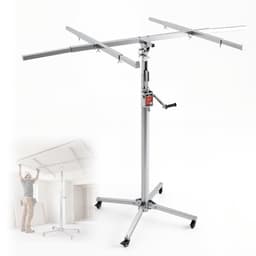
Boarding a ceiling is when a hook carrier and a foot pedal stop being relevant, because the sheet has to stay flat overhead while your hands fix it. This page is only the mast and cradle: hire and trade claims, and the one rolling hoist in our [panel lifter comparison](/hub/lifting-equipment/panel-lifter). Carriers are the wrong tool for that moment. Peter F. read these amazon.co.uk listings on 20 October 2026. There was no lab test. A qualifying purchase can earn a commission at no extra cost to you.

Boarding a ceiling is when a hook carrier and a foot pedal stop being relevant, because the sheet has to stay flat overhead while your hands fix it.

Our top picks

On this page

A ceiling needs a hoist, not a foot lifter

HSE’s plasterboard page separates low wall panels, where a foot lifter can help, from ceiling lifts that need overhead support. Foot lifters here and on trade sheets move tens of millimetres. Brillirare’s DL01 claims about 50 mm. Trend’s door lifters are often quoted near 38–60 mm. A 10.4 ft claim on a wheeled hoist is vertical reach, not a door gap. 10.4 ft is about 3.2 m on paper, not a measurement taken on site for this file. Hire desks commonly quote about 3.5 m and 75 kg. Parker Hire lists about £45 a day ex VAT for that class. Refina quotes up to 3.5 m, 75 kg, tilt, and twin cable for about £835 ex VAT, roughly £1,002 inc VAT. If the sheet must stay up while you screw, you need a hoist, hire, or props, not a trough and not a foot hoop.

What you are comparing on price

The WUDLEP hoist lists 10.4 ft, 150 lb, a manual crank, and a four-leg wheeled base at £144.99, at 14.3 kg. The amazon.co.uk file is three ratings at 3.9. The detailed UK review is the caution: the board bowed in the cradle, props were still needed, a bag zip failed, and the machine reportedly stopped after two weeks. That is not the flat hold hire firms assume at 75 kg and 3.5 m. Treat 150 lb as a seller claim, not an examination record. A day near £40–£45 ex VAT, plus VAT and transport, can beat a questionable buy for one ceiling if you will not store a mast. A trade hoist around £1,002 inc VAT suits repeat work if you can store it and maintain the cables. The £144.99 listing is a third tier, not the same product as a hire-desk lifter.

If the hoist is used at work

Once you employ people to board ceilings, LOLER sits with HSE’s plasterboard guidance. Regulation 9 and HSE’s examination pages expect a thorough examination before first use in many cases, after assembly where safety depends on installation, then typically every twelve months, or six months for people-lifting equipment and some accessories, unless a written scheme says otherwise. PUWER still requires the equipment to be maintained. Hire briefings repeat the same checks: know the marked safe working load, inspect cable, cradle, and outriggers, keep steel clear of overhead power, do not leave a raised panel unattended, and treat a loaded hoist as top-heavy. An amazon.co.uk hoist does not arrive with that history or a marked plate. Employers should default to examined hire or a documented trade buy unless the risk assessment accepts the gap. At home, LOLER paperwork is not the job, but props and a second person still belong in the plan if the cradle bows.

What to check before you wind a sheet up

Lock the outriggers, inspect the cable and cradle, and compare the marked safe working load or the listing claim with the board weight. Keep the route clear, have props ready if the board will not stay flat, and do not leave a load on the mast. If the board bows, support it and hire a trade-class lifter for the next sheet. The walk and the floor jack are a different job, covered on how to carry plasterboard.

Common questions

Will a foot lifter or a carrier board a ceiling?
No. A carrier walks the sheet at your side. A foot lifter raises the bottom edge a few centimetres at the floor. Neither holds a board flat overhead while you fix.
What should a ceiling hoist be able to do?
Support the sheet at working height with a cradle that keeps the board flat enough to screw, within a marked or credibly stated load, with stable outriggers and a lift you trust. Hire-class machines quote about 3.5 m reach and a 75 kg safe working load. Verify that on the hire sheet you sign.
Is the £144.99 Amazon hoist the same as a hire machine?
Not on the UK review in this set. Hire desks specify a marked safe working load and more predictable cradle behaviour. The Amazon listing’s detailed review mentions a bowed board and props still needed.
What does LOLER require if I employ people?
Plan the lift, use suitable examined equipment where LOLER applies, and maintain it under PUWER. HSE guidance on regulation 9 describes a typical twelve-monthly thorough examination for much lifting equipment, with six-monthly cycles for some people-lifting equipment and accessories unless your written scheme differs.
Does a householder need a thorough examination?
LOLER duties attach to work equipment used at work. For a DIY ceiling at home, the practical parallel is a pre-use check, and not trusting an unmarked bargain hoist with your only ceiling board.
When is hire the better spend?
For one or two ceilings, when you have nowhere to store a mast, or when a bowed board would cost more in rework than a day rate near £40–£45 ex VAT on a trade plasterboard lifter.

Related pages

Sources

Public UK sources named below. amazon.co.uk prices, stars and review counts on these eleven listings were read for the 20 October 2026 score method. Page updated October 2026.

  1. HSE: plasterboard manual handling (retrieved 20 October 2026)
  2. HSE CIS76 (retrieved 20 October 2026)
  3. Manual Handling Operations Regulations 1992, regulation 4 (retrieved 20 October 2026)
  4. HSE: LOLER overview (retrieved 20 October 2026)
  5. HSE L23 (retrieved 20 October 2026)
  6. British Gypsum WallBoard 12.5 mm data sheet (retrieved 20 October 2026)
  7. Travis Perkins Gyproc WallBoard 2400 × 1200 × 12.5 mm (retrieved 20 October 2026)
  8. FTH Hire Group plasterboard lifter safety guidance (retrieved 20 October 2026)