Sack truck manual handling regulations: what applies

Sack truck manual handling regulations do not turn a printed kilogram rating into a legal one-person limit. What applies at work, and what does not at home.
On this page

A new starter points at the toe plate and reads 200 kg as if it were a personal allowance. They want permission, and the label looks like permission. Sack truck manual handling regulations, where you employ people, deal with the task and the force on the person. The printed kilogram line is the maker's rating for that frame. The Health and Safety Executive's figures of about 20 kg and 15 kg are guideline forces for starting a push.
This page is for a small employer whose staff push trolleys, and for a householder using the same numbers at home. It draws on HSE's INDG143 (January 2020), the pushing and pulling assessment page, and the PUWER overview. We have not load-tested frames in a lab. A qualifying purchase through our amazon.co.uk links can earn us a commission at no extra cost to you.
In short
At work, avoid risky handling where you reasonably can, then assess what remains and reduce it. The truck's kilogram rating, the HSE force guidelines, and that employer duty are three different things. At home, those workplace regulations do not follow you into a private move, and a bad tilt can still injure you.
Home use and work use are different duties
If someone on your payroll pushes a sack truck, you are in workplace law. The Manual Handling Operations Regulations 1992 require you, so far as is reasonably practicable, to avoid manual handling that carries a risk of injury. Where you cannot avoid it, you assess the task and reduce the risk. HSE's short guide is INDG143, revised in January 2020, and the fuller priced guidance is L23. A sack truck already reduces a carry, and pushing or holding a load on a slope remains inside that duty.
At home the duty changes. Moving your own fridge on a Saturday does not make you an employer under those regulations, and PUWER does not follow the truck into a private hallway. The same tilt can still drop a load on your foot, and the maker's rating still describes the frame. If you bought the truck as a consumer and the listing does not match what arrived, the Consumer Rights Act 2015 is the general frame for quality and description. This page is not advice on a particular order.
The split shows up in what you write down. At work you record the task, train the people who do it, and keep the truck maintained. At home you still match the stated rating to the mode you use. The how to use an aluminium sack truck guide covers the tilt and the strap. A paid helper, or a sole trader delivering to customers, has stepped into work even on a hallway floor.
The force guidelines are not a kilogram limit
Three figures get confused on the same job, and only one of them is a force. The truck rating is the maker's kilogram claim for that frame and that mode. HSE's pushing and pulling guideline figures are about 20 kg for men and 15 kg for women to start or stop a load, and about 10 kg and 7 kg to keep it moving. The 20 kg figure is a starting force at the hands, which is why reading it as a maximum sack weight sends the assessment the wrong way.
The mass on the toe plate lives on a different line. A maker may print 70 kg or 200 kg for the mode the listing describes. In our aluminium sack truck comparison, the Move-It truck is about £69.99 with 4.7 from 140 reviews, at 70 kg on two wheels and 120 kg on four. You quote 70 kg when you tip it as a sack truck. It weighs about 7.15 kg empty, and a steel-frame bullet disagrees with an aluminium material line.
The route decides whether that label helps. A smooth floor and a firm tyre can keep the hand force inside the guideline while the sack is well above 20 kg. A carpet, a soft tyre, a stuck threshold, or a ramp can push the force through the guideline on a lighter sack. HSE's figures assume reasonably good conditions, and someone with a previous injury can be hurt below the line. If the start already feels like a heave, change the load, the route, or the truck.
What PUWER asks you to maintain
The Provision and Use of Work Equipment Regulations 1998 apply to equipment people use at work, including a sack truck you provide. Regulation 5 is the maintenance duty: the truck stays in efficient working order. For this tool that means wheels that run true, pins and nuts present, a flat toe plate, and a folding lock that holds the mode you selected. A loose wheel or a bent plate is out of use, on the same stop list as when to stop using a sack truck.
How often you look is yours to record, because these sources do not hand you a fixed interval. Forty trips a day on a rough yard need a shorter check than one delivery a week. Nuts, bolts, and wheels usually show the fault first, and how often to inspect a workplace hand truck sits beside that check. The same sources show no LOLER thorough-examination interval for a manual sack truck, so a tail lift in the building keeps its own date.
A hired truck does not pause the duty. The hire company and the employer who puts the truck into use both carry work-equipment responsibilities. On arrival you check the frame, wheels, pins, and handle lock, and you take a faulty truck out of use. People who push it need instruction on that truck, including which rating applies and when to stop. This page will not decide who is liable if someone is hurt.
Standards that do not cover a two-wheel barrow
EN 1757:2022 is a European standard for pedestrian-propelled platform trucks. The scope note used here places it on platform trucks with at least three wheels, so a two-wheel sack truck sits outside it. A listing that prints EN 1757 next to a two-wheel barrow is pointing at the wrong document. Count the wheels in the mode you will use before you treat the citation as relevant. A convertible that folds into a platform is still a sack truck when you tip it onto two wheels.
A missing EN number is a weak reason to reject a truck, and the wrong number is a weak reason to trust one. At work, suitability still comes from PUWER: the truck has to fit the load, the floor, and the people. The kilogram line on the amazon.co.uk listing remains a maker's claim. The aluminium sack truck buying guide matches that stated mode to the job, and a field that disagrees with a bullet leaves the rating unresolved. Judge the truck on the wheel count you can see.
What to write into a simple assessment
HSE's RAPP tool, in INDG478, is the method for pushing and pulling a hand trolley or sack truck. A sack truck risk assessment is a page a supervisor can follow, covering the task, the load, the place, and the person. Write the real route.
- Name the load you move, the heaviest side if it is uneven, and the truck rating for two-wheel or four-wheel mode.
- Name the distance, the floor, the thresholds, and any ramp, including a van tailboard.
- Name who pushes, how many times a shift, and whether one person does the whole run.
- Name the condition that day: wheels, pins, toe plate, and handle lock.
- Compare the likely hand force with the HSE guideline forces, and write the change if that force is too high.
A ramp is where tidy sheets go wrong. The force to start, and the force to stop the load running on, both rise on a slope, so the flat-floor guideline does not travel up unchanged. Write the surface and the wheel type on that line. Two people on one sack truck often fail as a fix, because the second person lifts instead of sharing a push. A one-off move of a few metres is a different task from forty trips across a yard.
Common questions
Is there a legal maximum load for one person on a sack truck?
What does 20 kg on the HSE page mean?
Does PUWER apply to a sack truck at home?
Do staff need training to use a sack truck at work?
Does a sack truck need a LOLER thorough examination?
Is EN 1757 the standard for a two-wheel sack truck?
What should the assessment say if the route has a ramp?
Who is responsible if a hired sack truck is faulty?

Peter F. is the editor for DIY & tools at productscompared.co.uk. Comparisons in this category are checked against amazon.co.uk listings, review evidence and public UK sources.
Related articles
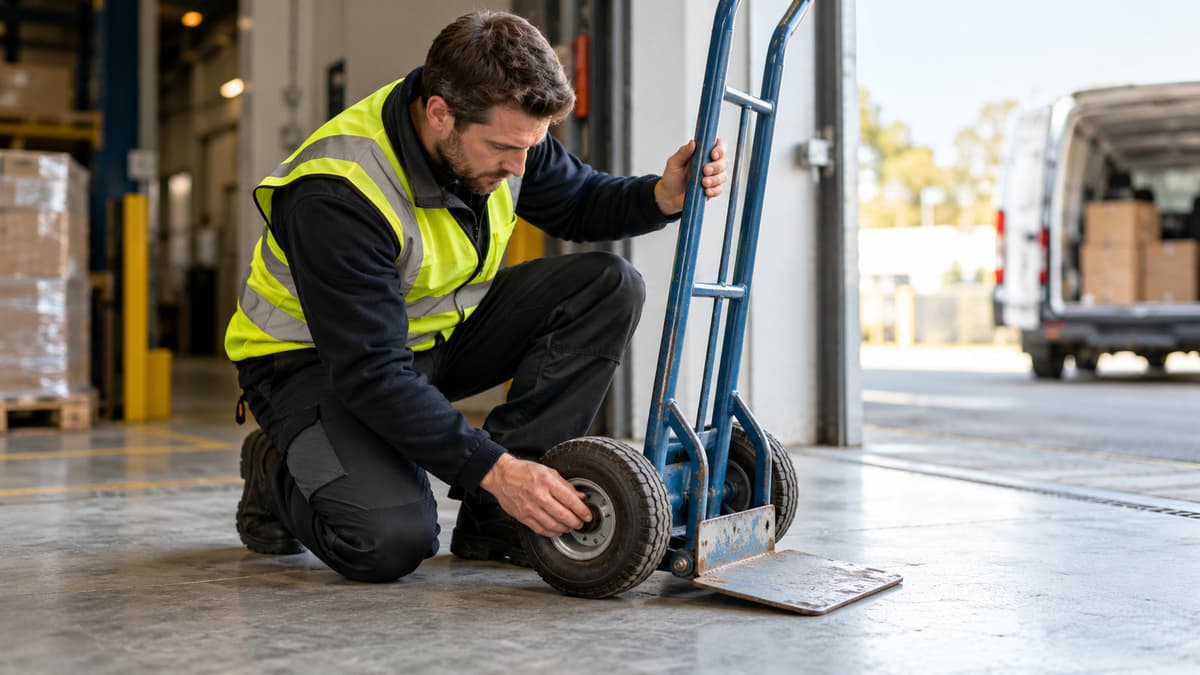
How often to inspect a workplace hand truck
What to look at on a workplace sack truck between jobs, and why a printed load line is not an inspection interval.
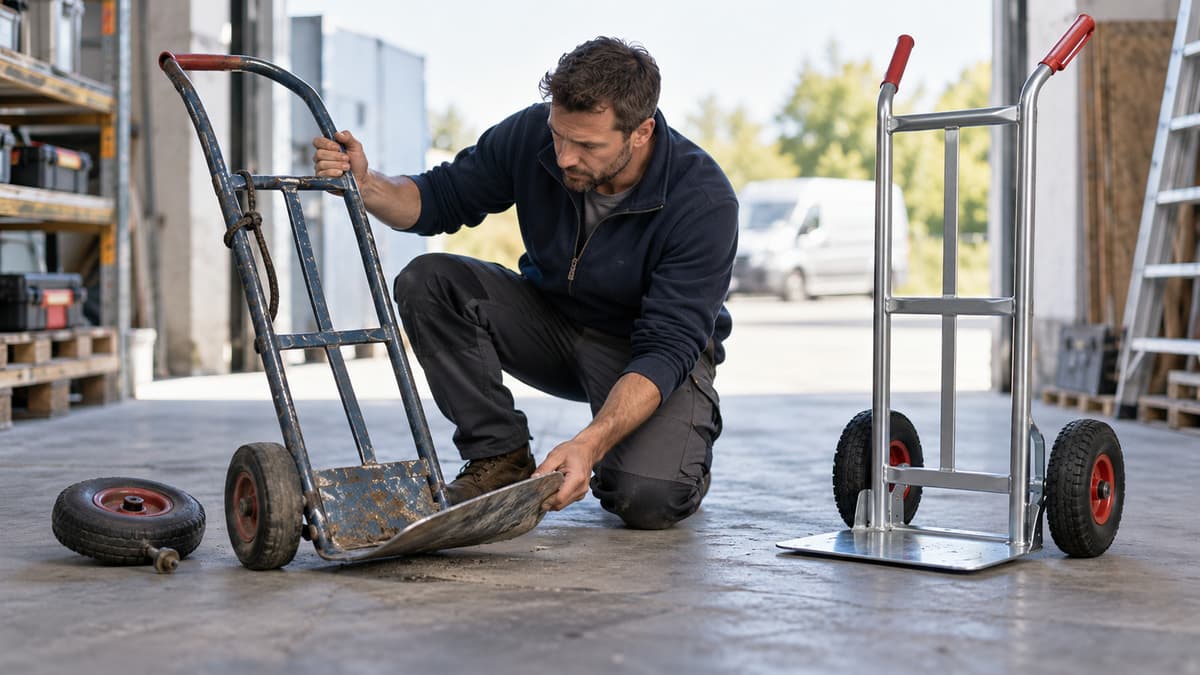
When to stop using a sack truck
Bent plates, cracked joints, and wheels that will not run straight, and when a repair still leaves the frame in use.

Nuts, bolts, and wheels on a sack truck
Pins, nuts, and tyres to check before a loose fixing lets a wheel walk off under a load.