Independent comparisons. We may earn from shop links. More info

How to use a sack truck

Updated: 22 October 2026

You have boxes by the door, or a washing machine still on its base, and the sack truck is against the wall. The next few minutes decide whether the load slides and whether the printed kilogram matches the force on a slope. This page is how to use a sack truck you already have. Choosing a model is the [aluminium sack truck comparison](/hub/lifting-equipment/aluminium-sack-truck). Peter F. read those listings on 20 October 2026. This is not a lab test. A qualifying purchase can earn a commission at no extra cost to you.

You have boxes by the door, or a washing machine still on its base, and the sack truck is against the wall.

Our top picks

On this page

Set the truck up before you load it

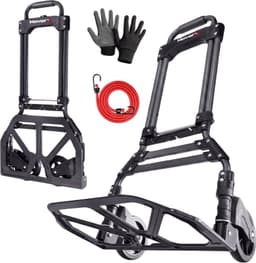
A sack truck is a lever. The toe plate goes under the load, you tilt back so the weight sits over the axle, and the wheels roll. Confirm the mode first. On the Move-It the extract states 70 kg on two wheels and 120 kg on four. The higher number does not apply while the frame is tipped. Walk the route empty. Check pneumatic tyres if the listing uses them, and check hinge pins on a folder before a heavy appliance. Extend a telescopic handle so the grip sits between waist and shoulder. Lock a folding toe plate before you load. Capacity before you buy is in the aluminium sack truck buying guide.

Get the toe plate under the load and strap it

Slide the toe plate under the centre of the load, not under one corner. Keep a tall appliance upright where the maker says so. Bosch's UK fridge guidance says use a sack truck, avoid lifting alone, and keep the unit upright where possible. A bungee is weaker than a strap. Thread it so tension pulls down into the plate. If no strap is included, add one before you tilt. On a stack of boxes, strap from the bottom upward so the pile moves as one unit.

Tilt back and move at walking pace

Tilt until the load balances over the axle. A jerk loads your wrists and can chip a frame. Push when you can see and steer. HSE's push and pull assessment gives force guidelines for employers: about 20 kg for a man and 15 kg for a woman to start or stop a load on a good surface, and about 10 kg and 7 kg to keep it moving. Those figures are force on your body, not the weight allowed on the toe plate. Walk at a steady pace and keep the load in front of you. If you must pull, shorten the route and use a spotter on the blind step. In platform mode, do not treat four wheels like a tipped truck on stairs.

Slopes, kerbs and the point where you stop

Any slope raises the force you feel. HSE guidance tells employers to avoid kerbs and steps where a ramp or lift exists. At home a driveway or a single doorstep counts. If the truck wants to run downhill, lower the load. A kerb needs a controlled lift. Bring the axle close and lift the toe plate over the lip with your legs. Do not lever the handle. Stop when the load blocks your view, when the rating is for another mode, or when the route is a flight with no stair kilogram. That decision is on sack truck for stairs. The printed kilogram is a product rating, not a certificate for your slope.

Common questions

Do I push or pull a sack truck?
Push when you can see and steer the load. Pull only when the doorway or the landing forces it, and keep that stretch short. A spotter helps on the first step you cannot see. Pulling a tall appliance backwards through a house is how the load meets a frame you did not notice.
How do I get the toe plate under a box?
Tip the box slightly, or lift one edge, and slide the plate fully under the centre. Lower the box onto the plate before you strap. A plate that only catches a corner lets the stack twist as soon as you tilt. If the plate folds, lock it before the weight arrives.
Should I strap the load?
Yes for appliances and for stacked boxes. A bungee alone often fails on smooth plastic or when the centre of gravity sits high. Run the strap so it pulls the load down into the plate. On a stack, start at the bottom box so the pile moves as one unit rather than shedding the top carton.
How high should the handle be?
Between waist and shoulder, so you are not locked with your arms straight down. Extend a telescopic handle to that band if the listing allows it. A grip that stops at the hip for a shorter user fights the same handle-height point HSE gives employers. Check that a folding handle stays where you set it before you lean.
What if the floor slopes?
Expect a higher start and stop force than on flat laminate. Reduce the load, get a helper, or use a ramp if you have one. Do not treat the full printed kilogram as comfortable on an incline. If the truck starts to run downhill, stop and lower the load. That feeling is the limit, not a challenge to push through.
Can I use the full printed kilogram figure?
You can plan inside the manufacturer rating for the correct mode on a flat, controlled route. Your body still limits what you can start and stop. HSE force tables for employers describe that push and pull limit separately from the number on the toe plate. A platform rating does not apply while the frame is tipped.
When do I stop and get help?
Stop when the load blocks your view, when the force on a slope feels uncontrolled, when you are not sure which mode rating applies, or when the route includes stairs and the listing has no stair-specific kilogram. A second person on a tall appliance is the ordinary answer, not a failure of the truck.

Related pages

Sources

Public UK sources named below. amazon.co.uk prices, stars and review counts on these ten listings were read for the score note dated 20 October 2026. Page updated October 2026.

  1. HSE INDG143: Manual handling at work (retrieved 20 October 2026)
  2. HSE: push and pull assessment (retrieved 20 October 2026)
  3. HSE INDG478: Risk assessment of pushing and pulling (RAPP) (retrieved 20 October 2026)
  4. Provision and Use of Work Equipment Regulations 1998 (retrieved 20 October 2026)
  5. EN 1757:2022 scope, platform trucks (retrieved 20 October 2026)
  6. BIL Group: sack truck buyers' guide (retrieved 20 October 2026)
  7. Manutan UK: sack trucks buyers' guide (retrieved 20 October 2026)
  8. PARRS: aluminium folding stair climber, 60 kg / 30 kg on stairs (retrieved 20 October 2026)