Independent comparisons. We may earn from shop links. More info

Scarifier for a mossy lawn

Updated: October 2026

The lawn is more moss than grass by October, and the obvious move is to buy a machine and rip the green carpet out. A scarifier for a mossy lawn is often the wrong first purchase. Moss fills a gap the grass has already lost, and the Royal Horticultural Society says you can leave it where grass will not win. If you still want it out, comb it with spring tines on a dry autumn day and change the reason it grew. Blades are for thatch. The ten listings in our [lawn scarifier comparison](/hub/lawn-and-garden-equipment/lawn-scarifier) are the only machines this page can name. A qualifying purchase can earn us a commission at no extra cost to you.

The lawn is more moss than grass by October, and the obvious move is to buy a machine and rip the green carpet out. A scarifier for a mossy lawn is often the wrong first purchase.

Our top picks

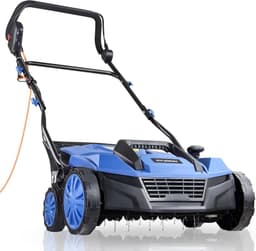
Hyundai Hyundai HYSC1800E 1800 W

Best overall

Hyundai Hyundai HYSC1800E 1800 W
9.0/10about £125.99
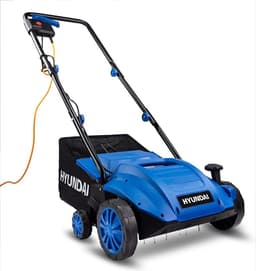
Hyundai Hyundai HYSC1532E 1500 W

Best value

Hyundai Hyundai HYSC1532E 1500 W
8.6/10about £89.99
Darlac Darlac DP888 telescopic

Alternative

Darlac Darlac DP888 telescopic
7.6/10about £38.99
On this page

Moss is a symptom

The RHS lists shade, compacted soil, mowing too low, and ground that stays wet. Grass that is struggling leaves a space moss will take. Raking removes what you can see. It does not move a fence or lift a lawn that holds water. If those are the conditions, the moss comes back. You are allowed to leave it. The RHS says moss can stay where grass is unlikely to succeed, and that killing or raking it without changing the site is a short result. A pocket under a tree is not the same job as a thatch mat on a sunny lawn. If you do want the moss out, the RHS puts scarifying in October or early November, when the soil is not waterlogged. A baked or frozen surface is a stop. The pass itself is how to scarify a lawn. This page stays with the moss decision.

Spring tines first

Lawnsmith separates the jobs. Wire tines pull moss that is sitting in the sward. Blades cut thatch, the brown layer that stops water and seed reaching the soil. Most corded listings here are a 2-in-1, so you choose which cassette to fit. Fit the rake cassette for moss. The Hyundai rows, the NETTA and the corded Bluemars name a rake beside blades. The cordless Bluemars lists 24 tines and 16 blades. Positive marks on the lever, such as +4 mm or +10 mm, are the above-soil positions, which is where a first moss comb belongs. Husqvarna UK still keeps spring tines to about 1–2 mm in the soil if you lower them. Dropping a blade drum to −12 mm because the moss looks thick is how a lawn loses the grass it had left. Aerator on these listings is not the moss answer. It usually means the bladed drum, not hollow tines. If a listing never names a rake cassette, do not assume you can comb moss with it. The PHIWOS line says interchangeable blades and does not clearly name a spring drum.
Hyundai Hyundai HYSC1800E 1800 W

Testsieger

Hyundai Hyundai HYSC1800E 1800 W
9.0/10about £125.99

What to buy in this set if moss is the job

If you are removing the moss and a socket can reach, buy a corded machine that names a rake drum, not the highest wattage. The Hyundai rows, the NETTA and the corded Bluemars all list a rake. Which of those is the top pick on review volume lives on the best lawn scarifier page. A 30 L or 45 L bag will not swallow a mossy lawn in one walk. On a small patch you can face, a manual head matches the RHS description. The Darlac DP888 at about £38.99 has 4.1 from 796 reviews and no box. The YTDHYM at about £31.99 is 4.7 from 21 reviews. One Darlac reviewer suggested under about 20 m². That is one garden. Skip the EcoBuild as a moss specialist: 4.7 from 7 reviews, and one review says the deepest setting felt like a small rotavator.

It will come back unless the site changes

The moss returns if you scarify and then mow at the same low setting, under the same shade, on the same wet soil. Raise the cut so the grass shades its own surface. If the ground is compacted, hollow-tine aeration is a separate job. If water sits after ordinary rain, the problem is drainage. Afterwards the lawn looks worse, because you have removed the green that was hiding bare ground. Clear every scrap before you seed. If you use a moss killer, the wait before seeding stays on the product label.

Common questions

Should I get rid of moss at all?
Only if you want grass there and the grass has a fair chance. The RHS says you can leave moss where shade, wet soil or compaction means grass will not win. Removal without a change of conditions is temporary. If you can already see soil and the moss is a thin guest, you may not need a machine.
Rake tines or blades for moss?
Use spring tines, the rake cassette, for moss sitting in the lawn. Use blades for thatch. A positive depth mark is the above-soil rake position. Blades at −12 mm are not a moss setting. Aerator on these boxes is not hollow tines.
Will scarifying stop the moss coming back?
No. It removes what is there. Shade, low mowing, compaction and wet ground put it back. Raise the cut, improve the light if you can, and treat drainage or hollow tines as separate work. Another scarifying pass is not a substitute.
Which machines here have a spring drum?
The three corded Hyundais, the NETTA and the corded Bluemars name a rake as well as blades. The cordless Bluemars lists 24 tines and 16 blades. The Darlac and the YTDHYM are manual heads with no second cassette and no box. The PHIWOS listing says interchangeable blades and does not clearly name a spring drum.
When is moss a drainage problem?
When water sits after ordinary rain, or the same hollow is mossy every winter however often you rake it. A scarifier cannot alter levels. Hollow tines are a different tool. Call a contractor if the lawn is also beyond a 10 m lead, or if you suspect disease or grubs rather than moss.

Related pages

Sources

Sources from the research digest, last checked on 23 October 2026. Shelf prices and star lines are from the amazon.co.uk capture on 19 October 2026.

  1. RHS, Lawn care in autumn (retrieved 23 October 2026)
  2. RHS, Moss in lawns (retrieved 23 October 2026)
  3. Noise Emission Regulations 2001, Schedule 4 paragraph 49 (retrieved 23 October 2026)
  4. GOV.UK, Noise guidance (retrieved 23 October 2026)
  5. Consumer Rights Act 2015, section 9 (retrieved 23 October 2026)
  6. Electrical Safety First, Leaf blowers and garden vacs (retrieved 23 October 2026)
  7. UK Lawn Care Association, Advice for homeowners (retrieved 23 October 2026)
  8. Husqvarna UK, Manage thatch in lawns (retrieved 23 October 2026)
  9. BBC Gardeners' World, Lawn scarifiers (retrieved 23 October 2026)