Lithium battery charger fire safety for garden tools

Charge garden-tool batteries more safely, spot damage early and choose a sensible location for removable packs and robot mower docking stations.
On this page
You finish mowing with one bar left on the pack, put it on charge beside a pile of gardening gloves and walk away. That is where lithium battery charger fire safety for garden tools matters most. A genuine charger, a sound battery and a clear hard surface reduce avoidable risks. A hallway socket, a covered charger or a damaged pack can turn a routine top-up into a serious problem.
A removable 20 V battery charging indoors is a different problem from a robot mower docking outdoors. Follow the instructions for your exact battery, charger and mower.
In short
Use the charger supplied with your garden tool, or a replacement explicitly approved for that exact battery system. Charge on a clear, hard surface while you are awake, keep the equipment away from an escape route, and unplug it when charging is complete. Stop immediately if the pack is swollen, cracked, leaking, unusually hot or behaving differently from normal.
Use the right charger
A connector that slides into a battery does not make a charger compatible. The charger has to provide the voltage and current the pack expects, and modern systems may also use temperature sensing or electronic communication. An unapproved charger can bypass the conditions the battery management system was designed around, even if charging appears to start normally.
Use the charger supplied with the tool. If it is lost or damaged, match the model numbers on the charger and battery to a replacement the manufacturer explicitly lists for that pack. Check the manual or the manufacturer's current compatibility information. A marketplace title that says universal is not that check. Similar-looking batteries in one brand can use different capacities, arrangements or charger requirements.
Before every charge, stop for a split cable, a loose plug pin, a cracked charger casing or a scorched contact. Do not tape them. Keep the contacts clean and dry, and do not push metal tools or spray into them. If the pack is wet, follow its drying instructions before you connect it. Fire and rescue services advise the supplied charger, left uncovered, because warmth needs air. A coat, box or cloth can hold heat and hide warning signs.
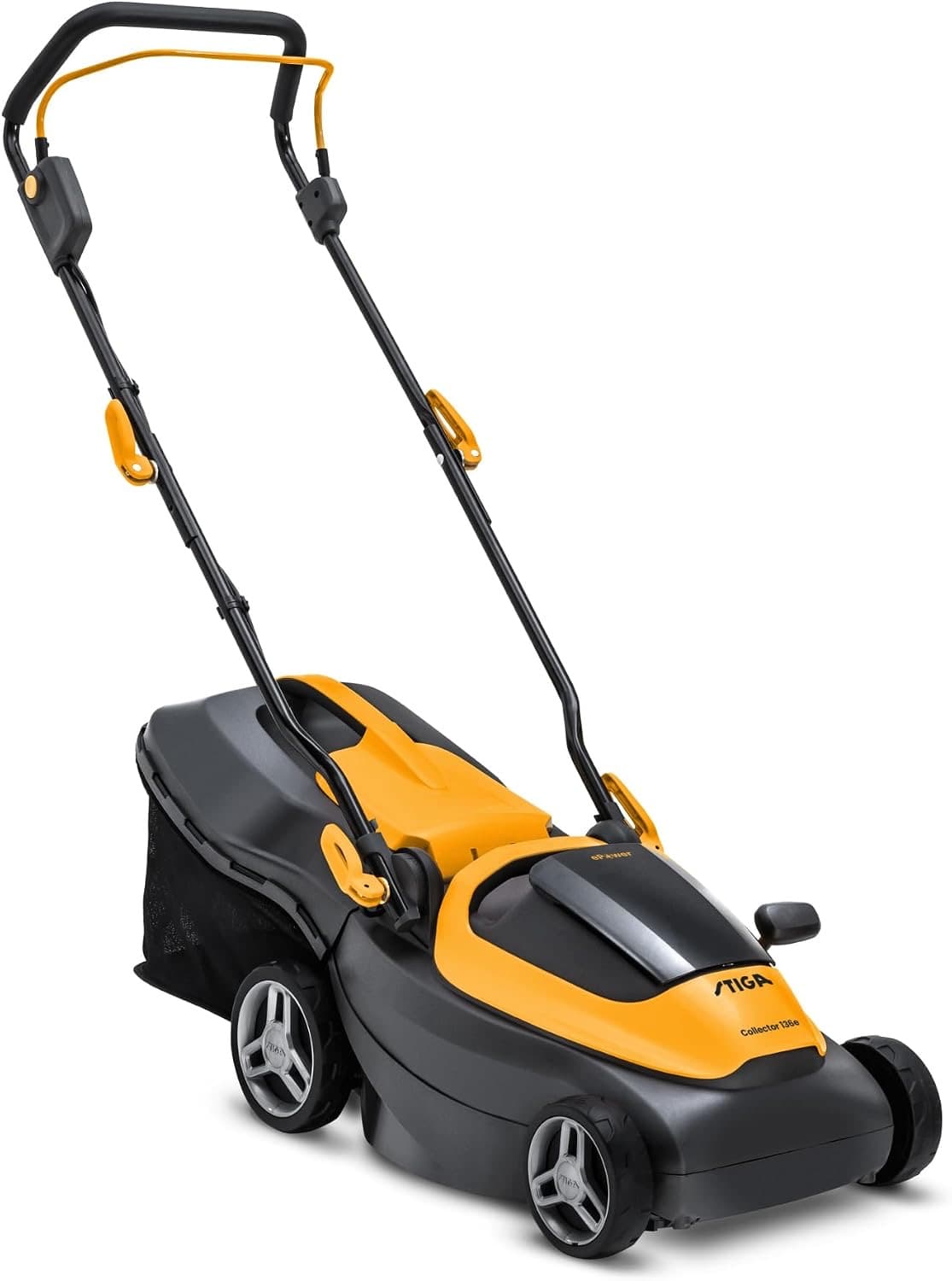
If you are replacing the tool and the battery system, the Stiga lawn mower comparison shows what each listing says is included. The top pick is the STIGA Collector 136e Kit at about £199, with 4.4 from 264 amazon.co.uk reviews. The kit names two 2 Ah batteries and a dual charger. That list belongs to this listing. It is not permission to fit those packs in a different mower.
Choose a safer charging place
Where you charge matters as much as what you plug in. Use a stable hard surface, such as a clear worktop or solid shelf, with space around the pack and charger. Keep them away from paper, fuel, paint, aerosols, dry leaves, curtains and soft furnishings. Leave the charger uncovered and visible.
Do not charge in a hallway, by the stairs or anywhere that forms your main escape route. Smoke and heat can make that route unusable. Greater Manchester Fire and Rescue Service suggests that power tools are better kept in a shed than on an escape route. A damp or freezing outbuilding is not automatically suitable. The manufacturer's temperature range, moisture protection and storage instructions still apply.
Charge while you are awake and nearby, and check for unexpected heat, smell, noise or swelling. When the pack is full, disconnect it in the order the manufacturer specifies and unplug the charger. Do not leave a full pack on a live charger for days. Avoid daisy-chained leads and overloaded adaptors. The cable should not cross a walkway, catch under a door or coil tightly around a warm supply. If the shed has no suitable socket, or it is damp, ask a qualified electrician.
Place a robot mower dock correctly
A robot mower base is part of navigation and daily operation. Its location may depend on level ground, cable routing, approach space, weather and communication with the mower. Some satellite-guided models need an open view of the sky. A metal-roofed shelter chosen so the battery charges under cover can stop the machine positioning itself.
Follow the installation guide for that exact mower and base, including clearances and the specified power supply. One Stiga A 1500 quick guide shows a UK plug code beside an EU code. That option does not prove what a different listing supplies. After storms or garden work, look for damaged cables, standing water and debris on the contacts. Isolate the power before cleaning as the manual describes. Do not open the power supply or box it in. A homemade cover can trap heat or collect condensation. A removable pack is watched on a chosen surface. A robot dock is installed as specified and then inspected. Those instructions are not interchangeable.
Recognise a damaged battery
A failing lithium battery does not always smoke first. Early signs include swelling, a distorted or cracked casing, leakage, discolouration, an unusual chemical smell, hissing, excessive heat or a charge time that has changed markedly. A pack that has been dropped, crushed or struck by a mower blade can be damaged inside while looking almost normal.
Stop using and charging it. Move people away from immediate danger and follow the manufacturer's emergency advice. Do not squeeze, puncture or open a swollen casing, and do not put it in water or try one last charge. If there is smoke, fire or an immediate threat, leave the area, call 999 and follow the fire service's instructions. A pack may warm in normal use. Too hot to touch, a rapid rise, or heat with smell, noise or deformation is different. Disconnect only if you can do so without approaching a hazardous pack.
Do not put lithium batteries in household rubbish. They can be crushed and ignite in a collection vehicle or waste facility. Ask your council recycling service, retailer or manufacturer how it accepts a damaged pack before you transport it. Mid and West Wales Fire and Rescue Service advises taping terminals for recycling. A swollen or leaking pack may need extra arrangements, so describe its condition when you ask.
Check the plug and battery system
Buying from amazon.co.uk does not establish that every charger in a listing is for the UK. Check what the listing includes, then inspect the delivered charger's label, plug and model code. A BS 1363 claim has to be supported for that product. A familiar-looking plug, or a UK option in another model's manual, is not that proof.
20 V is a system label, not a compatibility specification. Rails, terminals, electronics, current and charger support can differ. One Stiga 136e configuration uses two 2 Ah packs and a dual charger, while a 132e listing names one 4 Ah pack. That is not permission to swap packs. Check the codes on the tool, pack and charger against current manufacturer information, including when a bare tool arrives without a battery. The same check applies to a Stihl hedge trimmer or a Stihl leaf blower.
Follow a simple charging routine
A repeatable routine catches damage before convenience takes over. It should take less than a minute before charging and a few seconds when the battery is full.
- Let the pack settle. After hard use, follow the manufacturer's guidance before charging, especially if the pack is hot, wet or has just come in from very cold conditions.
- Inspect the battery, charger and plug for cracks, swelling, contamination, loose parts, damaged cable or scorched contacts.
- Put the charger and pack on a stable hard surface, uncovered and away from combustible materials, children, pets and your escape route.
- Match the model codes and use only a charger approved for the exact battery system.
- Start charging when you can notice unusual heat, smell, sound or shape. Do not leave it running overnight or while you are out.
- Follow the product instructions, unplug the charger and store the pack under the recommended temperature and moisture conditions.
This routine cannot eliminate every cell defect, and it does not replace a product recall or manufacturer warning. If charging behaviour changes after months of normal use, treat that change as information rather than accepting it as ageing.
Common questions
Can I charge a garden-tool battery in the hall overnight?
Can I use a different charger for my garden-tool battery?
What are the warning signs of a failing lithium battery?
Where should a robot mower docking station sit?
Are e-bike battery rules the same for a 20 V mower pack?
Can I use a Stiga 132e battery in a 136e mower?
What plug should a UK garden-tool charger have?
How should I recycle a swollen garden-tool battery?

Peter F. is the editor for DIY & tools at productscompared.co.uk. Comparisons in this category are checked against amazon.co.uk listings, review evidence and public UK sources.
Related articles

Boundary wire or GPS robot mower: which setup suits you?
Compare boundary-wire and GPS robot mowers, including installation, trees, mobile coverage and map changes.
Is a robot mower worth it for a small garden?
A robot mower can be poor value on a tiny lawn, in long grass, or where charging and edges do not fit.
Best mower for a small garden UK: choose the right size
Measure the grass, then compare collector and robot options, access, edges and storage.