Independent comparisons. We may earn from shop links. More info

Snake plant toxic to cats, dogs and small children

Updated: 21 October 2026

You share the flat with a cat, a dog or a small child, and the amazon.co.uk listing asks whether it is pet friendly without ever answering. That blank line is not a yes. A snake plant is toxic to cats and to dogs if it is eaten, and the sap irritates skin. Every plant in the [snake plant comparison](/hub/houseplants/snake-plant) carries that warning. The [snake plant buying guide](/hub/houseplants/snake-plant/sub/snake-plant-buying-guide) only needs the one-line version.

You share the flat with a cat, a dog or a small child, and the amazon.co.uk listing asks whether it is pet friendly without ever answering. That blank line is not a yes.

Our top picks

On this page

The listing question is not an answer

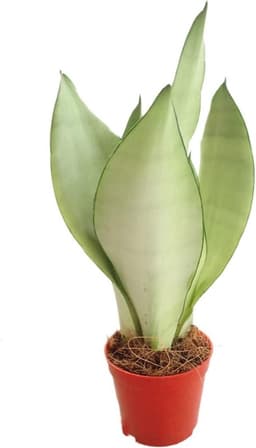
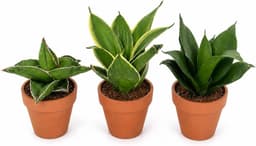
Two listings ask the pet question and then stop. The mini trio B0GRJG699J asks whether the plant is pet friendly and does not answer. C.B. Plants Moonshine, B0B3M3X2SW, asks whether it is safe for pets and does not answer. No listing in this set says the plant is pet safe. NASA-TM-101766 tested mother-in-law's tongue in a sealed chamber, not a ventilated flat, and it was not a pet-safety test. The best snake plant page can help you choose a shape only after the plant can be kept out of reach. If it cannot, there is no best one in this set.

Harmful if eaten

The RHS says sansevieria is poisonous and should be kept out of reach of children and pets. The genus page says harmful if eaten. It does not name a safe cultivar. Moonshine, a mini, a sword leaf and a cylindrical spear are the same risk. The ASPCA, a US source and not a British veterinary guideline, lists Sansevieria trifasciata as toxic to cats and dogs. It names saponins, with nausea, vomiting and diarrhoea. If a pet chews a leaf and is sick, call a vet. If a child has eaten a leaf, seek medical help.

Sap on skin

The RHS says the sap is a skin irritant and that you should wear gloves when you cut leaves or propagate. Sap is the issue when a leaf is snapped, trimmed or taken as a cutting. Seek medical help for sap in the eye or a spreading skin reaction. Keep prunings off the floor.

Where not to put it

Do not put it on the floor, on a low shelf, or in a small child's room if chewing is plausible. Cats jump, so a high shelf is not a guarantee. A 5.5 cm pot or a silvery leaf does not make it suitable. There isn't one pet-safe sansevieria in this comparison. Once it is out of reach, watering belongs on snake plant care.

If a pet has already chewed a leaf

If a cat or a dog has chewed a leaf and is sick, call a vet. Nausea, vomiting and diarrhoea are the signs the ASPCA lists. Do not offer a home remedy, and do not call the upset mild. The RHS does not publish a harmless amount. For a child who has eaten leaf, or for sap in an eye, seek medical help. For a plant that arrived rotten, the retailer is the call, not the vet.

Common questions

Are snake plants poisonous to cats?
Yes. The RHS says sansevieria is poisonous and should be kept out of reach of pets, and the genus page says harmful if eaten. The ASPCA, a US source, lists it as toxic to cats, with saponins, nausea, vomiting and diarrhoea. That page is not a British veterinary protocol. No cultivar here is exempt, including Moonshine. An unanswered pet question is not a yes.
Are they poisonous to dogs?
Yes. The RHS wording covers pets, not cats alone, and the ASPCA lists dogs as well as cats, with saponins and gastrointestinal signs. A dog that chews a fallen leaf is in the same category. If the dog is sick after chewing, call a vet. Do not use a US poison-hotline number from the UK.
Is Moonshine or a mini sansevieria safer than a big one?
No. The RHS does not exempt a cultivar, a silvery leaf or a 5.5 cm pot. Moonshine's listing asks if it is safe for pets and does not answer. The £15.00 mini trio asks if it is pet friendly and does not answer. A smaller plant is still harmful if eaten. Price, from £9.99 to £16.99, does not change that.
My listing asks whether it is pet friendly and has no answer. What does that mean?
It means the question was asked and not answered. B0GRJG699J and B0B3M3X2SW both do this. Silence is not a declaration that the plant is safe. No bullet in this comparison says pet safe. If you need a pet-safe houseplant, this set does not supply one.
What does the sap do to skin?
The RHS says the sap is a skin irritant and that you should wear gloves when handling cut leaves or propagating. An intact plant is mainly a chew risk. A snapped leaf is when sap gets on skin or into an eye. Seek medical help for sap in the eye or a spreading skin reaction. Keep prunings away from pets.
What should I do if my cat has chewed a leaf?
Call a vet if your cat is sick. Tell them it was a snake plant, also sold as sansevieria or mother-in-law's tongue. The ASPCA lists nausea, vomiting and diarrhoea. Do not wait because a blog called the upset mild. If a child has eaten a leaf, or sap is in an eye, seek medical help. The RHS gives no safe amount.
Is it safe on a low shelf in a child's room?
No. The RHS says keep it out of reach of children because it is poisonous if eaten. A low shelf in a child's room is the opposite of that. A higher shelf is still not a guarantee with a climbing toddler or a cat. Air purifying in a title does not change that. The NASA work was a sealed chamber.

Related pages

Sources

Public UK sources named below, plus the NASA chamber study and the ASPCA pet note. amazon.co.uk prices, stars and review counts on these seven listings were read on 20 October 2026. Page updated 21 October 2026.

  1. RHS Sansevieria growing guide (retrieved 20 October 2026)
  2. RHS mother-in-law's tongue details (retrieved 20 October 2026)
  3. RHS Sansevieria genus guide (retrieved 20 October 2026)
  4. GOV.UK plant passports (retrieved 20 October 2026)
  5. Consumer Rights Act 2015, section 9 (retrieved 20 October 2026)
  6. Which? on houseplants by post (retrieved 20 October 2026)
  7. NASA-TM-101766 sealed-chamber study (retrieved 20 October 2026)
  8. ASPCA snake plant toxicity note (retrieved 20 October 2026)