Independent comparisons. We may earn from shop links. More info

Artificial green wall vs living wall

Updated: 21 October 2026

You searched for a living wall, and the amazon.co.uk titles in this set still put those words on plastic leaves that never see a watering can. An artificial green wall vs living wall choice is three different jobs: a dry screen you hang this weekend, a climber in the ground, or an engineered wall that holds compost and water. The seven listings here are only the first of those. This page does not pick a winner among them. Shelf prices for the plastic sit on our [plant wall comparison](/hub/houseplants/plants-wall). A qualifying purchase can earn us a commission at no extra cost to you.

You searched for a living wall, and the amazon.co.uk titles in this set still put those words on plastic leaves that never see a watering can.

Our top picks

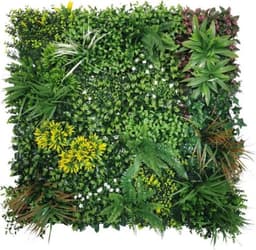
Ark Mat Ark Mat VG-3 Lowther Green

Best overall

Ark Mat Ark Mat VG-3 Lowther Green
7.8/10about £39.95
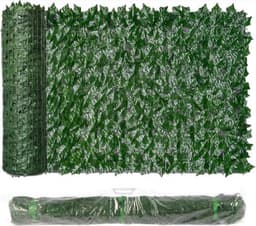
Vinclus Vinclus ivy roll

Best value

Vinclus Vinclus ivy roll
7.0/10about £21.99
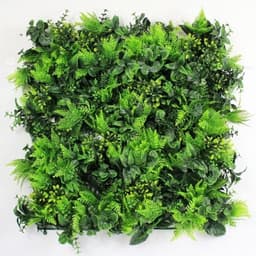
ULAND ULAND mixed leaf 12-pack

Alternative

ULAND ULAND mixed leaf 12-pack
5.8/10about £114.90
On this page

What the listings actually are

Every file in this set is artificial. None includes compost, a pump or a drip line, and the seller lines say you do not water them. Shelf prices run from the Vinclus roll at £21.99 to the ULAND fern carton at £119.90. Printed weights run from a doubtful 454 g on that fern pack up to about 8.18 kg for the broadleaf carton, and about 750 g for an Ark Mat panel. Those figures are plastic and backing, not wet substrate. The Royal Horticultural Society describes green walls as three separate routes, and these titles collapse all three into one result. The plastic set is only the route with no roots.

The real-plant options

The RHS splits the living version into direct greening, indirect greening, and a living-wall system. Direct greening is a climber rooted in the ground and growing on the wall. Indirect greening uses a trellis or wires, so the plant is not stuck to the masonry. Both keep the roots in soil you can reach with a hose or with rain. A clematis or a honeysuckle on a trellis is the lighter job if you have a bed or a deep pot and can wait a season or two. A young climber will not hide a balcony the week you order it. A living-wall system holds a growing medium and usually needs irrigation. No planted kit is in this set, so there is no amazon.co.uk ASIN here for compost panels.

Weight, water and wildlife

Installer figures are not a British Standard, and they are not the weight of a 750 g plastic panel. Biotecture states about 75 kg per square metre for its BioPanel when saturated, and about 2 litres per square metre per day. Life on Walls quotes about 40–70 kg per square metre, and about four to eight maintenance visits a year on their contracts. Use each number only for that company’s system. A saturated module is a load for the wall and the brackets. Plastic here does not ask for that water. The RHS note on biodiversity is about real foliage. A polyethylene fern tile is not habitat because the listing says green, and these panels do not clean the air.

Which job you have

Stay with the artificial set if you will not water, or if you have no soil and no useful light. A rented balcony, a dark hallway, or a fence you want green by the weekend fits that. Choose on coverage in the buying guide, and accept plastic with no wildlife value. Leave this set if you want plants you can maintain. A climber on a trellis is the simpler living option when roots have somewhere to go. An irrigated wall waits until an installer has looked at the structure. If you will not keep a climber alive, you get a dead climber and then the roll anyway. Peter F. checked the RHS green-wall pages and the installer figures as of 21 October 2026. We did not weigh a wet wall.

Common questions

Is an artificial panel a living wall?
No. A living wall holds plants and a growing medium, and it usually needs water. These seven listings are artificial foliage. The included lines have no compost, pump or drip line, and the seller text says you do not water them. A 750 g panel and an 8 kg carton are plastic and backing, not a wet module.
Do these panels need water or light?
They need neither, on the seller lines in this set. There is no soil to dry out and no leaf that photosynthesises. Indoor or outdoor is a fade and fixing claim, not a light requirement. A real climber still needs light, water and roots. Buying plastic for a dark hallway is coherent. Expecting a fern is not.
What is the simpler real-plant option?
A climber in the ground or a deep pot, on a trellis or on wires. That is the RHS direct and indirect greening pair. You need soil, time and pruning, not the kilogram figures quoted for engineered modules. It looks thin in the first year. With nowhere for roots, the engineered wall is the living route left.
How heavy is a wet living wall?
It depends which system. Biotecture’s BioPanel figure is about 75 kg per square metre when saturated. Life on Walls quotes about 40–70 kg per square metre for walls they install. Those are company figures, not a national standard, and not the plastic here. Do not add 75 kg to a 1 kg ivy roll.
Will plastic help bees or birds?
Not on anything these listings show. RHS work on green walls and invertebrates is about real plants. A moulded fern or an ivy roll does not flower or hold those insects. If wildlife is the reason, plastic fails it even when it blocks a view. A climber can do that job only once it has grown.
Why do the Amazon titles say living wall?
Because that is the phrase shoppers type, and the catalogue titles follow it. The bullets then say no watering and name polyethylene, resin, a panel or a roll. Read the included-components line. If it is a panel, zip ties or a rolling strip, you are buying plastic.
When must a structural check happen?
When the wall would hold wet growing medium, not when you tie plastic to a sound timber fence. That load needs the wall, the fixings and a survey together. A cable tie and a 1 kg roll are a different job, on the installation guide.

Related pages

Sources

Public UK sources named below. amazon.co.uk prices, stars and review counts on these seven listings are the figures used for this comparison. Page updated 21 October 2026.

  1. Planning Portal, fences, gates and garden walls (retrieved 21 October 2026)
  2. GPDO 2015, Schedule 2, Part 2, Class A (retrieved 21 October 2026)
  3. mygov.scot, building a fence or wall (retrieved 21 October 2026)
  4. GOV.WALES, planning permission for fences, gates and garden walls (retrieved 21 October 2026)
  5. Anti-social Behaviour Act 2003, section 66 (retrieved 21 October 2026)
  6. Kent Fire and Rescue, artificial or dried foliage (retrieved 21 October 2026)
  7. GOV.UK, General Product Safety Regulations 2005 (retrieved 21 October 2026)
  8. RHS, green walls (retrieved 21 October 2026)