Dwarf Cavendish vs Ensete: which banana for the UK
It is easy to treat dwarf Cavendish vs Ensete as two sizes of one plant, because both titles say banana and the pots are a similar price. They are different genera. You are choosing a green Musa acuminata or a red Ensete 'Maurelii' for a bright UK room. Musa basjoo, the plant people wrap in fleece, is a third species and it is not in the parcel. The pots are on the [banana plant comparison](/hub/houseplants/banana-plant). This page says when the green type, when the red type, and one recommendation with a condition. Peter F. used RHS pages and the amazon.co.uk files from 20 October 2026.
It is easy to treat dwarf Cavendish vs Ensete as two sizes of one plant, because both titles say banana and the pots are a similar price. They are different genera.
It is easy to treat dwarf Cavendish vs Ensete as two sizes of one plant, because both titles say banana and the pots are a similar price. They are different genera. You are choosing a green Musa acuminata or a red Ensete 'Maurelii' for a bright UK room. Musa basjoo, the plant people wrap in fleece, is a third species and it is not in the parcel. The pots are on the banana plant comparison. This page says when the green type, when the red type, and one recommendation with a condition. Peter F. used RHS pages and the amazon.co.uk files from 20 October 2026.
Our top picks
| Badge | Product | Species | Light | Setting | Note | Price | Offer |
|---|---|---|---|---|---|---|---|
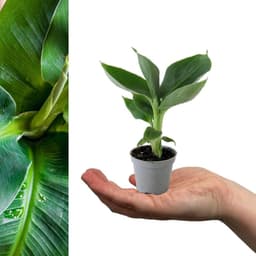
| Best overall |  Carbeth Plants Carbeth Musa acuminata (6 cm, two) | Musa acuminata (dwarf Cavendish on the bullet) | Bright light; bullet says they love the sun | Indoor; home or office on the bullet | 5.6 | about £12.99 | View offer |
 Carbeth Plants Carbeth Ensete 'Maurelii' (9 cm) | Ensete 'Maurelii' (Ethiopian black banana) | Full sun to partial shade; sunlight field Partial Shade | Indoor; patio pot in warmer areas is a bullet | 7.1 | about £14.99 | View offer | |
| Best value |  Carbeth Plants Carbeth Musa acuminata (12 cm) | Musa acuminata (dwarf Cavendish on the bullet) | Bright light; bullet says they love the sun | Home or office on the bullet; outdoor question unanswered | 6.6 | about £13.99 | View offer |


On this page
Two genera, not two sizes of one plant
Leaf colour and winter rating
Fruit, pups and pets
Which listing is which
When to pick which
Common questions
Which one is hardier in a British winter?
Which one might flower, and will I get a banana I can eat?
Do both make pups I can pot up?
Is either one safe if a cat chews a leaf?
Why do some sites say the Cavendish stays at 2 metres?
Related pages
Sources
Public UK and RHS sources named below. amazon.co.uk prices, stars and review counts on B0B34TDMPZ, B0CWLGT445 and B0CN3K5WBX were read on 20 October 2026. Page updated 21 October 2026.
- RHS banana growing guide (retrieved 20 October 2026)
- RHS Musa acuminata 'Dwarf Cavendish' (retrieved 20 October 2026)
- RHS Ensete ventricosum 'Maurelii' (retrieved 20 October 2026)
- RHS hardiness ratings (retrieved 20 October 2026)
- RHS Wisley, protecting bananas over winter (retrieved 20 October 2026)
- GOV.UK plant passports for distance sales in Great Britain (retrieved 20 October 2026)
- ASPCA banana (Musa acuminata) (retrieved 20 October 2026)
- amazon.co.uk banana plant search snapshot, 20 October 2026 (retrieved 20 October 2026)