Independent comparisons. We may earn from shop links. More info

What size hot water cylinder do I need?

Updated: 17.10.2026

The useful question is what size hot water cylinder do I need at peak demand, not how many bedrooms you have. The Hot Water Association suggests 35–45 litres of stored hot water per occupant as a rule of thumb, then habits and recovery change it. Our [hot water cylinder comparison](/hub/hot-water/hot-water-cylinder) covers 30–120 litre electric wall stores, below many household tables. Those litres illustrate the range. They do not promise a set number of showers. Peter F. checked the listings, with no lab test. A qualifying purchase can earn a commission at no extra cost to you.

The useful question is what size hot water cylinder do I need at peak demand, not how many bedrooms you have.

Our top picks

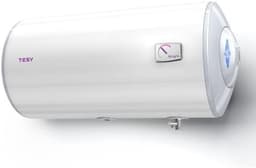
TESY TESY BiLight 30 litre

Best overall

TESY TESY BiLight 30 litre
8.8/10about £139.99
TESY TESY BiLight 120 litre

Alternative

TESY TESY BiLight 120 litre
8.8/10about £254.99
On this page

The litre rule and what it is not

At 35–45 stored litres per person, one occupant begins around 35–45 litres, two around 70–90 litres and four around 140–180 litres. That is a starting point. The Hot Water Association also describes low daily use as roughly 20–30 litres per person, average use as 30–50 litres and high use as 50–70 litres. Same occupancy can still mean different stores. Focus on the busiest hour. Morning-only use can recover before the next draw. Consecutive showers plus a bath cannot. Visitors, a large bath and a high-flow shower push the number up. Bedroom tables often start around 120–150 litres for a small home, which is why 30 and 50 litre products look out of place beside them. Use the hot water cylinder buying guide to identify the product type before applying a table.

Showers and baths in litres

The Hot Water Association gives a mains-pressure shower at about 18 litres per minute at 40°C, with some heads reaching 25 litres per minute. Five minutes at 18 litres per minute is 90 litres of mixed water. Cold water is blended in, so that is not 90 litres taken straight from a hotter cylinder. Flow matters as much as duration. Its bath example uses about 100 litres at 40°C, described as roughly 60 litres stored at 60°C. Another industry guide puts a bath around 70–80 litres and a five-minute shower near 45 litres. Those ranges frame a calculation. They do not guarantee that a 50 litre store fills a bath. The TESY 50 litre horizontal mentions V40 of 78 litres and separately uses 78 litres per hour as a flow field. Those are different measures, so we would not promise fixed shower minutes.
TESY TESY BiLight 30 litre

Testsieger

TESY TESY BiLight 30 litre
8.8/10about £139.99

Where 30 to 120 litres sit

The smallest product here is a 30 litre TESY. For one person that sits below the top of the 35–45 litre rule, though daytime recovery may suit a basin or an annexe. The 50 litre products cover one person more comfortably and still struggle with a strong shower, a bath or back-to-back use. The 80 litre TESY sits in the band for two light users. 100 and 120 litres add buffer. Four people at 35–45 litres each point towards 140–180 litres, so the 120 litre listing is not a default family cylinder. The 120 litre TESY weighs 30 kg empty, so the filled mass is roughly another 120 kg before fittings. The 100 litre horizontal model is nearly a metre wide and is supplied without the required relief valve. If a system boiler or heat pump supplies the store, these six direct products are the wrong type. Read direct or indirect hot water cylinders before sizing a coil-fed store. Pressure is separate in unvented or vented hot water cylinders.

Reheat only where the listing is readable

Recovery can replace used heat before the next draw, but element power is only one input. Heat loss, the thermostat, the start temperature and the incoming water also change the result. A larger element still needs a suitable circuit, and it does not turn a small store into unlimited hot water. The 30 litre and 50 litre horizontal TESY models state 1,500 W. The GEESEN 50 litre states 2,000 W, and the 100 litre horizontal TESY states 3,000 W. Only the 50 litre horizontal TESY gives a heat-up claim: 1 hour 18 minutes from 15°C to 60°C, for stated conditions rather than your winter supply. The 80 litre TESY prints 1,500 kW and the 120 litre prints 220 W alongside 220 V. Neither is a usable element rating. Ask for the nameplate before you estimate recovery.

Common questions

How many litres should I allow per person?
Use 35–45 litres of stored hot water per occupant as an initial rule of thumb. Then adjust for the busiest period, shower flow, baths and recovery time. It is not a guarantee. The Hot Water Association notes wide variation between households with similar occupancy.
Is a 50 litre cylinder enough for one person?
It can be when use is modest and the store has time to recover. A long high-flow shower or bath may consume most of its useful mixed-water output. Check the actual shower flow and heating input instead of relying on occupancy alone.
How much hot water does a bath use?
Published examples range from about 70–100 litres at bathing temperature, depending on the bath and fill level. The Hot Water Association equates a 100 litre bath at 40°C to roughly 60 litres stored at 60°C. Treat that as an example, not a guarantee.
Does a faster element let me buy fewer litres?
Sometimes recovery reduces the storage needed between draws, but only if the element and circuit can replace heat before the next use. It cannot cover a peak that empties the store faster than it reheats. Size the peak first, then model recovery.
Is 120 litres enough for a family?
Not by default. Four people at the 35–45 litre starting point suggest 140–180 stored litres, although actual demand and recovery may change the result. A 120 litre wall store needs a household-specific calculation rather than a family label.
When should an installer override the rule of thumb?
An installer should refine it whenever shower flow, bath size, simultaneous use, available electrical input, boiler output or heat-pump operation differs from the assumptions. They should also check wall loading, pipe runs, controls and the safe discharge before a size is ordered.

Related pages

Sources

Public UK sources listed in the research digest, and the amazon.co.uk listings for these six cylinders. Prices in the digest were captured on 16 October 2026.

  1. Approved Document G (2024 amendments) (retrieved 16.10.2026)
  2. Part G FAQ (retrieved 16.10.2026)
  3. CNC Building Control: unvented hot water cylinder (retrieved 16.10.2026)
  4. Hot Water Association, unvented note (retrieved 16.10.2026)
  5. Hot Water Association, sizing a hot water cylinder (retrieved 16.10.2026)
  6. HSE: legionella and hot and cold water systems (retrieved 16.10.2026)
  7. Regulation (EU) No 812/2013 on legislation.gov.uk (retrieved 16.10.2026)
  8. TESY BiLight series (retrieved 16.10.2026)