Independent comparisons. We may earn from shop links. More info

LPG or natural gas water heater

Updated: 17.10.2026

Choosing an LPG or natural gas water heater is a fuel decision before it is a brand decision. Propane, butane, and mains gas arrive at different pressures, through different fittings, and the indoor models here also differ in the flue. A hose swap does not convert one into the other. This page sets the three pressures, the Amazon field on the Camplux BW264BC that names the wrong gas, and the two indoor flues. The [gas water heater comparison](/hub/hot-water/gas-water-heater) prints the fuel line from each listing. There is no lab test. A qualifying purchase through the links can earn a commission at no extra cost to you.

Choosing an LPG or natural gas water heater is a fuel decision before it is a brand decision.

Our top picks

On this page

Propane, butane, or mains gas

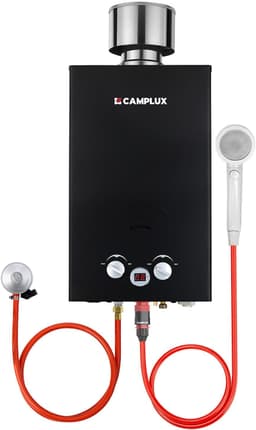
UK cylinder propane is regulated at 37 mbar. Cylinder butane is regulated at 28–30 mbar. Mains natural gas is about 21 mbar nominal on the GOV.UK table, which is not a reading at your meter. Propane is the winter fuel. Calor notes that butane’s boiling point is about −2 °C. On the BW264BC the butane regulator is not in the box. A caravan built to EN 1949 may use 30 mbar for both LPG types, so stay with the van’s own regulator. The lighting order is on the how to use page. Paid work on a metered supply is for a Gas Safe registered engineer.

The listing that contradicts itself

The BW264BC looks dual-fuel if you read only one field. The Amazon specification line says Natural Gas. The bullets supply a 37 mbar regulator for a propane Calor cylinder, and Camplux’s UK page describes propane at 10 litres a minute and 20 kW. Trust the data plate, then the bullets. There is no flue in that price. The BW158BC says propane or butane and supplies only the propane regulator. The Gearpass outdoor page never names 37 mbar.

Two indoor natural-gas heaters

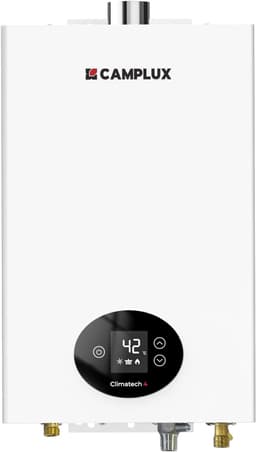
The GX318NG lists 12 litres a minute, 24 kW, and a 60/100 mm balanced flue, at about £179.99. A balanced flue takes combustion air from outside and sends the exhaust outside. The bullets state natural gas at 20 mbar. That printed figure is not a commissioning result, and the flue kit is not in the box. The BD300NG lists 11 litres a minute at about £189.99, with 4.0 from 20 reviews. The exhaust is 108 mm, and the bullets say balcony or kitchen while the title also says bathroom. The BFCMA gas flue guide says open-flued gas appliances are not for bathrooms, showers, or garages. In England, Wales, and Scotland, regulation 30 requires a room-sealed appliance in a bathroom or shower room. Start from the buying guide.

Conversion

A conversion from natural gas to LPG, or the other way, is a genuine kit for that model and a recommission by a Gas Safe engineer who holds the LPG category when LPG is the result. No Amazon listing in this set includes that kit. The BW264BC’s Natural Gas field is not one, and the GX318NG’s 20 mbar line is not an invitation to retune it onto a propane bottle. If the data plate and the gas you have do not match, buy the heater built for that gas. A hose is not a kit. Outdoor propane picks are on the best gas water heater page.

Common questions

Propane or butane for a garden shower in winter?
Propane, at 37 mbar, with the clip-on these Camplux outdoor kits supply. Butane at 28–30 mbar can run the same style of heater in mild weather if you fit the butane regulator, which the BW264BC does not include. Butane’s boiling point is about −2 °C, so a cold patio is where a butane bottle fades. The heater cannot correct a bottle that has stopped making vapour.
Is mains gas the same pressure as a 37 mbar bottle?
Mains natural gas in the UK is about 21 mbar nominal. A propane cylinder regulator is 37 mbar. The gases, the jets, and the fittings differ. A camping heater built for the clip-on is the wrong machine for the meter, and a natural-gas indoor heater is the wrong machine for a Calor bottle. Match the data plate to the supply you have.
Why does the BW264BC say natural gas in one field?
The specification field says Natural Gas. The bullets and Camplux’s UK page describe propane at 37 mbar, 10 litres a minute, and 20 kW, and reviewers fit a Calor propane bottle. Use the data plate on the unit. One conflicting Amazon field does not make the BW264BC a mains-gas heater or a dual-fuel heater.
What does 20 mbar on the GX318NG mean?
The listing states a 20 mbar natural-gas supply. UK mains gas is about 21 mbar nominal on the GOV.UK table. The gap is small on paper and still not a commissioning result. A Gas Safe engineer has to confirm this appliance on the actual supply. The 60/100 mm balanced flue is a separate question, and the flue kit is not in the box.
Balanced flue or a 108 mm exhaust?
The GX318NG names a 60/100 mm balanced flue, the room-sealed pattern in this set. The BD300NG names a 108 mm exhaust for a balcony or kitchen, while its title also says bathroom. Open-flued gas appliances are not the bathroom pattern. Regulation 30, in England, Wales, and Scotland, requires a room-sealed appliance in a bathroom or shower room.
Can I convert a natural-gas unit to propane myself?
Leave it to a kit made for that model and a Gas Safe engineer with the LPG category. No listing in this Amazon set includes that kit. Hose swaps and jet guesses are outside this page on purpose. If the maker has no kit for the exact model, choose the heater that was built for the gas you have.
Are caravan regulators the same as the Camplux clip-on?
Often they are not. The Camplux outdoor kits use a 37 mbar propane regulator with a 27 mm clip-on. A caravan built to EN 1949 may be arranged for 30 mbar on both propane and butane, through the van’s own regulator. Use the system the van was built with rather than forcing the camping clip-on onto a different stub.

Related pages

Sources

Public UK sources and the amazon.co.uk listings used for this comparison, last checked on 15 October 2026.

  1. Gas Safety (Installation and Use) Regulations 1998 (retrieved 15.10.2026)
  2. HSE: Gas safety in the home, FAQs (retrieved 15.10.2026)
  3. HSE: Gas safety for landlords (retrieved 15.10.2026)
  4. HSE: Check a gas engineer (retrieved 15.10.2026)
  5. Smoke and Carbon Monoxide Alarm (England) Regulations 2015, regulation 4 (retrieved 15.10.2026)
  6. GOV.UK: Gas types and supply pressures in the UK (retrieved 15.10.2026)
  7. Liquid Gas UK, Consumer Guidance Sheet 39 (retrieved 15.10.2026)
  8. nidirect: Carbon monoxide dangers if camping, caravanning or boating (retrieved 15.10.2026)