Independent comparisons. We may earn from shop links. More info

How to use a portable gas water heater

Updated: 17.10.2026

You use a portable gas water heater outdoors, on its own cylinder, after the regulator matches the bottle. This page is for an owner of an outdoor unit in this set, such as a Camplux AY132B, a BW264BC, or a Gasland G10 Pro, who wants the first light in free air and the heat exchanger intact after a frost. It is the wrong manual for the Camplux GX318NG, the BD300NG, and the Gearpass JSQ32. House gas pipework is a Gas Safe job. The [gas water heater comparison](/hub/hot-water/gas-water-heater) shows which listing is which. There is no lab test. A qualifying purchase through the links can earn a commission at no extra cost to you.

You use a portable gas water heater outdoors, on its own cylinder, after the regulator matches the bottle.

Our top picks

On this page

Match the regulator before you open the cylinder

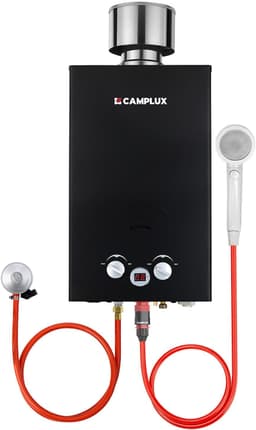
The regulator in the Camplux boxes here is 37 mbar with a 27 mm clip-on, for propane. Butane needs a 28–30 mbar regulator that is not in the box. A caravan built to EN 1949 may be set up for 30 mbar on both LPG types. Use the van’s own regulator. Propane is the winter bottle. Calor notes that butane’s boiling point is about −2 °C. Fit the washer before you tighten the regulator. If a Gearpass clip-on will not seat on a UK propane cylinder, stop. Do not pack the joint with tape. The three pressures are on the LPG or natural gas page.

Batteries, water, then gas

Ignition on these outdoor heaters is two D cells, and they are not in the box. Fit them before you open the cylinder. If a fresh pair and a confirmed regulator still leave the display dark, pack the heater away rather than holding a lighter at the burner. Many of these heaters fire when flow opens, so a dry start looks like a fault. Let water leave the shower head before you expect a flame. A butt that only trickles will not open a burner that starts from 0.25 bar. The G10 Pro and the BE158BP60 include a pump, and one BE158BP60 review says that pump did not run. Prove it moves water, then open the gas. Lay the 150 cm gas hose unkinked and out of the standing area.

Check for leaks, then set the temperature

Brush soapy water on every gas joint with the cylinder valve open and the burner still off. Bubbles mean a leak. Shut the valve, remake the joint, and test again. A quiet test does not commission a flue. Light the heater the way its own card describes, outdoors, with water already passing. On the BW264BC, reviewers who wanted about 37 °C ran the water high and the gas low. If the outlet keeps rising, shut the gas and the water. Water from the case is the point where you stop and return the heater.

Wind, hose, and frost

Wind blows these flames out. Stop the water so the burner can restart, then open the shower again. A longer outdoor shower hose, with a tight joint, is a fair fix for the short 150 cm hose. Frost splits the heat exchanger. Open the drain plug, empty the case, and store it warm and dry. If water is already coming from the case after a cold night, stop. Do not run this cylinder routine on a house gas pipe. Where the burner may stand is the camping shower page. If you are still choosing the gas, use the buying guide before the first light.

Common questions

Which regulator goes on a Calor propane bottle?
Use a 37 mbar propane regulator with a 27 mm clip-on, which is what the Camplux outdoor kits in this set supply. Seat the washer, then clip on. Butane uses 28–30 mbar, and that regulator is not in the BW264BC box. A caravan on the EN 1949 30 mbar setup is a different fitting. If a Gearpass reducer will not clip onto the bottle, it is the wrong piece for that cylinder.
Are the batteries in the box?
No. These outdoor heaters need two D cells, and the listings do not include them. Fit them before you open the gas. A pump model still needs its 12 V supply. New batteries that leave the panel dark, as in the Gearpass outdoor reviews, mean the unit is not ready to light.
What order do I connect gas and water?
Fit the regulator and washer, fit the batteries, run water through the shower head, check the joints, then open the cylinder and light the burner. These heaters often need flow before they fire, so a dry start looks like a fault. The gas hose is about 150 cm. Keep it unkinked and out of the place you stand.
How do I check for a leak without a flame?
Brush soapy water on the gas joints with the cylinder valve open and the burner off. Bubbles mean you shut the valve and remake the joint. A quiet test covers the connections you have just made. It does not approve an indoor flue or a bathroom install.
What do I do when the wind blows the flame out?
Stop the water so the burner can restart, then open the shower again. The rain cap on the BW158BC and BW264BC is there for that weather and still loses to a strong gust in reviews. Keep the case in free air. Standing over the flame to block the wind puts you on the burner.
How do I drain it before frost?
After use, close the gas, open the drain plug, and empty the case. Store it warm and dry. Camplux’s care notes say not to leave water in over a frost, and BW264BC reviewers find the plug straightforward. If water is already leaking from the case after a cold night, stop using the heater.
When should I stop following these steps?
Stop if the heater is a flued indoor model, if you still smell gas after a joint has been remade, if the outlet temperature keeps climbing, or if water is coming from the case. A fixed install, a flue, or a fuel conversion belongs with a Gas Safe engineer. This page is not a guide to house gas pipework.

Related pages

Sources

Public UK sources and the amazon.co.uk listings used for this comparison, last checked on 15 October 2026.

  1. Gas Safety (Installation and Use) Regulations 1998 (retrieved 15.10.2026)
  2. HSE: Gas safety in the home, FAQs (retrieved 15.10.2026)
  3. HSE: Gas safety for landlords (retrieved 15.10.2026)
  4. HSE: Check a gas engineer (retrieved 15.10.2026)
  5. Smoke and Carbon Monoxide Alarm (England) Regulations 2015, regulation 4 (retrieved 15.10.2026)
  6. GOV.UK: Gas types and supply pressures in the UK (retrieved 15.10.2026)
  7. Liquid Gas UK, Consumer Guidance Sheet 39 (retrieved 15.10.2026)
  8. nidirect: Carbon monoxide dangers if camping, caravanning or boating (retrieved 15.10.2026)