Independent comparisons. We may earn from shop links. More info

How to install a 50 litre electric water heater

Updated: 21 October 2026

You are about to hang a 50 litre electric water heater, or you are deciding the job is not yours to finish. Confirm the orientation, check the wall for a full tank, fit the discharge, fill until a hot tap runs without air, and only then apply power. A competent person does the controlled parts. This is how to install a 50 litre electric water heater in a UK home. Ranking stays on the [50 litre hot water cylinder comparison](/hub/hot-water/50-litre-hot-water-cylinder). Peter F. wrote these notes on 20 October 2026 from public UK sources and the four listings, not a lab install. A qualifying amazon.co.uk purchase can earn a commission at no extra cost to you.

You are about to hang a 50 litre electric water heater, or you are deciding the job is not yours to finish.

Our top picks

On this page

Why 50 litres is not a DIY unvented install

A 50 litre mains-pressure store is an unvented store, well above the 15 litre line. LABC says storage over 15 litres is controlled and notifiable. Fifty litres does not get the small-vessel exemption. CNC Building Control says an unvented store over 15 litres needs a competent person and a Benchmark-style record. The Water Supply (Water Fittings) Regulations 1999 require a safety-device arrangement, other than for an instantaneous heater not over 15 litres. Scotland and Northern Ireland have their own regulations. A GEESEN bullet that says no specialised electrical work does not change Approved Document P: a new circuit, and work in a bathroom zone, is still notifiable. You can measure and buy missing bolts. You hand the connection to a competent person. Do not turn a vertical tank on its side. That check is on the horizontal or vertical page.

Wall, fittings, and filling

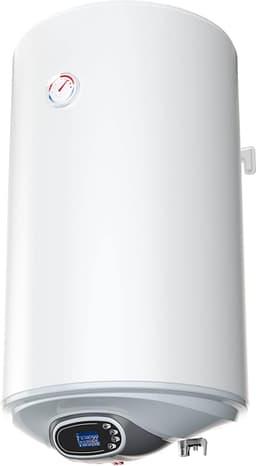
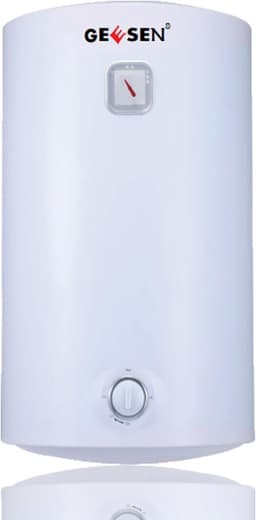
Fifty litres of water is about 50 kg, so a filled heater is about 65 to 70 kg. The TESY includes a wall bracket and not the fixing bolts. The Eldom Favourite lists an inlet and safety valve. The Spectra lists a 3-way inlet valve and does not list screws. The GEESEN lists a hanging plate, screws, a safety valve, a drip pipe and an American NTP 1/2 adapter. If the pipework is UK compression thread, solve that adapter before the tank is on the wall. Fill before you switch on. The GEESEN bullet says so, and an Eldom fiche says the store must be filled before heating because water above 50 °C at the outlet can scald. Open a hot outlet and fill until water runs steadily before you energise.

Electrics

The heaters here are listed at 1.5 kW or 2 kW, a smaller load than a 3 kW immersion. The IET, in Wiring Matters in September 2025, discusses heaters on vessels over 15 litres against their own final circuit. Do not read that as permission for a 13 A plug on every 50 litre store. The TESY bullet asks for a 16 A fused spur. The GEESEN title says UK plug, and the components line does not name a BS 1363 plug. A new circuit, or work in a bathroom zone, is notifiable under Part P. Show the data plate to the electrician.

The discharge

The safety device required for an unvented heater has to be able to discharge. A pipe that ends inside a sealed cupboard, or a valve that has been capped because it dripped once, is not a finished install. You should be able to see if water is coming out. When the competent person finishes, you should have a commissioning note in the Benchmark style CNC describes, plus the notification they have made for your nation. How long 50 litres then lasts in a shower is on the shower page, not a reason to skip the fill-before-power step.

Common questions

Can I install a 50 litre cylinder myself?
You can prepare the space. You should not commission an unvented store of 50 litres as DIY. Measuring the cupboard, buying missing bolts and checking the orientation are the parts that sit with you. Pipework, the safety device, the discharge and the electrical connection sit with the installer.
Why does 15 litres matter?
Fifteen litres is the small-vessel line in the building-control guidance these sources use. At or under 15 litres, an unvented heater can fall outside notification if the electrical work is also outside notification. A 50 litre store is more than three times that volume, so the exemption does not apply. Above it, a safety-device arrangement is required.
Do I fill it before I switch it on?
Yes. Fill until a hot tap runs without air, and only then energise the element. The GEESEN listing says to fill the tank before first use. Eldom's Favourite-family fiche says the store must be filled before heating. An empty tank with power on is the dry-fire failure these warnings are written to prevent.
What size electrical supply?
There is no single plug size that covers every listing here. The TESY page asks for a 16 A fused spur. The titles in the set are 1.5 kW or 2 kW, not a 3 kW immersion. A new circuit or a bathroom-zone install is notifiable. The installer confirms the plate on the heater.
Why is the safety valve dripping on first heat?
Heating expands the water, and the relief valve is there to let that expansion go somewhere safe. A drip on first heat is a reason to check that the discharge pipe is open, visible and run to a safe point. It is not a reason to cap the valve. If the discharge does not stop, leave the heater isolated and call the person who fitted the valve.
How heavy is it once it is full?
About 65 to 70 kg, from roughly 50 kg of water plus 15 to 18 kg empty. The TESY and the Spectra are 17 kg empty, the Favourite 18 kg, and the GEESEN 14.9 kg. Fix into structure, not plasterboard alone.
Do Scotland and Northern Ireland use the same form?
No. England and Wales are where the over-15-litre notes from LABC, CNC and Approved Document G sit most directly. Scotland and Northern Ireland have their own building regulations. Ask the competent person which scheme and which record apply at your address.

Related pages

Sources

Public UK sources named below, as used for this comparison. amazon.co.uk prices, stars and review counts are the figures on the four listings in the product data. Page updated 21 October 2026.

  1. Approved Document G (2024 amendments) (retrieved 21 October 2026)
  2. HSE hot and cold water systems (retrieved 21 October 2026)
  3. CNC Building Control: hot water cylinder permission (retrieved 21 October 2026)
  4. BSI BS EN 12897:2016+A1:2020 (retrieved 21 October 2026)
  5. Regulation (EU) No 812/2013 on legislation.gov.uk (retrieved 21 October 2026)
  6. Hot Water Association: sizing a hot water cylinder (retrieved 21 October 2026)
  7. Approved Document P 2013 (retrieved 21 October 2026)
  8. IEC 60379:2023 electric storage water heater methods (retrieved 21 October 2026)