Independent comparisons. We may earn from shop links. More info

How to fit tesa Insect Stop

Updated: October 2026

The usual failure is tape that lets go or a window that will not lock. How to fit tesa Insect Stop is a short order: clean and dry the frame, stick the tape without overlaps, press the mesh, then trim, and check that the sash still closes. Product choice sits on the [tesa fly screen buying guide](/hub/hedges-and-privacy-screens/tesa-fly-screen/sub/tesa-fly-screen-buying-guide). The twelve listings are on our [tesa fly screen](/hub/hedges-and-privacy-screens/tesa-fly-screen) comparison. A qualifying purchase can earn us a commission at no extra cost to you.

The usual failure is tape that lets go or a window that will not lock.

Our top picks

On this page

Clean the frame and let it dry

The bond fails on the surface. DIY Flyscreens says a poor stick is usually dirt, and it points to an alcohol wipe, a dry frame, and no bond on brick, texture, or loose paint. tesa names aluminium, uPVC, and wood. Do not soak uPVC in white spirit, methylated spirits, or WD-40. Everest tells owners to avoid those. One review of the anthracite 130 cm x 150 cm sheet says the tape came off a rubber seal in the wind. If that seal is the only flat face, stop before the tape goes on.

Stick the hook tape corner to corner

Run the hook tape along the frame, corner to corner, without laying one piece over another. An overlap is a lump the mesh will not press flat, and that corner peels. Standard boxes here are one net and one strip set. Reviews on the white 130 cm x 150 cm sheet say the tape ran out when the sheet was split across two windows. If your strip is shorter than the frame, buy another set rather than bridging the gap. The 120 cm x 240 cm Comfort listing does not state cut-to-size, so this sequence is for the sheets that do.

Press the mesh, then trim

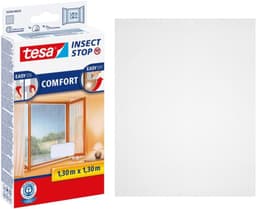
Lay the mesh on the tape and press it taut, not drum-tight. tesa’s window pages say a cut-to-size sheet is trimmed after it is on. Scissors are the tool reviewers prefer. The white 130 cm Comfort square, at £14.61, is the listing that clearly includes a pressing device. Trim after the mesh is stuck, and leave a little spare so the edge does not fray.

Leave a way to the handle

A sheet across the whole inside face blocks the handle. Leave a flap wide enough for your hand, and press it on again when the window is open. Reviews of the tall Comfort sheet describe that, and one report says a fixed mesh stops the window being used. If the casement swings outwards, a flap is not proof you can still lock the sash. That case is on fly screens for outward-opening windows. Close and lock once before you trim the last edge. A magnetic curtain is not fitted like this. That product is on window sheet or magnetic door curtain.

When fitting should stop

Stop if the only surface is loose paint, textured render, or a rubber seal the tape has already left. Stop if a tenancy forbids adhesive. No-drill is not permission to stick tape to someone else’s uPVC. Stop if the window is an escape route you cannot clear quickly. In England, Approved Document B volume 1, paragraph 2.10, expects an unobstructed opening of at least 0.33 m² and at least 450 mm by 450 mm, with the bottom no more than 1,100 mm above the floor, and the sash must stay open without being held. Scotland, Wales, and Northern Ireland use their own rules.

The order that keeps the window usable

If the frame is clean, dry, and flat, stick the tape corner to corner, press the mesh, and trim only after you have closed and locked the sash. If the lock will not throw, or the only face is a rubber seal, take the tape off. If the sash opens outwards, treat a flap as a test, not as a finished fit.

Common questions

What should I clean the frame with?
Use an alcohol wipe on the face where the tape will sit, then let it dry. DIY Flyscreens treats dirt or texture as the usual reason tape lets go. Everest says not to use white spirit, methylated spirits, or WD-40 on uPVC, so do not turn a wipe into a soak with meths. Loose paint and old silicone are poor surfaces.
Can I overlap the tape at the corners?
No. Butt the strips at the corner. An overlap makes a lump, the mesh does not press flat, and that corner peels. The same rule applies on sound uPVC, aluminium, and painted wood. If the strip is too short to meet, buy another set.
Should I use scissors or the plastic cutter?
Scissors. Reviews prefer them to the supplied plastic cutter on a fine mesh. Open/Close names a pressing brush and a cutter, and the 130 cm Comfort square includes a pressing device. The tall Comfort sheet’s components field only says one item, so a cutter in a review is not a promise for every box.
When do I cut the mesh?
After the tape is on the frame and you know the strip goes all the way round. Cutting the net in half first is how people run out of tape. tesa’s Standard pages say the mesh can be trimmed. The 120 cm x 240 cm Comfort listing does not state cut-to-size, so do not slice that sheet as if it were a Standard net.
The tape will not stick. What now?
Take it off, clean the face again, and let it dry. A second layer on dust or a rubber seal will not rescue the first. Reviews report tape leaving a rubber seal and adhesive that holds poorly. Do not scrape uPVC with a metal blade. If the surface is loose paint, brick, or a seal, stop.

Related pages

Sources

Sources listed in the research digest. Listing prices are the amazon.co.uk figures stored for this set. A spot check on 15 October 2026 put one three-pack near £14.19, against £13.40 in the saved listing.

  1. tesa UK window fly screens (retrieved 15 October 2026)
  2. tesa UK Insect Stop Standard for windows (retrieved 15 October 2026)
  3. tesa UK Insect Stop Comfort for windows (retrieved 15 October 2026)
  4. tesa UK Insect Stop magnetic curtain (retrieved 15 October 2026)
  5. tesa PDF 55384, 55394, and 55374 (retrieved 15 October 2026)
  6. Approved Document B, volume 1, dwellings (retrieved 15 October 2026)
  7. Consumer Rights Act 2015, section 9 (retrieved 15 October 2026)
  8. Streme window and door screen help (retrieved 15 October 2026)