Independent comparisons. We may earn from shop links. More info

Hedge plants buying guide: height before star ratings

Updated: October 2026

You have measured a boundary, a failed box edge, or a view from next door, and the amazon.co.uk sort is already leading with stars and pack price. A hedge plants buying guide for this basket has to start with the finished height, because the four listings are not one plant. Green Spire stays about knee to waist height. Red Robin and firethorn become a tall screen only if you keep clipping them. The [hedge plants comparison](/hub/hedges-and-privacy-screens/hedges-plants) holds the cards, the pounds, and the ratings. This page is the order of decisions: the job, then what is actually in the box, then whether a plant that can pass 2 metres is a complaint waiting for a neighbour. A qualifying purchase can earn us a commission at no extra cost to you. We compared those listings and public UK sources. We did not run a nursery trial.

You have measured a boundary, a failed box edge, or a view from next door, and the amazon.co.uk sort is already leading with stars and pack price.

Our top picks

On this page

Three jobs, not one best plant

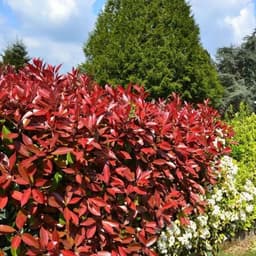
The first split is the job, not the star rating. A low edge, a winter screen, and a thorny boundary are three different plants in this set, and the Royal Horticultural Society treats evergreen hedges as winter cover that needs more trimming than a deciduous row. If you want a neat green line along a path or a replacement for a tired box edge, Green Spire is the plant that matches. The RHS profile gives it a maximum of 0.5–1 m and a spread of 0.1–0.5 m, in full sun or partial shade, in a sheltered spot. Both amazon listings say up to 15 cm a year and no flowers. If the job is a screen that still has leaves in January, the photinia 6-pack is the listing that can grow into one. Unclipped Red Robin is 4–8 m on the RHS profile, with a spread of 2.5–4 m, and the society notes it is prone to leaf spotting in a cold wet winter. Firethorn is the third job: a boundary or a wall that becomes thorny and, on older wood, berrying. The Carbeth bullets sell security hedging and do not mention thorns. The best hedge plants page names who should take each pick and who should skip it.

What arrives in the box

Finished height on an RHS profile is not the height in the parcel. The Green Spire 6-pack is about 22 cm on arrival at about £21.25, with the same 0.5–1 m ceiling. The single plant is a 1 litre, 13 cm square pot at about £16.15: 24 cm of plant, 36 cm if you include the pot. You pay more per plant for a named pot, not for a taller hedge. If the run is more than one gap, the 6-pack is the listing that matches a short edge. The photinia pack is six plants in 9 cm pots at about £23.99. The seller says they cover about 2.5 m of hedging. That figure is a run length, about one plant every 40 cm, not a mature height and not a screen you can stand behind this year. The 9 centimetres attribute is the same number as the pot. The pyracantha is about £10.99 with a height attribute of 20 cm. One review says about 10 cm, pot-bound, with mainly yellow leaves. Green Spire is full sun or partial shade on the listing, which agrees with the RHS. The photinia and the firethorn listings say partial shade only.

The 2 metre test

A plant that can reach 4–8 m is how a screen becomes a complaint, so the law sits after the parcel, not before the species choice. In England and Wales the Anti-social Behaviour Act 2003, section 66, is about a high hedge: a barrier to light or access, wholly or predominantly two or more evergreen trees or shrubs, more than 2 metres high. GOV.UK’s complaint checklist adds that the hedge must be on someone else’s land. The council cannot order removal, a killing cut, or a trim below 2 metres. Your own hedge is not automatically illegal at 2.1 m. Scotland’s High Hedges (Scotland) Act 2013 also covers deciduous hedges. Northern Ireland’s High Hedges Act (Northern Ireland) 2011, section 2, follows the evergreen test. Green Spire’s RHS maximum is 1 m, so that cultivar does not grow into this complaint on the profile figure. Unclipped photinia or pyracantha can. The pair-by-pair argument, low edge against red new growth, is on Green Spire or photinia.

What to leave off this shortlist

This comparison stops at three species and four listings. Cherry laurel, privet, yew, Leylandii, and trough hedging are other pages or other shops. Do not import their prices or their best-for-privacy labels onto an about £21.25 euonymus 6-pack. Disease resistant on the Green Spire 6-pack is seller wording. The plant is not Buxus, so box blight and the box tree caterpillar are not its diseases. It can still get euonymus scale or mildew, and the RHS says it is harmful if eaten. USDA zones 6–9 on the Green Spire pages are not an RHS rating. The photinia listing says hardy and suitable for UK gardens and gives no temperature. If you need thorns, the wrong buy is either Green Spire. The about £10.99 firethorn is the thorny listing, and it is still a young plant.

Common questions

Will Green Spire hide a first-floor window?
No. The RHS maximum for Euonymus japonicus Green Spire is 0.5–1 m, and both listings in this set repeat a slow yearly increase of up to 15 cm. A first-floor window needs a plant that can be kept as a tall screen, which in this basket is photinia or, once grown, firethorn. Buying the 4.8-star 6-pack for an upstairs view spends about £21.25 on the wrong height.
Do six small Red Robin plants make a screen this year?
They make a short row of small plants. The seller says six 9 cm pots cover about 2.5 m of hedging, which is a spacing claim, not a finished height. Reviews describe tiny shoots. The RHS ultimate height of 4–8 m is what an unclipped Red Robin can become over years, at up to about 30 cm a year, if you keep cutting it. It is not privacy in the first season.
Is a hedge over 2 metres illegal?
Not by itself. In England and Wales a neighbour can complain when a row of two or more mostly evergreen trees or shrubs on your land is a barrier to light or access and is over 2 metres. The council cannot order you to remove it, to cut it so hard that it dies, or to take it below 2 metres. A hedge you own is not automatically against the law at 2.1 m.
Does Scotland treat a deciduous hedge the same way?
Scotland’s High Hedges Act also covers deciduous hedges, so a leafy row can fall inside a complaint there. England, Wales, and Northern Ireland use an evergreen test: the row must be wholly or predominantly evergreen. A beech or hornbeam hedge is outside the English high-hedge definition and can still be inside the Scottish one. Green Spire, photinia, and firethorn are evergreens, so the evergreen test can apply to them once they are tall enough.
Is disease resistant on the Green Spire 6-pack a promise about the soil?
No. It is seller wording on that listing. Green Spire is not box, so it is not a host for box blight or the box tree caterpillar. It does not sterilise blight left in the ground, and it can still suffer euonymus scale, mildew, or dieback in a cold wind. If the old edge died of blight or caterpillar webbing, clear the litter and do not assume the new plant has cleaned the bed.
Which listing is the wrong buy if I need thorns?
Either Green Spire listing. They are low, flowerless evergreens sold as a box-style edge, and the bullets do not describe a barrier. The Carbeth firethorn is the plant in this set whose species carries long thorns, even though this listing’s bullets omit them. At about £10.99 and about 20 cm, or about 10 cm in one review, it will not stop anyone on the path until it has grown.

Related pages

Sources

Public UK sources named below. amazon.co.uk prices, stars and review counts are from the four listings in this comparison. Page updated 21 October 2026.

  1. RHS, planting a hedge (retrieved 21 October 2026)
  2. RHS, Photinia × fraseri Red Robin (retrieved 21 October 2026)
  3. RHS, Photinia growing guide (retrieved 21 October 2026)
  4. RHS, Euonymus japonicus Green Spire (retrieved 21 October 2026)
  5. RHS, pyracantha growing guide (retrieved 21 October 2026)
  6. Anti-social Behaviour Act 2003, section 66 (retrieved 21 October 2026)
  7. GOV.UK, high hedges: complaining to the council (retrieved 21 October 2026)
  8. Wildlife and Countryside Act 1981, section 1 (retrieved 21 October 2026)