Independent comparisons. We may earn from shop links. More info

Dual fuel towel rail heating element

Updated: 16 October 2026

The boiler is off and the towels still come off damp. A dual fuel towel rail heating element heats that rail on its own, if the rail can take a rod and you keep the element and the boiler apart. This page is the valve and T-piece regime. A straight swap is on the [how to replace a towel rail heating element](/hub/heating/towel-radiator-heating-element/sub/towel-radiator-heating-element-how-to-fit) page. The eight listings are on the [towel radiator heating element comparison](/hub/heating/towel-radiator-heating-element). We did not fit a rail in a lab. A qualifying purchase through our links can earn us a commission at no extra cost to you.

The boiler is off and the towels still come off damp. A dual fuel towel rail heating element heats that rail on its own, if the rail can take a rod and you keep the element and the boiler apart.

Our top picks

Rica Rica 300W PTC element

Preis-Tipp

Rica Rica 300W PTC element
8.8/10about £26.50
Valdern Valdern 400W dual-fuel kit

Alternative

Valdern Valdern 400W dual-fuel kit
7.6/10about £31.99
On this page

What dual fuel is for

Dual fuel means the rail takes heat from the central heating in winter and from an element in summer. One heat source at a time is the rule from The Radiator Company and from towelradiator.co.uk. Not every wet rail can take a rod. The Radiator Company notes that some slim designer rails lack the depth. If the boss is absent, or a 250 mm element already meets the far wall, stop before you buy a kit. Thread and insertion length are on the buying guide.

T-piece, valves, and the air vent

A T-piece lets the element enter while the flow and return remain for winter. The Radiator Company's electric sequence is both valves fully off, the air vent eased, then the element on. The eased vent gives the heated fluid room to expand. towelradiator.co.uk states that an element running while the valves are open tries to heat the whole system and burns the rod out. When the heating season starts, switch the element off, close the bleed, and then open the valves. If the valves will not close, you do not have dual fuel yet.

The kit in this comparison

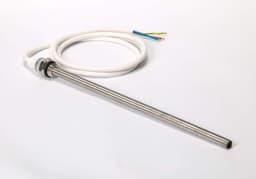
The kit in this set is the Valdern 400 W element, ASIN B08155B3HF, at £31.99. The box includes a T-piece and a blanking plug, the thread is stated as 1/2 inch BSP, and the listing states a 70°C cut-out. Reviewers report no timer, a failure at 33 days, and trouble with the pipe adapter. If you already own a T-piece, a separate 300 W element can be the cleaner match.

Element choice once the rail is isolated

With both valves shut and the vent eased, the Rica 300 W PTC listing, at £26.50, says the ceramic eases off near 65°C, and two reviews say a unit did not. The Greened House 300 W WiFi element, at £60, adds a 7-day schedule. A review says it senses the rail, not the room. towelradiator.co.uk warns that room-sensing controls fight a dual-fuel system. That is a retailer warning, not a statute. If the question left is app versus ceramic, use the WiFi towel rail element or PTC page.

Common questions

Can the element and the boiler run together?
Keep them apart. Dual fuel is one heat source at a time. Electric mode is both valves fully off, the air vent eased, then the element. Winter mode is the element off, the bleed closed, and the valves open. towelradiator.co.uk warns that an element running into an open system tries to heat the whole circuit and burns out. A Valdern reviewer describes switching the element off before the boiler starts.
What does the T-piece do?
It lets the element screw into the rail while the flow and return stay available for central heating. A dual-fuel valve can do that in one body. The Valdern 400 W kit at £31.99 includes a T-piece and a blanking plug, with 1/2 inch BSP stated. The T-piece does not isolate the rail by itself. You still close both valves before electric use. If the adapter misses your pipe, the fitting in the box is not yet a working joint.
Why ease the bleed screw?
The Radiator Company's electric sequence is valves fully off, air vent eased, then the element on. The eased vent gives the heated fluid room to expand while the rail is isolated. You close that bleed when you return the rail to the boiler, after the element is off. A shut vent on a closed rail, and open valves with the element running, are the two mistakes. The open-valve case is the one tied to a burnt-out rod.
Will a room thermostat element fight the system?
A control that senses room air can fight the central heating. towelradiator.co.uk says not to use a room-sensing element on dual fuel. That is a retailer warning, not a UK law against thermostatic heads. A Greened House review says that WiFi element senses the rail, not the room, which is closer to heating the rail. You still isolate the valves first. Rail sensing does not make open pipes safe.
Is the Valdern kit enough hardware?
It is enough when the 1/2 inch BSP thread fits, the rail has the depth, the adapter matches, and you accept the reviews. The box has the 400 W element, a T-piece, and a blanking plug, at £31.99, with a stated 70°C cut-out. Reviewers report no timer, a failure at 33 days, and a pipe-adapter problem. If you already have a T-piece, a separate element can be the simpler buy. The kit does not include the spur or the isolating habit.
What watts if the boiler already heats the rail in winter?
Size the element for summer drying. Elegant Radiators' retailer guidance suggests about 150–250 W supplementary on a 600–900 mm rail and 250–400 W on a 900–1200 mm rail. In this set that is a 300 W rod or the 400 W Valdern kit. The full choice, including a rail that is the only heat, is on the buying guide. Running the element and the boiler together does not add those watts safely.

Related pages

Sources

Public UK sources used for this comparison, plus the amazon.co.uk listings for these eight ASINs. Page updated 16 October 2026. Prices are the shelf figures on those listings, not a live re-check.

  1. IET Section 701 note (retrieved 16 October 2026)
  2. IET BS 7671:2018 FAQ (retrieved 16 October 2026)
  3. Approved Document P (2013) (retrieved 16 October 2026)
  4. Electrical Safety First: bathrooms (retrieved 16 October 2026)
  5. Ofgem price cap, 1 October to 31 December 2026 (retrieved 16 October 2026)
  6. Elegant Radiators heating elements guide (retrieved 16 October 2026)
  7. The Radiator Company dual-fuel guide (retrieved 16 October 2026)