Independent comparisons. We may earn from shop links. More info

Towel rail heating element buying guide

Updated: 16 October 2026

The rail is already on the wall, and the listings look interchangeable until the thread or the spur is wrong. This towel rail heating element buying guide keeps the order tight: thread and insertion length, then watts, then the bathroom zone and the fused spur, and only then any app or ceramic claim. The [towel radiator heating element comparison](/hub/heating/towel-radiator-heating-element) holds the eight listings, the shelf prices, and the star lines. This page does not name a top pick. Prices are the figures in those listing files, not a live re-check on 16 October 2026. A qualifying purchase through our links can earn us a commission at no extra cost to you.

The rail is already on the wall, and the listings look interchangeable until the thread or the spur is wrong.

Our top picks

On this page

Thread and how long the rod is

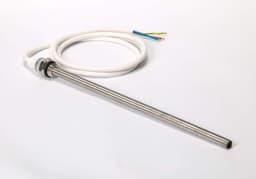
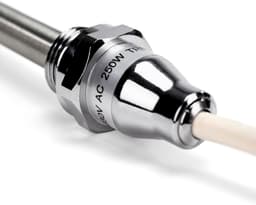
The rod has to enter the rail before wattage means anything. Greened House, Rica, Manissa, and Valdern state a 1/2 inch BSP thread. The Kudos-Trading file does not, so measure the old element or the boss before you assume every chrome rod matches. Length in these files runs from 250 mm on the Rica rod to 380 mm on the Manissa element and the Greened House 400 W element. A shorter rod can still heat if the thread matches and the element stays submerged. A rod that meets the far wall will not go in. The how to replace a towel rail heating element page covers the swap, including sealed rails you should leave closed.

Watts for drying towels or heating the room

This set's steps are 300 W and 400 W. On a 1,200 mm rail that only dries towels, 300 W is the lower step and 400 W is the step when the rail also warms the room. The Kudos-Trading element at £36.99 fights a single figure: the title says 250 W and the bullets also say 150–600 W. Stay with one stated wattage inside the band for your rail. Control comes after the spur, on the WiFi towel rail element or PTC page.

Zone, IP, and the fused spur

These listings call for a fused spur. A title that prints IP55 or IP64 is a listing claim we did not verify in a lab. The fuse follows the maker: Rica and Manissa say 3 A, and a UK Radiators sheet for a different element specifies a 5 A BS 1362 fuse. In England and Wales, a new circuit or a bathroom-zone alteration is notifiable under Approved Document P. The best towel rail heating element page then applies these gates.

What the listing price still does not tell you

Shelf price runs from £23 for the Manissa 300 W element to £26.50 for the Rica PTC rod, £31.99 for the Valdern kit, £36.99 for Kudos-Trading, and £60 to £65 for Greened House WiFi. Greened House prints a 110 mm lead, so the spur has to sit almost against the rail. Rica shows 4.4 from 138 reviews. Greened House 300 W shows 4.7 from 45, and the black ASIN repeats that text, so the two counts are one pool.

Common questions

Is 1/2 inch BSP safe to assume?
Only where the listing states it. Greened House, Rica, Manissa, and Valdern state 1/2 inch BSP in this set. The Kudos-Trading file does not. Measure the thread on the element you are removing, or confirm the boss, before you order. PTFE tape seals a matching thread. It does not convert another pitch into 1/2 inch BSP.
What watts suit a rail used only to dry towels?
Use the Elegant Radiators height table as retailer guidance, not as a British Standard. Supplementary heat there is about 150–250 W on a 600–900 mm rail and 250–400 W on a 900–1200 mm rail, higher if the rail is the only heat. This set's steps are 300 W and 400 W. On a 1,200 mm rail that only dries towels, 300 W is the lower step and 400 W stays inside that upper band.
Is IPX4 enough in zone 2?
The IET's note on Section 701 sets at least IPX4 for zones 1 and 2, and IPX5 if you clean with water jets, plus 30 mA RCD protection on bathroom circuits. IPX4 meets that zone 2 minimum when jets are not how you clean. An IP55 or IP64 line in a title is unverified here. WiFi or ceramic control does not relax the IP or RCD requirement.
Should the fused spur be 3 A or 5 A?
Follow the maker of the element in your hand. Rica and Manissa specify 3 A. A UK Radiators sheet for a different element specifies a 5 A BS 1362 fuse in a fused connection unit. No single amp rating covers every rod in this comparison. If your leaflet disagrees with a forum post, the leaflet wins, and a registered electrician fits the spur when you are not competent to.
Can I use a 13 A plug in the bathroom?
These listings are sold for a fused spur. A 13 A socket is permitted only at least 3 m horizontally from the boundary of zone 1. That distance rules out the usual spot beside a bath. Extension leads in a bathroom are a known hazard in Electrical Safety First's advice. A new spur in the bathroom zones is the sort of work Approved Document P treats as notifiable in England and Wales.
What does 300 W cost per hour?
Full-load 300 W uses 0.3 kWh an hour. Times Ofgem's 26.32 pence per kWh Direct Debit average for England, Scotland, and Wales, 1 October to 31 December 2026, that is about 7.9 pence. A 400 W element is about 10.5 pence on the same rate. Northern Ireland is outside this average. A schedule can cut the hours, which is not a measured percentage saving.

Related pages

Sources

Public UK sources used for this comparison, plus the amazon.co.uk listings for these eight ASINs. Page updated 16 October 2026. Prices are the shelf figures on those listings, not a live re-check.

  1. IET Section 701 note (retrieved 16 October 2026)
  2. IET BS 7671:2018 FAQ (retrieved 16 October 2026)
  3. Approved Document P (2013) (retrieved 16 October 2026)
  4. Electrical Safety First: bathrooms (retrieved 16 October 2026)
  5. Ofgem price cap, 1 October to 31 December 2026 (retrieved 16 October 2026)
  6. Elegant Radiators heating elements guide (retrieved 16 October 2026)
  7. The Radiator Company dual-fuel guide (retrieved 16 October 2026)