Independent comparisons. We may earn from shop links. More info

How to install an electric underfloor heating mat

Updated: 22 October 2026

You have the mat rolled out in the doorway and the tiler is asking whether to stick it down before the electrician arrives. How to install an electric underfloor heating mat is mostly about order: plan the free floor, test the cable, turn the mesh without cutting the element, set the floor probe, test again, then stop before the supply. This page follows 230 V self-adhesive mesh mats like those in our [electric underfloor heating comparison](/hub/heating/electric-underfloor-heating), not the 12 V vehicle film. Peter F. compared the listings on 20 October 2026. Nothing was tested in a lab. A qualifying purchase can earn a commission at no extra cost to you.

You have the mat rolled out in the doorway and the tiler is asking whether to stick it down before the electrician arrives.

Our top picks

On this page

Plan the free floor and test the cable before it sticks down

Mark baths, shower trays, WCs and fixed cabinets before you unroll the mesh. Do not heat under fittings you cannot walk on. The free-floor maths sits on the electric underfloor heating buying guide. Unroll the mat dry and compare the resistance with the label. An industry manual, not a HEATIT instruction, calls for a test before fixing, again before tiling, and after tiling, with live-to-neutral ohms within about five per cent of the label and no path to earth. That test is wasted if you cut the yellow element to force a fit. HEATIT and bolisi say the heating wire must stay whole. Only the mesh may be cut to turn a corner. If the reading is already out of tolerance, stop before adhesive.

Cut the mesh, never the element

Self-adhesive mesh mats in this set are 0.5 m wide. ThermoSphere’s installation notes show three legal moves: a 180° return along the wall, a 90° turn by cutting the mesh tabs, or releasing a short length of cable from the mesh for a small obstruction. Keep free cable at least about 50 mm from other runs. Do not cross cables, overlap them, or tape across the heating line. This set has mesh rolls only, so an awkward room may waste mesh area. A narrow en-suite may spend area turning strips. That is normal. Cutting the element to shorten the roll is not. If the mat is too long after you have stuck half of it, turn and plan the cold-lead route. Do not trim the wire.
bolisi bolisi 3 m² 200 W/m² mat

Testsieger

bolisi bolisi 3 m² 200 W/m² mat
7.0/10about £51.99

Set the floor probe, then test again before adhesive

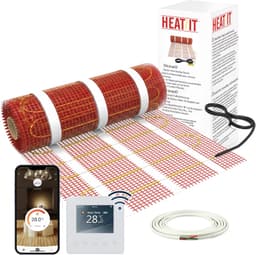
A floor-probe thermostat needs a sensor in the heated area, in a conduit between two cable runs, so it reads tile temperature rather than a draught. Bolisi’s three-square-metre listing is the only captured row with a two-metre sensor tube, and it still sells the thermostat separately. Other mats assume you supply conduit and probe with the controller. Route the cold lead to the back box the electrician confirms. Repeat the resistance test after the mesh is fixed and before adhesive covers the cable. Record the reading. If it has moved beyond the label tolerance, find the damage before tile. A 500 V insulation test is an electrician’s instrument, not a DIY buzzer. Cure time before switch-on belongs to the adhesive maker. Do not copy one brand’s ten-day rule onto another listing.

Stop at the connection

Lay and test the mat. An electrician connects it. BS 7671 commentary for floor heating expects 30 mA RCD protection, and Voltimum and Professional Electrician repeat that point. In England, Approved Document P makes a new circuit notifiable in any room, and work in a bath or shower zone is notifiable even on an existing circuit. Scotland and Northern Ireland set their own rules. If a council sheet clashes with Approved Document P, ask building control. Call an electrician for a new circuit, a consumer-unit change, bathroom-zone work, a load near the controller limit, or a resistance reading that misses the label. A damaged element may be rejoined with a maker kit fitted by an electrician. None of these listings includes that kit. Insulation boards are absent from every box, yet Heat Mat and BN Thermic recommend them against downward loss.

Common questions

Can I cut the mat to length?
You can cut the mesh to turn corners. You cannot cut, shorten, overlap or cross the heating cable. The captured listings are explicit on that point.
How do I turn a 0.5 m mesh around a corner?
Use a 90° mesh cut, a 180° return along a wall, or release a short length of cable from the mesh for a small offset. Keep a gap of about 50 mm between live runs, and do not let the cables cross.
When do I test the cable?
Before fixing, after fixing and before covering, and after tiling if your manual or electrician requires a final check. Compare ohms with the label and record the value. A reading already out of tolerance in the box is a reason to stop before adhesive.
Where does the floor sensor go?
Between two cable runs in the heated area, in conduit or the supplied sensor tube, so the thermostat reads floor temperature rather than hallway air. Bolisi is the captured row that includes a two-metre tube. The thermostat itself is still a separate purchase on that listing.
Can I tile and then call the electrician?
You can schedule tiling before connection, but the mat should already pass resistance checks and the sensor route should be agreed. Connection and RCD protection are not DIY steps in this guide.
Who connects the mat to the consumer unit?
A registered electrician. In England a new circuit is notifiable in any room, and work in a bath or shower zone is notifiable too. Even when an alteration is not notifiable on the Approved Document P test, the work still has to be safe.
What if the resistance does not match the label?
Stop. Do not cover the floor. Contact the supplier or an electrician. Do not cut or splice the element yourself. A repair kit, where a maker offers one, is electrician work, and none of these listings includes that kit.

Related pages

Sources

Public UK sources named below. amazon.co.uk prices, stars and review counts on these nine listings were taken from the listing files captured on 19 October 2026. Page updated October 2026.

  1. Approved Document P (2013) (retrieved 20 October 2026)
  2. IET Part P FAQ (retrieved 20 October 2026)
  3. Professional Electrician, heating cables (retrieved 20 October 2026)
  4. Voltimum, electric floor heating (retrieved 20 October 2026)
  5. Warmup StickyMat (retrieved 20 October 2026)
  6. BN Thermic, tiles (retrieved 20 October 2026)
  7. Heat Mat, measuring up (retrieved 20 October 2026)
  8. Quick-Step UK laminate FAQ (retrieved 20 October 2026)