Independent comparisons. We may earn from shop links. More info

Patio ceiling heater or infrared panel

Updated: 22 October 2026

You are looking at two products that share a search and almost nothing else. One is a halogen tube that glows over a patio seat. The other is a flat panel meant for a room, sold with ceiling in the title. Choosing a patio ceiling heater or infrared panel is that split: where the heat has to land, and what the weather rating on the listing actually is. The [ceiling heater comparison](/hub/heating/ceiling-heater) names the six ASINs and the prices. This page makes one choice. A small ceiling light is a third family, on the [ceiling heater buying guide](/hub/heating/ceiling-heater/sub/ceiling-heater-buying-guide), not a slim panel. A qualifying purchase can earn a commission at no extra cost to you. No figure below is a measured saving, and no IP code here was proved in a lab.

You are looking at two products that share a search and almost nothing else. One is a halogen tube that glows over a patio seat. The other is a flat panel meant for a room, sold with ceiling in the title.

Our top picks

On this page

Two heats, one search

Energy Saving Trust puts the difference in plain language. Infrared panels for the home do not glow, and they are less intense than the glowing elements used on patio heaters. A Department for Energy Security and Net Zero literature review places domestic panels in the far-infrared band. Short-wave emitters run much hotter and are a different application. The review does not certify a household saving you can quote as a percentage. A watt on the meter is still a watt. A halogen tube is directional. You feel it on skin and clothes while it is on, in the line of the element, and you see the orange glow. A far-infrared panel is for surfaces and people in a closed room, without that patio glare. Infrared Heaters Direct, writing about their own range, make the outdoor point directly: a panel’s output does not offset cold air on an open patio, which is why quartz or halogen is the outdoor tool. That is a shop explainer, not a test of the Hocosyme panels. At the Ofgem cap for 1 October to 31 December 2026, 26.32 pence per kWh in England, Scotland and Wales, an hour at 2,000 W is about 53 pence and an hour at 1,000 W is about 26 pence, before the standing charge. The tube costs more per hour because it draws more. Wind on an open side is why the tube’s job is a covered seat rather than a whole garden.

When the patio tube is the right tool

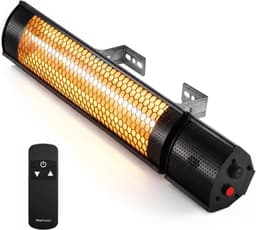
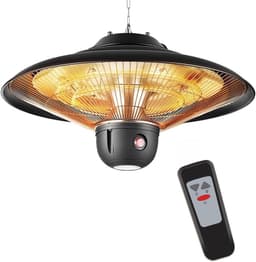
Use the tube when people are sitting still under a cover, for the length of a meal or a conversation, and you can point the heat at them. In this set that is the Pro Breeze at about £79.99 or the Donyer Power at about £95.99, both with a 2,000 W top step. Reviewers describe heat within seconds, including on a lower setting, on balconies, under pergolas and gazebos, and in garages. Some Pro Breeze comments put a useful feel at about 2 m to 2.5 m on a small patio. The same people say wind strips it away. An open lawn, with no roof and a breeze, is a poor match even at 2,000 W. Donyer prints IP24. That is splash, not driving rain, even though a bullet says rain or snow. Pro Breeze prints IP65 and tells you to use an IP65 outdoor socket. UK reviews say the box or the instructions contradict outdoor rain use. Electrical Safety First says the patio heater stays outdoors, on an outdoor socket, and not on an extension lead. A covered pergola in a dry spell is the honest job. Skip the tube when the room is a living room or a bathroom. Who should open which of the two listings, given 4.1 from 316 against 3.7 from 243, is the best ceiling heater page.

When the panel is the right tool

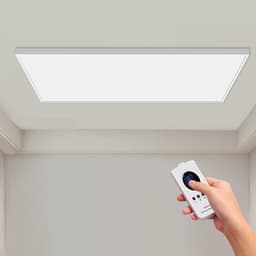
Use a panel when the space is an indoor room, the ceiling or wall can take the weight the manual states, and you want heat without a glowing tube over the sofa. A 1,000 W panel is a different tool from a 2,000 W halogen. The retailer rule of thumb of about 50–60 W per square metre, in a well-insulated room, is only a prompt. At 50 W per square metre, 1,000 W is the band for about 20 square metres if the room is well insulated and the height is ordinary. Poor insulation or a tall ceiling moves that. It is not a promise, and it is not a reason to believe a listing highlight of 10–25 m². Far infrared does not earn a health claim. One Hocosyme bullet says the radiation does not dry skin, kills bacteria and speeds wound healing. That is seller copy. The DESNZ review does not hand you a certified bill saving either. Specialist ceiling panels on another shop, Ecostrad’s Accent IR range, were about £199.99 to £309.99 and were sold as IP54 units to be hardwired. They are not the amazon.co.uk rows here. A bathroom zone is a further limit, on the bathroom ceiling heater page.

What this comparison’s listings actually say

The outdoor pages and the panel pages do not line up as IP65 outside and IP24 inside. IP24 is on the Donyer ceiling tube, which is the outdoor listing. IP65 is a claim on the Pro Breeze outdoor listing, disputed in reviews. IP54 is a claim on both Hocosyme panels. A higher code on a patio title does not make that title proven. Donyer, B088WTXXDK, is the outdoor listing with ceiling in the mounting field, three heat steps, IP24, and 3.7 from 243 reviews. Early failure and melted switches are repeated in the sample. The flex is 39.37 inches. The spec line’s 14 A does not match 2,000 W. Pro Breeze, B08GFVSDP1, is about £79.99, 4.1 from 316, steps of 1,000 W and 2,000 W, a ceiling-or-wall bullet, and a wall-mount field. The 182 cm flex is called short. Hocosyme B0H2XJN5Y5 is about £149.99 with a thermostat. Hocosyme B0H2Y97JL4 is about £159.99 with Tuya named, and Alexa is not in the bullets. Both say 1,000 W and IP54. Both mounting fields say wall. Both titles say ceiling. One prints 17.2 kg and the other 7 kg on a body listed as 595 × 22 × 1,195 mm. Neither has a Customer Reviews line. For people outdoors under a cover, choose a patio tube, and treat the Pro Breeze review file as the stronger of the two outdoor pages only after you have accepted the wall field and the IP65 dispute. For a dry indoor room, choose a far-infrared panel whose mount lines agree, which these two Hocosyme pages do not. Do not put the panel on the patio, and do not put the tube in the lounge.

Common questions

Which one heats people outdoors?
The glowing halogen tube. In this set that is the Pro Breeze or the Donyer, at up to 2,000 W, aimed at people under a cover. Reviewers feel it quickly and lose it in wind. A far-infrared panel is the indoor tool. Shop guidance and Energy Saving Trust both treat the patio element as the more intense, glowing source.
Which one is for a room?
The panel, if you can confirm how it mounts. It does not glow in the way a patio tube does, and it is the product Energy Saving Trust distinguishes from patio elements. The Hocosyme listings say 1,000 W and claim 10–25 m². That area is the seller’s highlight. There are no reviews on either panel in this file.
Why does a panel fail on an open patio?
The output is the wrong shape for cold moving air. A panel warms a closed room. It does not throw a tight beam of short-wave heat at someone on an open seat the way a halogen tube does. Wind removes what little you feel. Cover and still air are the tube’s compromise, and even then reviewers say a breeze wins.
Does far infrared use less electricity per watt?
No. A watt drawn is a watt on the meter. A 1,000 W panel costs about half as much to run for an hour as a 2,000 W tube because it is half the load, about 26 pence against about 53 pence on the current Great Britain cap, before the standing charge. That is not a percentage saving certified for far infrared.
Is IP65 the outdoor choice and IP24 the indoor one?
Not in this set. IP24 is printed on the Donyer outdoor tube. IP65 is a claim on the Pro Breeze outdoor tube, and reviews say the packaging disagrees. IP54 is the claim on the indoor Hocosyme panels. Read the code that is printed, then read whether reviews or the manual contradict it.
What if the panel listing also says wall mount?
Believe the clash. Both Hocosyme titles say ceiling, both fields say wall, and the weights disagree at 17.2 kg and 7 kg. Until the manual in the box picks one fixing, you do not have a ceiling panel you can hang. A ceiling light is a third product, not a panel: the Lpoppcx states 400 W and belongs on the buying guide.

Related pages

Sources

Public UK sources named below. amazon.co.uk prices, stars and review counts on these six listings were taken from the listing files read on 20 October 2026. Page updated October 2026.

  1. Ofgem price cap, 1 October to 31 December 2026 (retrieved 20 October 2026)
  2. SELECT, BS 7671 Section 701 bathroom guide (retrieved 20 October 2026)
  3. NICEIC bathrooms and electrics (retrieved 20 October 2026)
  4. Electrical Safety First patio heaters (retrieved 20 October 2026)
  5. Energy Saving Trust, infrared heating explained (retrieved 20 October 2026)
  6. DESNZ infrared heating review (retrieved 20 October 2026)
  7. Ecostrad Accent IR ceiling panels (retrieved 20 October 2026)
  8. Heat Outdoors hanging-lamp manual (retrieved 20 October 2026)