Underfloor heating actuator: what it opens on a cold loop

An underfloor heating actuator opens one wet loop on the manifold. See why one room stays cold, and match voltage, thread and normal state before you buy.
On this page
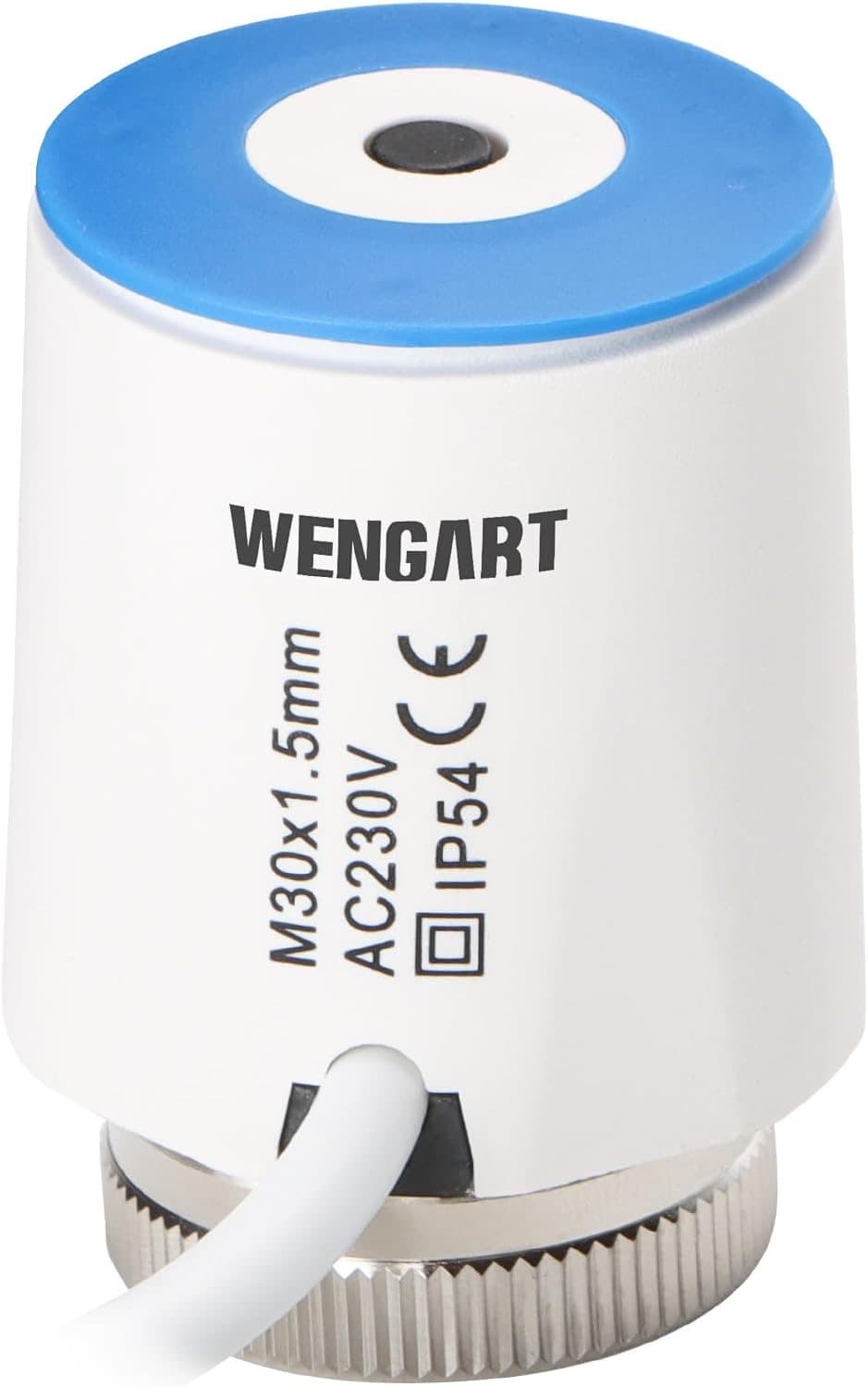
The bedroom floor is still cold, and the bathroom next door is already warm. In the airing cupboard a brass manifold carries a white head on each port, with a flow gauge beside it. That head is the underfloor heating actuator. It lets water into one loop, or it keeps the water out. The mixer, the pump, and the valve from the boiler each have their own job.
If only one room is cold, start with that head and the wiring centre that should feed it. In our underfloor heating actuator comparison, a captured amazon.co.uk listing at £9.71 never states a voltage. The RIMEX listing at £12.95 prints 230 V, normally closed, and an M30 thread.
In short
An underfloor heating actuator is the powered head on one loop of a wet manifold. When the thermostat calls, the wiring centre feeds that head, and a normally closed valve opens once the head has warmed. Flow gauges, the boiler zone valve, and electric foil are separate parts. If the pin is seized, stop.
The loop, the manifold and the head
Wet underfloor heating sends warm water through a pipe in the floor and brings it back to the manifold. Multipipe puts the actuator on the return pin for that loop. VPS describes one head per loop, held normally closed until it is powered. The spare-bedroom head leaves the kitchen loop shut.
Nu-Heat treats the actuator as the gate and the flow gauge as a separate setting, in litres per minute, once the gate is open. Turning the gauge does not power the head. If the bobbin sits at the bottom and you wind the gauge shut, you can close a loop that was only waiting for the valve to lift.
Wunda puts flow temperature at the mixer, before any head sees the water. The mixer blends one temperature for the manifold. The bedroom head only decides whether that water enters the bedroom pipe. If every room feels the same lukewarm, look at the mixer and the boiler, not at one spare head.
The RIMEX ZL-2033, ASIN B075HNRZQ4, prints M30 x 1.5 and a 4 mm stroke. Your old nut is the measurement that counts. A head that sits proud never reaches those few millimetres. If one port feeds the back bedroom and the ensuite, a new head there will not warm the kitchen.
What happens when the room calls for heat
The thermostat does not speak to the actuator by itself. Multipipe's cupboard is the ordinary one: the thermostat calls, and the wiring centre opens the actuator. A new dial cannot warm the floor if that zone's output never switches.
These heads are thermal. The RIMEX listing states about three minutes to open, 1.8 W once running, and inrush up to 300 mA. The Wengart WG2208 blue head states three to five minutes and 2 W. Wait that long before you call the head dead.
A powered shell becomes warm. The pin underneath can still be stuck. Ten minutes of a warm head, with the next loop flowing and this gauge at the bottom, is a seized pin. A shell that stays at cupboard temperature can be a healthy head that never received power.
Normally closed, as VPS describes it, stays shut with no power. A normally open head does the reverse, so the room can heat while the thermostat is satisfied. Copy NC or NO from the old label. The longer split is on normally closed and normally open actuators.
Some centres switch 230 V and some switch 24 V. A 24 V head on 230 V is the wrong part, and it is unsafe. A 230 V head on 24 V will sit there and do nothing useful. That split is the 230 V and 24 V actuator comparison. Two-wire is the common pattern. An end switch is a different circuit.
The RIMEX listing describes a red spot. The Wengart blue head lists a red stroke indicator. The Heatmiser-titled listing at £9.71, ASIN B00BI0QL8Q, states neither an indicator, a voltage, a thread, nor normally closed. Its manufacturer field reads Prowarm and its model field reads THERMALACTUATOR, at 4.6 from 65.
One cold room
If every underfloor room is cold, water may never be reaching the manifold. Check the zone valve on the primary, the pump, whether the boiler is firing, and the mixer. One new head cannot open a primary valve that has never moved.
One cold room, with the others warm, is the pattern this part belongs to. The neighbours have shown that the mixer is passing water. You are left with that zone's call, its wiring-centre output, the head, the pin, or a gauge wound shut. Trapped air or a kinked pipe can look the same. A new head does not bleed a loop.
- Turn that room's thermostat above the air temperature and wait at least ten minutes, past an opening time of about three minutes.
- Compare this flow-gauge bobbin with a loop that is heating. A bobbin at the bottom can mean the valve is shut, or that the gauge was closed on purpose.
- If the head has a mark, see whether it has travelled. If the listing never gave an indicator, leave the cap alone.
- Feel the shell. A powered head becomes warm at about 2 W. A shell still at cupboard temperature means power may never have arrived.
- If the pin does not move, stop. John Guest treats a seized actuator or zone valve as a plumber or electrician's job.
The warm loop next door proves water is at the manifold. It does not prove this pipe is clear, or that it serves the room you think it does.
What not to buy by mistake
Underfloor heating foil is a mat or loose wire under the floor finish, on its own thermostat. There is no manifold pin for a head to drive. If the floor is foil, an actuator has nowhere to screw. Insulation under the mat, and a probe you can still pull out, belong to that system.
A zone valve sits on the larger primary pipe, often with a lever and a switch that tells the boiler it has opened. The actuator is the smaller head on one manifold port. A new bedroom head does nothing if the zone valve never opens. A new zone valve does nothing for one dead head while the other loops heat.
Captured amazon.co.uk prices put B00BI0QL8Q at £9.71 and RIMEX B075HNRZQ4 at £12.95. The cheaper listing omits voltage, thread, and normally closed. The RIMEX listing states 230 V AC, normally closed, M30 x 1.5, about three minutes, 1.8 W, IP54, and a 0.5 m cable. Reviews include failures within one to three years, against 4.4 from 168.
The top pick, for a 230 V normally closed M30 loop with IP54 and a stated open time, is the Wengart WG2208 blue head at about £10.99, rated 4.5 from 48. Stroke in millimetres is not stated. It is wrong for 24 V or a nut that is not M30. Match voltage, fail position, thread, and two-wire or an end switch. One cold room needs one head.
A seized pin is not a job for pliers
Take a head off only when the pin still moves and springs back. If it stays down, leave it. A bent pin will not seal, and the job becomes a drain-down.
Photograph the old label: voltage, NC or NO, and any thread still readable. Photograph the wiring-centre voltage, which room is cold, whether the shell warmed in ten minutes, and whether the next gauge was flowing.
Pulling cores in the centre is work on a live circuit, and this page is not a wiring diagram. If the four facts match and the pin is free, the swap is in replacing an underfloor heating actuator. If the pin may not have returned, book a heating engineer.
Products Compared did not bench-test actuators. The cupboard checks follow Multipipe, VPS, Nu-Heat, Wunda, and John Guest. Prices and review lines are captured amazon.co.uk listings, updated October 2026. A qualifying purchase via amazon.co.uk (tag pcuk26-21) may earn a commission at no extra cost to you.
Common questions
What does an underfloor heating actuator open?
Is an actuator the same as a boiler zone valve?
Why is only one room cold on wet underfloor heating?
Can I swap the underfloor heating actuator myself?
How is a manifold actuator different from electric foil?
What are the flow gauges on the manifold for?
Does the room thermostat wire straight to the actuator?
Who should replace a seized manifold pin?

Products Compared publishes British-English buying guides based on amazon.co.uk listings and public UK sources. We do not run a lab and we do not invent test scores.
Related articles

Electric underfloor heating foil: checks before you lay it
Foil has no manifold actuator. Check insulation and whether the floor probe can still be replaced.

Towel radiator cold at the top: pipes before a key
A rail that is hot only at the bottom is a different fault from one cold loop on a wet manifold.

Condensation on cold walls: what to check before a heater
A cold corner can be moisture and poor ventilation. Another heater is not a damp survey.