Independent comparisons. We may earn from shop links. More info

Ear plugs for concerts

Updated: 21 October 2026

Ear plugs for concerts are filtered plugs, not a weaker version of a site muff and not a roll of foam you tolerate. In this amazon.co.uk set the two music listings are Hearprotek HP16 at £15.19 and Alpine MusicSafe Pro at £22, and they do not share one number. Cups at 34 or 35 dB stay on the tool pages. The cards are on the [ear protection comparison](/hub/hearing-protection/ear-protection). Peter F. used RNID, the Alpine UK product page and these listings on 20 October 2026. We did not meter a venue. A qualifying amazon.co.uk purchase can earn a commission at no extra cost to you.

Ear plugs for concerts are filtered plugs, not a weaker version of a site muff and not a roll of foam you tolerate.

Our top picks

3M 3M corded earplugs

Best overall

3M 3M corded earplugs
9.2/10about £14.43
Alpine Alpine MusicSafe Pro

Alternative

Alpine Alpine MusicSafe Pro
9.2/10about £22
Hearprotek Hearprotek HP16

Rank 3

Hearprotek Hearprotek HP16
9.0/10about £15.19
On this page

What a concert plug is for

A concert plug lowers the show and leaves the music recognisable. RNID describes damage risk from about 85 dB, with safe time roughly halving for each extra 3 dB, and a 100 dB show can be damaging in about 15 minutes. Filtered plugs are what RNID prefers over foam when you still want the band. The Optime III states 35 dB, and the 34 dB muffs will blunt a mix. Custom moulded plugs are not in this set. Fitting is on how to wear ear protection.

Hearprotek in this set

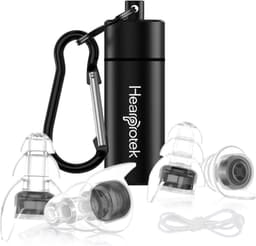
Hearprotek HP16 is £15.19, 4.3 from 1,880 reviews, and attenuation, SNR and NRR all state 23 dB. The bullets say two sizes, a cord and an aluminium case. The included-components field says No. The case is awkward in a dark venue. Reviews include a poor seal and itch. Try both sizes before the doors. Skip it if the case already annoys you.
3M 3M corded earplugs

Testsieger

3M 3M corded earplugs
9.2/10about £14.43

Alpine’s filters

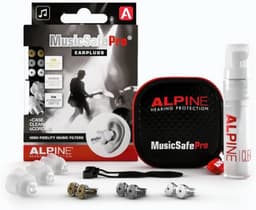
Alpine MusicSafe Pro is £22, 4.4 from 4,514 reviews. The bullets offer filters at 16, 19 and 22 dB. Alpine’s UK page lists the same three and a maker price of £25.95, which is not this shelf price. The amazon fields also print 22, 20 and 19 dB. Quote the filter you fitted, not one SNR. High frequencies drop. The bullets say no silicone and the material field says plastic. Skip it when you need one workplace figure.

What else still matters

Plugs do not move you from the speakers. RNID still pairs them with distance and about five quieter minutes in an hour. If you forgot the case, take the venue foam. These files do not state UKCA on either music ASIN. Sudden hearing loss is an urgent GP or NHS 111 matter. Tinnitus with facial weakness, vertigo or a head injury is A&E or 999. A tool, rather than a song, belongs on the ear protection buying guide.

Common questions

What is the difference between Hearprotek and Alpine in this set?
Hearprotek is £15.19, one stated 23 dB, two sizes and an aluminium case, with 4.3 from 1,880 reviews. Alpine is £22, three filter strengths in the bullets, a pouch, and 4.4 from 4,514 reviews, with extra spec fields at 22, 20 and 19 dB. Choose Hearprotek for a single number and a case. Choose Alpine if you will swap filters and you will not collapse those numbers. Both depend on fit, and both have reviewers who could not get a tip to suit them.
Which Alpine number is the SNR?
There is not one. The bullets say filters at 16, 19 and 22 dB. The SNR field says 20 dB, the NRR field says 19 dB and the attenuation field says 22 dB. Alpine’s UK page agrees with the three filter strengths and is not a reason to delete the amazon conflict. Quote the filter you are wearing, and mention the other printed figures if you are comparing listings. Do not use the maker’s £25.95 as the amazon price.
Will a 34 dB muff do for a gig?
It will reduce sound, and it is the wrong tool for hearing a band. Floriogra at £9.99 and the two-pack at £18.98 state 34 dB. The Optime III states 35 dB for 95–110 dB(A). Those are construction-style listings, with headband and seal problems of their own. Use a filtered plug if the job is the mix. Use the muff when the job is a tool in that stated band. Owning one does not make it the concert pair.
What if I forget the plugs?
Use the foam the venue offers rather than going without. RNID treats that foam as the spare, and filtered plugs as the better way to keep the music intact when you remembered them. Move away from the speakers as well. A forgotten Alpine pouch is not a reason to wear 35 dB defenders for the whole set unless that is all you have and the alternative is nothing. Even then, expect a blunter mix.
Do I still need to stand back from the speakers?
Yes. Plugs lower the level at the ear. They do not change how loud the stack is, and RNID still pairs earplugs with distance and a short break. A 100 dB show can be damaging in about 15 minutes on RNID’s note, which is inside a single long song if you are against the PA. Filters at 16 dB and filters at 22 dB are not a substitute for that step back.
When is ringing after a gig a medical visit?
Sudden hearing loss needs an urgent GP or NHS 111. Tinnitus with facial weakness, vertigo, or after a head injury needs A&E or 999. Ringing alone, with hearing otherwise unchanged, is not something this page can grade. It is a reason to check that the plugs were in, to take the next break, and to stand further away. It is not a reason to buy a 34 dB muff on the way home and call the problem solved.

Related pages

Sources

Public UK sources named below. amazon.co.uk prices, stars and review counts are from the twelve listings in this comparison. Page updated 21 October 2026.

  1. Control of Noise at Work Regulations 2005, regulation 4 (retrieved 21 October 2026)
  2. Control of Noise at Work Regulations 2005, regulation 7 (retrieved 21 October 2026)
  3. HSE noise regulations (retrieved 21 October 2026)
  4. HSE hearing protection (retrieved 21 October 2026)
  5. HSE real-world hearing protection (retrieved 21 October 2026)
  6. UK designated PPE standards notice (retrieved 21 October 2026)
  7. NHS hearing loss (retrieved 21 October 2026)
  8. NHS tinnitus (retrieved 21 October 2026)