Independent comparisons. We may earn from shop links. More info

What SNR ear defenders do I need

Updated: 21 October 2026

You are about to mow the lawn or run a drill in the garage, and the pair with the highest SNR looks like the careful buy. If you are asking what SNR ear defenders do I need, match the task to a band, then choose a 3M PELTOR muff whose stated range sits in that band. Prices and the five listings are on the [3M ear defenders comparison](/hub/hearing-protection/3m-ear-defenders). This page does not name a winner. We used amazon.co.uk listings and public UK guidance, and we did not run a lab test. A qualifying purchase can earn a commission at no extra cost to you.

You are about to mow the lawn or run a drill in the garage, and the pair with the highest SNR looks like the careful buy.

Our top picks

Peltor Peltor X2A (X2AC1)

Alternative

Peltor Peltor X2A (X2AC1)
8.7/10about £33.95
On this page

The three UK noise numbers

At work, the Control of Noise at Work Regulations 2005 set three figures. The lower action value is 80 dB(A) and peak 135 dB(C): protection has to be available if an employee asks. The upper action value is 85 dB(A) and peak 137 dB(C): provide protectors, enforce wear, and mark a zone. The exposure limit is 87 dB(A) and peak 140 dB(C) at the ear. Only that limit counts the muff. Those duties sit on the employer. If you must shout at about two metres, HSE says the noise may already harm hearing.

The HSE SNR guide

HSE’s guide is for the task level when you have no assessment. Around 85–90 dB(A), look for an SNR of about 20 or less. Around 90–95, about 20–30. Around 95–100, about 25–35. Around 100–105, about 30 or more. Aim for roughly 70–80 dB(A) at the ear. Below about 70 dB, people lift the cups. If a saw manual sits in the 90–95 dB(A) band, SNR 27 and 31 are both in range, so 31 is not automatically safer.

Where the 3M listings sit

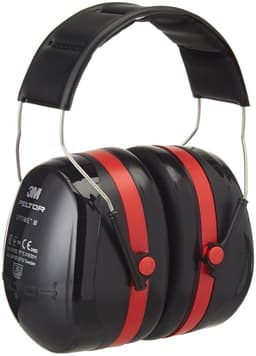
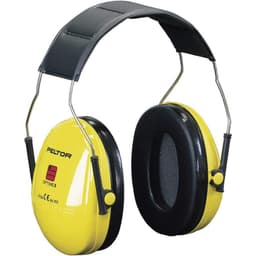
Optime I (B000VDYXQ8) is SNR 27 dB and 87–98 dB(A). X2A (B00EJIN6M8) is SNR 31 and 94–105 dB. X4A (B00BBCTQHY) prints 32 dB, 33 dB, and 32–33 dB, with no suggested band. Do not invent one. Optime III (B000VDX18E) says SNR 35 dB and 95–110 dB(A). The 3M UK page for H540A says SNR 34 dB under EN 352-1:2020. The best 3M ear defenders page names a top pick and a best-value pick. Do not add an earplug SNR to a muff SNR.

When the table is not enough

After a standard method has estimated the level at the ear, HSE says to add about 4 dB, because a lab SNR is optimistic. Add it to that estimated level, not to the SNR on the box. An estimate of 76 dB(A) becomes about 80 dB(A). Thick spectacle arms lift the cushion. How the seal fails is on the ear defenders with glasses page. The headband slide and the cushion interval are on the how to wear ear defenders page.

Common questions

What SNR do I need for a task around 90 dB(A)?
For a task around 90 dB(A), HSE’s guide points to an SNR of about 20, or the 20–30 band nearer 95 dB(A). The target at the ear is roughly 70–80 dB(A). Do not chase a level below about 70 dB(A). Optime I at SNR 27 sits in that 20–30 band. Its 87–98 dB(A) line is a shopper’s guide, not a meter on your tool.
Is a higher SNR always safer?
A higher SNR reduces more sound in the lab rating, and it can leave the ear so quiet that you lift the cups. HSE’s over-protection line is about 70 dB at the ear. SNR 35 on a short, moderate job is often too much, even though the same figure can fit a task around 100–105 dB(A). Safer means the level at your ear stays in range and the muffs stay on.
Do the 80 and 85 dB duties apply to DIY at home?
The 80 and 85 dB(A) action values, and the 87 dB(A) exposure limit, come from the Control of Noise at Work Regulations 2005. They bind employers, not a householder. RNID still treats repeated exposure at 85 dB and above as harmful, so the reason to wear a muff at home is real. It is a different duty from a marked zone at work.
Why do Optime III pages disagree between 34 and 35 dB?
The amazon.co.uk listing for ASIN B000VDX18E states SNR 35 dB and a band of 95–110 dB(A). The 3M UK page for H540A states SNR 34 dB and cites EN 352-1:2020. Both figures are what those pages publish. This guide does not treat the gap as a test we ran. A one-decibel difference is smaller than the effect of a broken seal.
When is the simple SNR table the wrong tool?
Use the four HSE rows for ordinary task levels. Set them aside for low-frequency plant, and for impulsive noise if people at work are exposed and the job has not been measured. The table is built for the level of the task, not an all-day dose. The extra 4 dB still applies after a standard estimate of the level at the ear.
Should I add an earplug SNR to a muff SNR?
An earplug SNR and a muff SNR are separate ratings. Adding them treats two lab methods as a single sum, which they are not. Double protection can be appropriate when one device is not enough, and that choice belongs in an assessment. If the muff seal is already leaking, a second number on a plug does not repair the cup.
What should I read in the power-tool manual before I buy?
Look for a stated sound pressure or sound power level, and for any line that tells you to wear hearing protection. That figure is the task clue you place on the HSE rows. It is not a measurement of your shed. If the manual is silent, use the shout-at-two-metres check as a rule of thumb only. Do not guess a decibel value.

Related pages

Sources

Public UK sources named below. amazon.co.uk prices, stars and review counts are from the five listings in this comparison. Page updated 21 October 2026.

  1. Control of Noise at Work Regulations 2005, regulation 4 (retrieved 21 October 2026)
  2. Control of Noise at Work Regulations 2005, regulation 7 (retrieved 21 October 2026)
  3. HSE, Hearing protection (retrieved 21 October 2026)
  4. HSE, real-world factors (retrieved 21 October 2026)
  5. 3M UK, Optime III H540A (retrieved 21 October 2026)
  6. 3M X series data sheet (retrieved 21 October 2026)
  7. 3M UK, WorkTunes Connect (retrieved 21 October 2026)
  8. 3M UK, HY54 hygiene kit (retrieved 21 October 2026)