Independent comparisons. We may earn from shop links. More info

How to use a torque wrench

Updated: October 2026

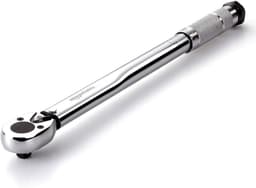
How to use a torque wrench, once you own a 3/8 inch click model, is a short sequence: set the marked value, pull until the first signal, stop, and leave the wrench at its lowest marked setting. Models are on the [best 3/8 torque wrench](/hub/hand-tools/torque-wrench-3-8-inch/sub/torque-wrench-3-8-inch-best) page. The ranges are in the [3/8 inch torque wrench comparison](/hub/hand-tools/torque-wrench-3-8-inch). The Products Compared editorial team wrote this on 16 October 2026 from the listing bullets and Park Tool’s use-and-care page. We did not torque a fastener in a lab. If you buy through our links, we may earn a commission at no extra cost to you.

How to use a torque wrench, once you own a 3/8 inch click model, is a short sequence: set the marked value, pull until the first signal, stop, and leave the wrench at its lowest marked setting.

Our top picks

On this page

Set the number on the scale you can read

Unlock the adjustment the way that listing prints it, line the mark up with the figure, and lock it before you pull. Auto Jack Tools’ CTW38 sheet says unlock the collar, line the graduations up, lock, and pull until the release. That example is in foot-pounds. Do not copy one collar onto all twelve wrenches. YIYEIE says push the collar up to adjust and pull it down to lock. SHINTOUR says pull the knob down, turn, then release. Amazon Basics says unlock, set, lock, and use the imperial scale for a precise set. If your spec is in Nm and the precise scale is foot-pounds, you are on the wrong barrel. The main scale carries the large steps and the sleeve the fine ones. ATsafepro’s 5–60 Nm wrench is in 0.5 Nm steps, and one reviewer still could not tell whether 10 Nm sat on the line. The figure comes from the vehicle or component maker. Which window can hold it is the 3/8 inch torque wrench buying guide.

One smooth pull, then stop

Seat the socket, keep the wrench in line with the fastener, and pull on the handle in one steady movement. Park Tool says the head deflects, and that deflection is the signal even when there is little noise. Stop at the first click or the first obvious movement. A second pull adds torque the click has already told you not to add. If there is no click, or the square is deforming, stop. Torque-plus-angle fasteners, and a wheel or brake bolt already overtightened, are where a professional should take over.

A faint click is a warning, not a cue to pull harder

ss shovan’s bullet says that at low torque you may feel the shaft bend instead of hearing a click, and that you should turn slowly. Its scale starts at 10 Nm. SHINTOUR says the click is faint below 5 Nm, where its scale begins. Park Tool says there may be little noise at low settings, and you stop at the deflection. If you are near the first marks and you feel nothing and hear nothing, do not lean until something gives. A carbon stem around 4–6 Nm is often on or below those marks. That job may belong on another drive, covered on torque wrench for bike or car.

Store at the lowest mark, and do not undo with it

Wind the adjustment back to the lowest figure printed on the scale. Norbar’s note, which this set follows, is the lowest marked setting, not an unmarked zero. Park Tool says the same. Amazon Basics and the INGJER bullets say return to the lowest setting. ss shovan names 10 Nm because that is its minimum. Do not turn the handle below the lowest mark. Do not undo bolts with it. Draper’s instructions say not to undo fasteners, and torque on 64534 is right-hand only. A reversible head lets you position the tool. It does not make the wrench a breaker bar. An extension changes reach. It does not increase the maximum Nm. If the wrench never clicks at a setting on the scale, set it aside. A 12-month interval is not a step in this sequence, and it is not a household law.

Common questions

How do you set a click wrench to a Nm figure?
Unlock the collar the way that wrench’s bullet describes, turn until the sleeve and the main scale meet the handbook figure, and lock before you pull. On Amazon Basics the precise scale is imperial. If you cannot read the mark, do not guess it.
What do you do the moment it clicks?
Stop. The first click, or the first movement of the head, means the set value has been reached. A second pull adds load. Park Tool treats the head movement as the signal even when the click is quiet.
Why is the click quiet near the bottom of the scale?
There is less spring load at the low end, so the release is smaller. ss shovan says you may feel the shaft bend. SHINTOUR says the click is faint below 5 Nm. Quiet is a reason to go slower, not to pull harder.
Should you unwind it to zero?
No. Store it at the lowest marked setting: 5 Nm on a scale that starts at 5, and 10 Nm on ss shovan. An unmarked zero is the opposite of the Norbar and Park Tool notes used here.
Can you loosen bolts with it?
Do not. Draper’s instructions say not to undo fasteners with the wrench. Crack a tight bolt with a normal ratchet, then use the torque wrench only for the final tightening in the direction it measures.
What if there is no click at all?
Stop, and do not finish the fastener by feel. Review samples here link a missing click to a snapped bolt. A wrench that never signals is a fault or the wrong end of the scale.
Why do some locks pull up and some pull down?
Each maker prints its own collar. YIYEIE is push up to adjust and pull down to lock. SHINTOUR is pull the knob down, then release. Amazon Basics says unlock, then lock, without matching those two motions. Follow the sheet in that box.

Related pages

Sources

Public UK and standards sources, plus the amazon.co.uk listings in this comparison. Page updated October 2026.

  1. ISO 6789-1:2017 (retrieved 16 October 2026)
  2. ISO 6789-2:2017 (retrieved 16 October 2026)
  3. Norbar: how often should I recalibrate my torque wrench (retrieved 16 October 2026)
  4. Norbar standard calibration terms (CL305) (retrieved 16 October 2026)
  5. Consumer Rights Act 2015, goods remedies (retrieved 16 October 2026)
  6. General Product Safety Regulations 2005 (retrieved 16 October 2026)
  7. HSE: PUWER overview (retrieved 16 October 2026)
  8. Cycling Weekly: torque wrench group test (retrieved 16 October 2026)