Torque wrench calibration certificate
The sheet has a serial number and sometimes says calibration certificate. It came with a 3/8 inch click wrench. A torque wrench calibration certificate a workshop can file is a UKAS calibration to BS EN ISO 6789-2:2017. The paper in these cases is a declaration of conformance under Part 1 unless the sheet shows that UKAS work. The ranges are in the [3/8 inch torque wrench comparison](/hub/hand-tools/torque-wrench-3-8-inch). Hand movements stay on [how to use a torque wrench](/hub/hand-tools/torque-wrench-3-8-inch/sub/torque-wrench-3-8-inch-how-to-use). The Products Compared editorial team wrote this on 16 October 2026. We did not send these wrenches to a laboratory. If you buy through our links, we may earn a commission at no extra cost to you.
The sheet has a serial number and sometimes says calibration certificate. It came with a 3/8 inch click wrench. A torque wrench calibration certificate a workshop can file is a UKAS calibration to BS EN ISO 6789-2:2017.
The sheet has a serial number and sometimes says calibration certificate. It came with a 3/8 inch click wrench. A torque wrench calibration certificate a workshop can file is a UKAS calibration to BS EN ISO 6789-2:2017. The paper in these cases is a declaration of conformance under Part 1 unless the sheet shows that UKAS work. The ranges are in the 3/8 inch torque wrench comparison. Hand movements stay on how to use a torque wrench. The Products Compared editorial team wrote this on 16 October 2026. We did not send these wrenches to a laboratory. If you buy through our links, we may earn a commission at no extra cost to you.
Our top picks
| Badge | Product | Marked range | Printed claim | Case paper | Note | Price | Offer |
|---|---|---|---|---|---|---|---|
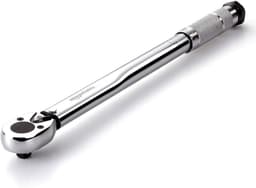
| Best overall |  ATsafepro ATsafepro AT215B001 5–60 Nm | 5–60 Nm | ±3% | Not shown as UKAS | 8.6 | about £25.99 | View offer |
| Preis-Tipp |  Amazon Basics Amazon Basics DS-DTW-3 20.4–108.5 Nm | 20.4–108.5 Nm | ±4% | Not shown as UKAS | 8.5 | about £19.99 | View offer |
| Alternative |  Draper Draper 64534 10–80 Nm | 10–80 Nm | No ±% in the listing | 2015 sheet in a 2017 review | 7.0 | about £36.41 | View offer |


On this page
The sheet is a declaration unless it says UKAS
A printed ±3% is a claim, not a lab result
Twelve months is a quality-system default
No click means stop, then the shop
Common questions
Is the sheet in the case a UKAS certificate?
What is the difference between ISO 6789-1 and 6789-2?
Does ±3% replace the standard’s ±4% or ±6%?
How often should a private user recalibrate?
What if the wrench never clicks?
Does a GS mark mean it was calibrated in Britain?
When do you need a signed uncertainty?
Related pages
Sources
Public UK and standards sources, plus the amazon.co.uk listings in this comparison. Page updated October 2026.
- ISO 6789-1:2017 (retrieved 16 October 2026)
- ISO 6789-2:2017 (retrieved 16 October 2026)
- Norbar: how often should I recalibrate my torque wrench (retrieved 16 October 2026)
- Norbar standard calibration terms (CL305) (retrieved 16 October 2026)
- Consumer Rights Act 2015, goods remedies (retrieved 16 October 2026)
- General Product Safety Regulations 2005 (retrieved 16 October 2026)
- HSE: PUWER overview (retrieved 16 October 2026)
- Cycling Weekly: torque wrench group test (retrieved 16 October 2026)