Independent comparisons. We may earn from shop links. More info

How to use a spanner without rounding the nut

Updated: 22 October 2026

You have an adjustable or a combination spanner on a nut, and the usual mistakes are a jaw that walks open or a pipe slipped over the handle. Either one rounds the flats or throws your knuckles into the work. This is how to use a spanner so the jaw stays seated, the load sits on the solid side, and you stop when the tool is the wrong one. The eleven tools these notes come from are on the [spanner comparison](/hub/hand-tools/spanner). Peter F. used UK workshop guidance and the review pattern in this set. Jaw clearance was not measured. A purchase through our links may earn a commission at no extra cost to you.

You have an adjustable or a combination spanner on a nut, and the usual mistakes are a jaw that walks open or a pipe slipped over the handle. Either one rounds the flats or throws your knuckles into the work.

Our top picks

On this page

Seat the spanner before you lean on it

Seat the jaw on the full flats. Tips and a tilt round the corners. Close an adjustable until both faces meet, and on a combination spanner use the stamped size. A 13 mm ring on 1/2 inch AF feels close and still slips. If the systems might be mixed, stop. Reset every nut. A loose worm opens between fasteners, even on the same size. Wobble the moving jaw with the jaws shut. A flop will walk off under load. Do not hammer the handle or grind the jaw. Which type to buy is on the spanner buying guide.

Put the load on the fixed jaw

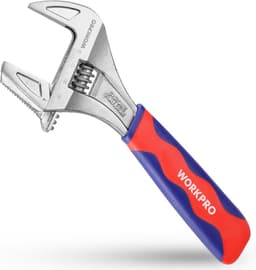
If you pull so the force opens the moving jaw, the setting creeps. Flip the spanner so the fixed jaw takes the load, reset the worm, and try again. If it still opens, the screw is slack. That shows up on the Navegando, the short WORKPRO and the 42 mm WORKPRO under a bath nut. Retire that tool. One guide loads the fixed jaw. Another says the moving jaw should lead. Trust the test. Clockwise tightens a normal right-hand thread after the jaw is seated. A ring has no worm. Serrations on the WORKPRO pipe face mark chrome. Use the smooth face on a finished nut.

Pull, and do not add a pipe

Pull towards you. A slip then takes your hand off the work, while a push drives your knuckles into a bracket or a wheel. Do not sleeve the handle with a pipe. The University of Essex note, pointing to HSE INDG229, says to scrap a slipping spanner and not to extend it. A cheater bar rounds the nut or cracks the tool. These spanners are not insulated. The Barpre is 16.1 cm with a 35 mm jaw, too short for real leverage, which is a reason to change tool. A slipping jaw comes out of the drawer.

When to stop and change tool

Stop when the adjustable still creeps after a flip and a reset. More force rounds the nut. Move to a ring or a fixed open end that fits. The SOL open pairs are already at their limit on a tight bolt, according to those reviews. Stop on a round fitting. One Stanley review damaged an aerator the jaw could not hold. The WORKPRO serrated face is not a gas-safe claim. A 34 mm or 40 mm tap tool, with two reviews, is a basin spanner only. Gas, brakes, steering and an overhead load belong with someone who does that work. The type choice is adjustable or combination.

Common questions

Which way do I pull an adjustable spanner?
Pull so the fixed jaw takes the load. If the moving jaw runs open as you turn, flip the spanner, reset the worm, and try again. If it still opens, the screw is slack and the tool should come out of use. Clockwise tightens and anticlockwise loosens on a normal right-hand thread, after the jaw is seated.
Why does the jaw open while I turn?
Because the force is running the worm open, or the worm was already loose. Reviews of the cheaper adjustables in this set describe that creep under load, including on bath nuts and between ordinary fasteners. Resetting once is normal. Resetting on every stroke means the jaw is not holding. Close the jaws and rock the moving face. A flop is play that a harder pull will not fix.
Should I push or pull?
Pull towards you when the nut allows it. A pull is easier to stop, and a slip brings your hand off the work rather than into it. A push is how knuckles meet a bracket. Line your body up so you are not standing where a sudden release throws you. If you can only push, because of the access, keep the force modest and your other hand clear.
Can I put a pipe on the handle?
No. An Essex workshop note that points to HSE guidance says not to extend a spanner with a pipe, and to scrap a spanner that slips. Extra leverage rounds the nut or breaks the tool. These handles are sized for muscle, not for a cheater bar. If you cannot move the fastener on the bare handle, use a longer spanner, a correct ring, or a socket.
When do I switch to the ring end?
When the fastener is tight enough that the adjustable creeps, or when you have the matching size in a combination set. The ring stays on the nut and needs less room to take a new bite than an open end. Use the open end when the ring will not pass a pipe or an obstruction. This file does not state a point pattern for the Hilka rings.
What if the nut is already round?
Stop. A spanner on rounded corners will slip and take more metal off. A different grip, often a socket or a specialist tool, and sometimes a new fastener, is the next step. Do not add a pipe, and do not keep pulling an adjustable that is already skating. If the nut holds a load overhead, or it is on brakes, steering or gas, that is a job for someone who does that work.

Related pages

Sources

Public UK and standards sources listed below, as used in the digest. Shelf prices and star lines are the amazon.co.uk figures dated 19 October 2026, not a fresh check on 22 October 2026.

  1. HSE, PUWER overview (retrieved 19 October 2026)
  2. University of Essex, Using hand tools safely (retrieved 19 October 2026)
  3. ISO 1711-1:2019, hardness and test torque (retrieved 19 October 2026)
  4. ISO 3318:2016, maximum head widths (retrieved 19 October 2026)
  5. RS, adjustable spanners guide (retrieved 19 October 2026)
  6. RS PRO 541-6573 adjustable wrench (retrieved 19 October 2026)
  7. GOV.UK trade tariff, heading 8204 (retrieved 19 October 2026)
  8. Trading Standards, Consumer Rights Act goods guidance (retrieved 19 October 2026)