Independent comparisons. We may earn from shop links. More info

Rubber mallet vs dead blow: rebound or shot-filled

Updated: 24 October 2026

You have seen both names on Screwfix or Toolstation, often in the same mallet list, and it is easy to think a dead-blow is just a heavier rubber mallet. A rubber mallet vs dead blow choice is about what is inside the head. Solid rubber rebounds. A shot-filled head is sold to reduce that rebound. They are not two labels for one tool. Peter F. set the split from UK retail listings and from the eleven solid heads in our [rubber mallet comparison](/hub/hand-tools/rubber-mallet), not from a bench test on 22 October 2026. A qualifying purchase can earn a commission at no extra cost to you.

You have seen both names on Screwfix or Toolstation, often in the same mallet list, and it is easy to think a dead-blow is just a heavier rubber mallet.

Our top picks

On this page

Two different heads

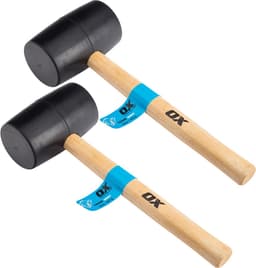
A rubber mallet here has a solid rubber head. The face gives a little, and the head comes back at you. UK Workshop puts it plainly: a dead-blow has loose shot so it does not rebound, while a soft-faced hammer is solid. ITS describes a dead-blow as shot-filled so it does not kick back. Hagerty UK describes shot inside a soft body. The shot moves after the face has stopped. Screwfix sells the Magnusson at 35 oz (0.99 kg), a 52 mm face, £11.49 including VAT, and says the shot-filled head reduces rebound. That is close to the OX twin pack at £12.49 for two solid mallets. Toolstation lists a Draper dead-blow at 128 oz (3.6 kg) for £77.99. Do not treat those as one tool. Face colour stays on the rubber mallet buying guide.

When the rubber mallet is the one to hold

Hold solid rubber when the surface is the finished face and a bounce is acceptable: a joint, a dowel, a tent peg, a light tap on a cabinet. Aim square, and accept that the head may spring back. A tight gap where the kick gets in the way is the condition that points to a dead-blow, not a reason to swing harder. A black face can mark white uPVC. ValueMax has a UK review of marks on capping. A white face, which this folder does not contain, is still solid rubber. Choose a listing whose weight text you can read, such as ValueMax at 450 g head and 690 g total, or BLOSTM at 16 oz and 453 g. Ram's flying-head reviews are a worse problem than bounce. More mass for a slab is the rubber mallet for paving slabs page, not a reason to call a maul a dead-blow.

When the dead-blow is the one to hold

Hold the dead-blow when rebound is the problem: a hub, a seized bush, or a tight engine bay, which is the case ITS and Hagerty describe. Picture Magnusson at £11.49, 35 oz, shot-filled, a 52 mm face. Shot does not make the blow harmless, and a hard face can still mark aluminium. Do not use a heavier dead-blow to hit a chipping porcelain or sandstone edge harder. The Draper 3.6 kg head is a poor substitute for a 16 oz furniture mallet. A household that only seats pegs and flat-pack joints does not need the shot. The loose-head stop stays on how to use a rubber mallet.

What this folder does not include

No kept ASIN is described as shot-filled. You should not read a minimal-rebound bullet as shot. OX, rank 1 at £12.49, prints that claim on solid rubber with a wood handle. The title says 32 oz / 900 g, the item weight is 950 g, and reviews also say 24 oz. None of that is loose shot. Amazon Basics is a rubber head titled as a club hammer, not a dead-blow. The top pick and the best value on the main page are both solid rubber, chosen for review volume and a readable weight. When you want less rebound, buy a UK listing that states the shot, such as the Magnusson at £11.49 including VAT. A 35 oz dead-blow is not a 2.5 kg paver's maul.

Common questions

What is inside a dead-blow head?
Loose shot, typically steel shot, behind a softer face. Screwfix's Magnusson listing says the shot-filled head reduces rebound, at 35 oz and £11.49 including VAT. If the listing does not mention shot or dead-blow, do not assume it is there. Every ASIN kept in this table is solid rubber or a small plastic-and-rubber kit.
Does a rubber mallet bounce?
Yes. A solid rubber head deforms and then recoils. You feel the handle kick on a hard peg. A minimal-rebound line on the OX twin pack is a claim on solid rubber, not evidence of shot. Bounce is fine for many taps. It is the reason to switch tools when the kick gets in the way.
Which one for a finished surface?
Use solid rubber when you are hitting the finished surface and a little bounce is acceptable. A dead-blow can still mark if the blow is heavy. Rubber can mark too: a ValueMax review reports marks on white capping. Shot does not guarantee a clean finish.
Which one for a tight automotive knock?
A dead-blow, when you need less rebound and the face is still softer than the part. Picture the Magnusson scale, 35 oz and a 52 mm face at £11.49, not the 3.6 kg Draper, unless the part is large enough. Do not hit harder with solid rubber to make up for the bounce.
Is a minimal-rebound bullet the same as shot?
No. OX prints that claim on a solid rubber twin pack. The file does not say the head is shot-filled. A dead-blow listing says shot-filled, dead-blow, or both, as the Magnusson page does. If you need the shot, buy the listing that names it.
Do I need both?
Only if you do both jobs. Tent pegs and flat-pack joints can stay with one solid rubber mallet whose weight text agrees. Add a shot-filled head when an automotive knock is actually on your list. An OX bullet has not put shot in the head.

Related pages

Sources

Sources from the research digest, last checked on 22 October 2026. The digest lists further shop and forum pages. Eight of those sources are cited here.

  1. HSE, PUWER overview (retrieved 22.10.2026)
  2. HSE, inspection of work equipment (retrieved 22.10.2026)
  3. PUWER 1998, regulation 4 (retrieved 22.10.2026)
  4. Consumer Rights Act 2015, section 9 (retrieved 22.10.2026)
  5. BS 876:1995, specification for hand hammers (retrieved 22.10.2026)
  6. Wonkee Donkee, paver maul sizes (retrieved 22.10.2026)
  7. Toolstation, mallets (retrieved 22.10.2026)
  8. Talasey, natural paving planning and installing guide (retrieved 22.10.2026)