Independent comparisons. We may earn from shop links. More info

How to use a rubber mallet: face square, then stop

Updated: 24 October 2026

You have the mallet in your hand, a peg or a joint in front of you, and the risk is not the brand on the handle. A loose head and a glancing blow are what hurt. This is how to use a rubber mallet: look at the joint, strike with the face square, and stop if the head moves. Peter F. drew the stop rule from the Health and Safety Executive’s inspection pages and from UK review text in our [rubber mallet comparison](/hub/hand-tools/rubber-mallet), not from a lab swing on 22 October 2026. A qualifying purchase can earn a commission at no extra cost to you.

You have the mallet in your hand, a peg or a joint in front of you, and the risk is not the brand on the handle. A loose head and a glancing blow are what hurt.

Our top picks

On this page

Check the head before you swing

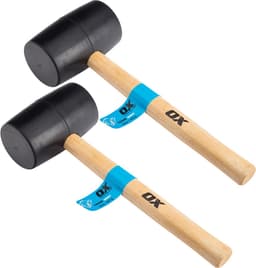
Before the first blow, hold the head and try to twist it on the shaft. It should not rotate, click or lift. Look for a split handle or a collar that has walked away from the rubber. That glance is the sort of visual check HSE separates from a recorded inspection. If the head moves, put the mallet down. On Ram, UK reviews describe the head leaving the shaft after three strikes, after about 15 minutes, and on the first stake. On LOZAGU, bodies describe it coming apart in fewer than ten hits. A new mallet that fails at once is the sort of fault the Consumer Rights Act 2015, section 9, frames as unsatisfactory quality. That is a return, not a patio repair. Rank 1 does not matter if the OX head rocks.

How to strike

Hold the end of the handle, not the neck under the head, and bring the face down square. A glancing blow skids, and on a tent peg that skid bends the peg. One BLOSTM reviewer notes that a missed blow on a thumb still hurts. A 450 g head at the end of a 320 mm handle still carries speed. Start with a light tap. If the face bounces straight back, you are hitting too hard or you wanted a shot-filled head. Keep your free hand off the face, and hold a peg low. Gloves do not keep a loose head on. Which ounce to buy stays on the rubber mallet buying guide.

Jobs that only need a tap

Most household jobs are taps, not demolition: a dowel, a hinge that needs a nudge, a peg in turf. Hit the stake, not the white cap beside it. A black face can still mark pale uPVC. On the Glarks faces, 25 mm and 35 mm, use the rubber side. A patio slab is the same idea at a larger size. Turnbull's sandstone guide describes a gentle tap, then a spirit level, with goggles on the tool list. Talasey says tap on a full mortar bed and never spot-bed. How hard to tap is the rubber mallet for paving slabs page.

When to stop

Stop as soon as the head twists, lifts or has already come off. Do not glue it back and do not keep driving stakes. If the mallet is new, use the return route. If the shaft is split, replace it. A hanging hole, such as the one HOUSERAN prints, does not make a cracked head safe. Stop, too, above about 1.8 m. That height is a rule of thumb from a hammer lanyard note, not from these listings. PUWER sits on an employer and does not apply to a weekend tent peg. If the bed is wrong, hire a landscaper. The mallet will not compact a sub-base. Which listing fits stays on the best rubber mallet page.

Common questions

What if the head twists?
Stop. A twist means the joint has already failed, before the first blow or after a dozen. Do not hit harder to seat it. On Ram and LOZAGU, UK reviewers describe heads leaving the shaft in minutes. A new tool in that state is a return under the Consumer Rights Act 2015, not a glue repair.
Can I hit a chisel with it?
You can tap a wide wood chisel or a plastic plug if the rubber face covers the end and your hand is below the strike. Do not use it as a steel hammer on a cold chisel into masonry, and do not strike a mushroomed head. One ValueMax review mentions chiselling a door for a lock, which is a light joinery tap, not stone breaking.
How hard should I tap a slab?
Hard enough to settle the slab onto a bed that is already full, then check with a spirit level. Turnbull describes that as a gentle tap. If you are beating the slab into a few dabs of mortar, you are hiding a spot bed, which Talasey tells installers not to do. A 16 oz head is a tap, not a maul. Stop if the edge chips.
What do I do if the head comes off?
Stop the job and do not refit the head with glue or a nail. If the mallet is new, take it back. UK reviews on Ram and LOZAGU describe heads coming off in the first minutes of staking. If it failed after years of use, replace the mallet.
Do I need goggles at home, and does PUWER apply?
Turnbull's sandstone guide lists goggles and gloves for laying slabs, so wear them when grit is coming off the stone. A quiet tap on a furniture joint is not illegal without goggles. PUWER is an employer duty. It does not apply to a tent peg in your own garden.
Where do I hold the handle?
Hold the end of the handle so the head can swing, and keep your other hand away from the face. A grip under the head puts fingers in the way of a miss. A glove does not keep a loose head on the shaft.

Related pages

Sources

Sources from the research digest, last checked on 22 October 2026. The digest lists further shop and forum pages. Eight of those sources are cited here.

  1. HSE, PUWER overview (retrieved 22.10.2026)
  2. HSE, inspection of work equipment (retrieved 22.10.2026)
  3. PUWER 1998, regulation 4 (retrieved 22.10.2026)
  4. Consumer Rights Act 2015, section 9 (retrieved 22.10.2026)
  5. BS 876:1995, specification for hand hammers (retrieved 22.10.2026)
  6. Wonkee Donkee, paver maul sizes (retrieved 22.10.2026)
  7. Toolstation, mallets (retrieved 22.10.2026)
  8. Talasey, natural paving planning and installing guide (retrieved 22.10.2026)