Independent comparisons. We may earn from shop links. More info

Carpenter's pincers vs end cutters

Updated: 23 October 2026

Your amazon.co.uk results put both names on one title, and the parcel can be either tool. Carpenter's pincers vs end cutters comes down to the jaw you need for the next nail or the next cut, not to which brand sits higher in a list. This page gives you one condition for each jaw. Prices, scores, and who should skip a named pair stay on the [carpenter's pincers comparison](/hub/hand-tools/pincers). Peter F. used the ISO catalogue entries, UK trade explainers, and the way these six listings are worded. We did not certify any pair, and a qualifying purchase can earn a commission at no extra cost to you.

Your amazon.co.uk results put both names on one title, and the parcel can be either tool.

Our top picks

On this page

Two jaws, one search

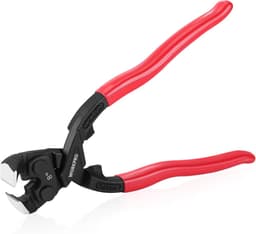
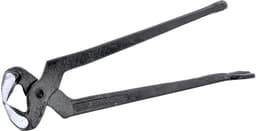
Wonkee Donkee describes carpenter's pincers as a gripping tool with a rounded head that rolls, and end-cutting pincers as a cutting tool with sharper jaws and a flatter head. Cromwell uses the same split: bulky nails want the carpenter's jaw, and cutting wire wants the cutting jaw. Both say each tool can do a little of the other job, which is why a thumbnail is a poor guide. Rolson, Draper, Amtech, and Bosch say carpenter's pincers. WORKPRO says end cutting and prints an 18 mm opening and a 3 mm medium-hard wire cut. Bosch also uses end-cutting language in a bullet while naming ISO 5743 and ISO 9243. BGS says end cutting pliers and prints DIN 9243A. Read the jaw, then what UK reviews say the tool did. Side cutters and fencing pliers are a different search.

When the carpenter's jaw

Choose the rounded carpenter's jaw when you need to grip a shank and roll it out. One side of the head stays on the wood while the handles come down. That pull is on the how to use carpenter's pincers page. None of these six claims a striking face. UK reviews use the Rolson pair on pallet nails and gripper rods, and the Draper pair on joists, often needing about 5 mm of shank. A BGS review, on an end-cutting title, still says the pair pulls small-head nails and cuts poorly. The rounded jaw can still shear a panel pin if you squeeze. Prefer it, with a light grip, when the pin has to come out whole.

When the end cutter

Choose the flatter end cutter when you need to cut close to a face and you are willing to sever the piece. The only capacity stated in this set is WORKPRO's 3 mm medium-hard wire, at HRC 60–62, with an 18 mm opening. Do not give that figure to the other rows. UK reviews say the Rolson pair did not cut 6 mm fence wire. WORKPRO reviews say thin nails get snipped. Bosch, sold as carpenter's pincers, draws the same complaint. A BGS review reports the opposite, a poor cut and a useful pull, so the title is not the jaw. A harder edge makes a keener cut, not a better puller.

What the numbers do not prove

ISO 9243:1988 is the document for carpenter's pincers, with a cutting edge of at least 45 HRC. ISO 5748:2004 is the document for end-cutting nippers. Printing either number is the listing's claim, not a check we ran. HRC figures around 60 on Bosch and WORKPRO sit above that floor and still shear pins in UK reviews. GS, Industry Standard with no number, and Din 5241 are not UK approvals. If you must pull and keep the pin whole, take the rounded jaw and stop when the steel nicks the shank. If you must cut close to a face, stay inside the capacity that listing prints.

Common questions

What is the difference between carpenter's pincers and end cutters?
Carpenter's pincers grip and roll, with a rounded head that acts as the fulcrum on the timber. End cutters cut close to a face, with sharper jaws and a flatter head. ISO 9243 covers the first tool and ISO 5748 covers the second. Each can do a little of the other job, which is why UK reviews describe pulls with end-cutting titles and cut pins with carpenter's titles. The shape of the jaw is the difference you can see.
Can I use end cutters to pull nails?
You can start a pull if the shank stands proud, and you should expect a thin pin to shear. WORKPRO is titled as an end cutting nail puller and UK reviews say thin nails get snipped. One BGS review says the opposite, a poor cut and a useful pull on small-head nails, so the title is not a guarantee either way. If the nail has to come out whole, the rounded carpenter's jaw and a lighter squeeze are the safer bet, and they can still nick the shank.
Which standard is which?
ISO 9243:1988 is carpenter's pincers, with a minimum cutting-edge hardness of 45 HRC. ISO 5748:2004 is end-cutting nippers. ISO 5743 is the general requirements document that Bosch names beside ISO 9243. DIN 9243A on the BGS title points at the carpenter's-pincers family in German numbering. A printed number is the maker's claim. It was not checked on these pairs, and it is not a UK approval.
Why does one listing use both names?
Because amazon.co.uk titles are written to match both searches. Bosch says carpenter's pincers and also end-cutting in a bullet. BGS says end cutting pliers and DIN 9243A. WORKPRO says end cutting and nail puller together. Read the jaw and the standard line after the title. If those two disagree, the tool in the photograph and the reviews of what it did are more useful than the first three words.
Does a harder edge make a better puller?
No. A harder edge makes a keener cutter. Bosch lists 60 ±2 HRC and WORKPRO lists HRC 60–62, both above the 45 HRC floor in ISO 9243, and UK reviews still say those jaws cut thin nails. Hardness on a listing is the maker's line, not a test we repeated, and it is not a reason to squeeze harder. For a pull, a light grip on a rounded jaw beats a harder edge used as if it were a vice.

Related pages

Sources

Standards are ISO 9243:1988 for carpenter's pincers and ISO 5748:2004 for end-cutting nippers, with the PPE at Work Regulations 1992 and HSE eye-protection guidance. Prices, stars, and review counts are the amazon.co.uk listing lines dated 19 October 2026. They are not a lab test. A Best Sellers page was shelf context only and is not a price source.

  1. ISO 9243:1988, carpenter's pincers (retrieved 22 October 2026)
  2. ISO 5748:2004, end cutting nippers (retrieved 22 October 2026)
  3. KNIPEX UK, carpenter's pincers (retrieved 22 October 2026)
  4. Wonkee Donkee Tools, what carpenter's pincers and end cutters are (retrieved 22 October 2026)
  5. The Personal Protective Equipment at Work Regulations 1992 (retrieved 22 October 2026)
  6. HSE, using the right type of PPE (retrieved 22 October 2026)
  7. SPAB, patching old floorboards (retrieved 22 October 2026)
  8. Cromwell, carpenter's pincers and end-cutting pincers (retrieved 22 October 2026)