How to use a brick hammer
You have one brick to shorten, and a single hard blow looks quicker than it is. A brick hammer will split a clay brick if you mark the line, support it, and score before you hit the face. A chip can leave the brick, and a loose head will not behave. This is how to use a brick hammer for that cut, and when to stop. UK how-to pages score every face on sand. The chisel end makes that score. Listings sit in the [mason's hammer comparison](/hub/hand-tools/mason-s-hammer). A qualifying purchase can earn us a commission at no extra cost to you. Products Compared used public UK guidance and those cards on 22 October 2026.
You have one brick to shorten, and a single hard blow looks quicker than it is. A brick hammer will split a clay brick if you mark the line, support it, and score before you hit the face.
You have one brick to shorten, and a single hard blow looks quicker than it is. A brick hammer will split a clay brick if you mark the line, support it, and score before you hit the face. A chip can leave the brick, and a loose head will not behave. This is how to use a brick hammer for that cut, and when to stop. UK how-to pages score every face on sand. The chisel end makes that score. Listings sit in the mason's hammer comparison. A qualifying purchase can earn us a commission at no extra cost to you. Products Compared used public UK guidance and those cards on 22 October 2026.
Our top picks
| Badge | Product | Peen | Face | Before you swing | Note | Price | Offer |
|---|---|---|---|---|---|---|---|
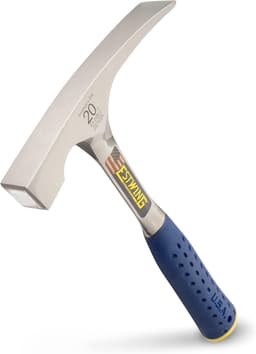
| Best overall |  Estwing Estwing E3/20BL 20 oz brick hammer | Chisel end; length not in the table | Square face for the split | One-piece not printed in the bullets | 9.2 | about £47.86 | View offer |
| Best value |  Roughneck Roughneck ROU61624 24 oz brick hammer | Chisel; one review calls it crooked | Square face for the split | Tubular joint, not one-piece | 9.2 | about £16.20 | View offer |
| Alternative |  Spear & Jackson Spear & Jackson SJ-BSS22 22 oz brick hammer | Chisel end for bricks and blocks | Flat square face, chamfered | Grip can slide in UK reviews | 8.0 | about £19.50 | View offer |


On this page
Mark and support the brick
Score with the chisel end
Split with the face
When this hammer is the wrong tool
Common questions
Do you score all four faces?
Which end scores, and which end splits?
What should the brick sit on?
What eye protection is the point?
When do you pick up a bolster and a club hammer instead?
When is a disc cutter the wrong next step?
What if the handle already moves?
Related pages
Sources
Prices, stars, and review counts are amazon.co.uk listings dated 22 October 2026. BS 876:1995, ISO 15601:2000, HSE guidance on hand tools, eye protection and paving cuts, and the Dry Stone Walling Association tool list are the public sources. None of these listings states BS 876. This is not a lab strike test.
- HSE INDG229: Using hand tools (retrieved 22 October 2026)
- HSE: Using the right type of PPE (retrieved 22 October 2026)
- HSE: Cutting paving, blocks, kerbs and flags (retrieved 22 October 2026)
- BSI Knowledge: BS 876:1995, specification for hand hammers (retrieved 22 October 2026)
- ISO 15601:2000, assembly tools for screws and nuts, forging and striking tools (retrieved 22 October 2026)
- Dry Stone Walling Association: tools (retrieved 22 October 2026)
- DIY Doctor: using a brick bolster (retrieved 22 October 2026)
- ITS: a guide to hammers (retrieved 22 October 2026)