Independent comparisons. We may earn from shop links. More info

How to use an electric planer

Updated: 23 October 2026

The planer is on the bench, the depth dial can take up to 2 mm, and the cutter will gouge the timber if it touches the wood before the motor is at speed. How to use an electric planer comes down to a shallow first pass, both shoes supported, and a place to put the tool down that is not the spinning knives. This page is the technique for any tool in the [Machine plane comparison](/hub/hand-tools/machine-plane). It is not a substitute for the manual in your box. A qualifying purchase through our links can earn a commission at no extra cost to you.

The planer is on the bench, the depth dial can take up to 2 mm, and the cutter will gouge the timber if it touches the wood before the motor is at speed.

Our top picks

DeWalt DeWalt DCP580N-XJ

Best overall

DeWalt DeWalt DCP580N-XJ
8.9/10about £117.98
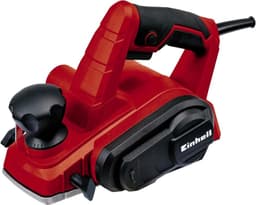
Einhell Einhell TC-PL 750

Best value

Einhell Einhell TC-PL 750
8.4/10about £39.78
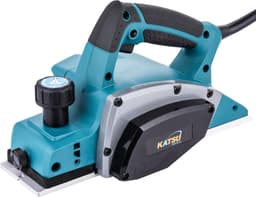
KATSU KATSU 101719

Alternative

KATSU KATSU 101719
7.7/10about £34.99
On this page

What the shoes, the lock-off and the park rest are doing

The front shoe sets the cut. The rear shoe rides the surface you have just planed, so the tool has to stay flat. A dipped nose or heel is snipe. Both shoes should be on the timber before the knives cut, and still supported as the cutter leaves. A lock-off must be pressed before the trigger stays live. KATSU and Stanley name one. Check the handle you have. Einhell calls its support an automatic park rest. A Stanley review mentions a spring-loaded heel. With no rest, wait until the cutter stops and lay the tool on its side.

One pass on a scrap, then the workpiece

Fit the plug or the battery only when the depth is set and the timber is supported. Start near half a millimetre on a door. BuildWiz gives that as a guide, not a figure we measured. About 2 mm, or 0-3 mm on the Draper bullets, is the claimed maximum, not the first click. Reach full speed before the knives meet the wood. Push with the grain, hands behind the cutter, and do not restart with the knives buried. Keep an edge square or the stile rounds. If the first pass removes more than you marked, the dial is optimistic. On end grain, come in from each end, or support the exit with a scrap block, which is the direction BuildWiz describes. Move on only when the scrap measures what you intended.
DeWalt DeWalt DCP580N-XJ

Testsieger

DeWalt DeWalt DCP580N-XJ
8.9/10about £117.98

Lines, a deep start, and a dial that lies

A line along the board is usually a nick. Turn or replace the blade only after you unplug or remove the battery. A second pass at the same depth reprints it. A deep start is a dipped nose, or knives meeting the wood before full speed. Settle the front shoe, reach speed, then push. One DeWalt buyer says zero on the DCP580 still shaved about a millimetre. A KATSU reviewer could only get about 1 mm from a stated 2 mm. A Draper reviewer says the indicator does not match the timber. Believe the timber. Snipe at the end means the rear shoe left while the knives were still cutting. Keep pressure on the heel until the cutter is clear. Tear-out means blunt knives or the wrong grain. A deeper setting makes it worse.

Blades, chips and noise

Turn a blade when the surface burns or a nick leaves a ridge. Einhell and DeWalt UK describe carbide reversible knives. KATSU lists 65 manganese steel, which dulls sooner on paint. Seat the knife level. Chips belong in a bag or a vacuum. HSE says do not sweep. Workplace limits bind an employer: 3 mg/m³ hardwood and 5 mg/m³ softwood. DeWalt declares 88 dB(A) for the DCP580N-XJ. The Noise Regulations 2005 set an employer action value at 80 dB(A). Wear hearing and eye protection. Stop if you suspect lead paint or a certified fire door.

Common questions

How do I set the depth for the first pass?
Set less than the maximum. BuildWiz suggests about half a millimetre on a door, as a rule of thumb, not as a measurement of your dial. Listings here state about 2 mm, and the Draper bullets say 0-3 mm of chip. Plane a scrap, measure, then move to the workpiece. If the dial and the ruler disagree, follow the ruler.
Which way do I push the planer?
Push with the grain when you can see it, at full speed, with both shoes supported. On end grain, come in from each end toward the middle, or support the exit corner with a scrap block. Do not start the cutter in the wood, and do not reverse down the cut with the motor running.
Why are there ridges along the board?
A straight ridge usually means a nicked knife. It hits the timber on every revolution. Unplug or remove the battery, turn a reversible blade or fit a new one, and check that it sits level. A step from passes that barely overlap is a path problem. A nick is a blade problem.
Can I put the planer down while the cutter spins?
Only on a park rest that holds the knives clear, and only if your model has one. The Einhell listing states an automatic park rest. A Stanley review describes a spring-loaded heel. If yours does not, wait until the cutter stops and lay the planer on its side. A spinning shoe on the board cuts a scar.
What does the lock-off do?
It stops the trigger until you press a separate button, so the motor cannot start by accident. The KATSU and Stanley bullets name a lock-off. Other models here may have one the listing omits, or they may not. It does not set the depth, and it does not replace unplugging before a blade change.
The dial says 2 mm and the wood says less. Is it broken?
Not necessarily. One KATSU review says the cut stopped around 1 mm against a 2 mm claim. A Draper review says the indicator did not match the measured depth. A DeWalt review says zero still cut about a millimetre. Measure the timber and treat the printed scale as a guide. If the motor bogs, stop and check the knives.

Related pages

Sources

Public UK sources from the research digest, last checked in October 2026. Shelf prices and star lines are the amazon.co.uk figures in the display file.

  1. HSE — Wood dust (retrieved October 2026)
  2. HSE — EH40/2005 (retrieved October 2026)
  3. legislation.gov.uk — Control of Noise at Work Regulations 2005, regulation 4 (retrieved October 2026)
  4. IEC — 62841-2-14:2015, hand-held planers (retrieved October 2026)
  5. DeWalt UK — DCP580N-XJ 18V XR brushless planer, tool only (retrieved October 2026)
  6. Bosch Professional GB — Planers (retrieved October 2026)
  7. BuildWiz — Planer (retrieved October 2026)
  8. Checkatrade — How to plane a door (retrieved October 2026)