Independent comparisons. We may earn from shop links. More info

How to plane a door with an electric planer

Updated: 23 October 2026

The door rubs the new carpet, or it sticks on the latch side in winter, and an electric planer can take 2 mm off in a pass you did not mean to make. How to plane a door with an electric planer starts before the cutter: tighten the hinge, decide whether the door is only swollen, and mark the gap you actually need. The listings are the [Machine plane comparison](/hub/hand-tools/machine-plane). Gap figures here are retailer guidance, not a statutory fire-door limit. A qualifying purchase through our links can earn a commission at no extra cost to you.

The door rubs the new carpet, or it sticks on the latch side in winter, and an electric planer can take 2 mm off in a pass you did not mean to make.

Our top picks

DeWalt DeWalt DCP580N-XJ

Best overall

DeWalt DeWalt DCP580N-XJ
8.9/10about £117.98
Bosch Bosch GHO 12V-20

Alternative

Bosch Bosch GHO 12V-20
8.5/10about £179.99
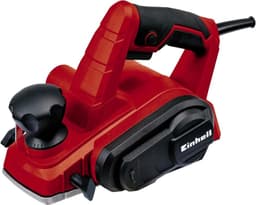
Einhell Einhell TC-PL 750

Best value

Einhell Einhell TC-PL 750
8.4/10about £39.78
On this page

Check the hinge and the season before the planer

A door that drops at the latch often has a loose hinge screw. If the leaf moves, or the screw turns without biting, pack the hole or fit a longer screw, then close it again. Checkatrade says sort the hinges before any cutter. If that closes the gap, leave the planer in the box. A door that only sticks from October to March may fit when the house dries. Plane it in February to a summer gap and it can rattle in July. Built-up paint is sometimes the only extra thickness. Only when the hinge is tight, and the door sticks in dry weather too, is the leaf too wide. Mark the rub with chalk on both faces. That is still the wrong first move if the screw was loose.

How much gap people aim for

There is no statutory millimetre for an ordinary internal door. Checkatrade talks about roughly 2-3 mm at the head and stiles. Doors2Floors, a retailer, talks about 3 mm there and about 6-10 mm at the bottom, depending on the floor. Neither figure is a regulation. Measure the carpet, then add a small clearance. Listings state a maximum around 2 mm, and the Draper bullets say 0-3 mm of chip. A Draper reviewer took 13 mm off seven doors as many shallow passes, not one cut. BuildWiz suggests 0.4-0.5 mm a pass, their rule of thumb. If the door is a certified fire door, stop using these ranges. The certificate is the limit, and Checkatrade says ask a professional.
DeWalt DeWalt DCP580N-XJ

Testsieger

DeWalt DeWalt DCP580N-XJ
8.9/10about £117.98

Taking the door off and planing the bottom or the edge

For more than a skim, take the door off. Checkatrade draws that line because a hanging bottom cut can catch the floor. Support the door, set near half a millimetre, reach full speed, and keep the shoe flat. An 82 mm tool, the Einhell, KATSU, Draper and DeWalt width here, covers a typical edge in one pass if you do not tilt. The Bosch GHO 12V-20 is 56 mm, and reviewers would not take a solid door down with it. On the bottom rail, plane from each end toward the middle, or use a scrap at the exit, as BuildWiz describes. Past the chalk, you cannot put the wood back. BuildWiz uses 25 mm as a lifetime caution on a hollow door, not as permission for today. If the skin flaps, stop. Seal the fresh edge before you rehang. Bare timber swells back into the bind.

Fire doors, hollow cores, and when to stop

A certified fire door is not an ordinary sticking door. The seal and the trim allowance belong to that certificate. Checkatrade says use a professional. With no paperwork, leave a communal door, a garage door, or a door a survey called a fire door. A 2 mm setting that is light on oak can break a hollow skin or leave the rail too narrow for a screw. The BuildWiz 25 mm remark is a warning, not a target. A twisted leaf, or 8 mm at the top and nothing at the bottom, will not be squared by planing the door. That is a joiner, or a new door. Stop when the stick is only seasonal, the hinge was loose, or you suspect lead paint.

Common questions

How much should I take off the bottom for carpet?
Measure the carpet and underlay, add a small clearance, and take it in shallow passes. Doors2Floors suggests about 6-10 mm at the bottom, as retailer guidance, not as law. Checkatrade's 2-3 mm figure is the head and stiles, not a pile. A listing maximum of 2 mm is one deep pass. Mark the line and check it.
Should I plane the door on its hinges?
Only for a light skim you can control. For a bottom rail, or more than a touch on the stile, take the door off and support it. Checkatrade draws that line. Fix the hinge first. If the rub disappears, do not cut.
What if it only sticks in winter?
Wait, or ease the one high spot, rather than planing the whole stile to a summer gap. Timber swells in damp air and shrinks when the house dries. If it still sticks in dry weather, after the hinge screws are tight, a shallow pass is justified.
Can I plane a fire door?
Not from a guess. Checkatrade says use a professional, and the certificate states any trim allowance. An ordinary fitting gap of 2-3 mm is not permission to cut a fire door. If you cannot find the paperwork for a communal or garage door, leave it.
Will an electric planer ruin a hollow door?
It can, if you treat the maximum chip as the setting. The face is a skin and the bottom rail is a strip. BuildWiz quotes 25 mm as a lifetime caution, not as a standard and not as today's cut. Use a very shallow pass, stop if the skin lifts, and seal whatever you expose.
Should I seal the edge afterwards?
Yes. Fresh end grain and a newly planed stile take up moisture and can swell back into the carpet or the frame. Checkatrade and BuildWiz both say seal or paint the raw edge. The same paint or varnish as the door is enough. Rehang and check the latch before another pass.

Related pages

Sources

Public UK sources from the research digest, last checked in October 2026. Shelf prices and star lines are the amazon.co.uk figures in the display file.

  1. HSE — Wood dust (retrieved October 2026)
  2. HSE — EH40/2005 (retrieved October 2026)
  3. legislation.gov.uk — Control of Noise at Work Regulations 2005, regulation 4 (retrieved October 2026)
  4. IEC — 62841-2-14:2015, hand-held planers (retrieved October 2026)
  5. DeWalt UK — DCP580N-XJ 18V XR brushless planer, tool only (retrieved October 2026)
  6. Bosch Professional GB — Planers (retrieved October 2026)
  7. BuildWiz — Planer (retrieved October 2026)
  8. Checkatrade — How to plane a door (retrieved October 2026)