Independent comparisons. We may earn from shop links. More info

Block plane vs smoothing plane

Updated: 23 October 2026

You can afford one plane, and the names in front of you are a No. 4 smoother and a block plane. Block plane vs smoothing plane is a geometry choice before it is a brand choice. A mini plane is neither of them. The listings are on the [hand plane comparison](/hub/hand-tools/hand-plane). How the iron is set, once you have chosen, is [how to use a hand plane](/hub/hand-tools/hand-plane/sub/hand-plane-how-to-use). Peter F. used amazon.co.uk files from 19 October 2026 and did not run a cutting trial. A purchase through our links can earn a commission at no extra cost to you.

You can afford one plane, and the names in front of you are a No. 4 smoother and a block plane. Block plane vs smoothing plane is a geometry choice before it is a brand choice. A mini plane is neither of them.

Our top picks

On this page

Bevel-down against bevel-up

On a Bailey bench plane the iron sits bevel-down, so the cutting angle is the bed, commonly 45 degrees. Paul Sellers' cap-iron gap is about 2 mm. MyToolShed quotes a Record 04 at about 245 mm with a 50 mm iron, as a maker figure, not a measurement of these listings. A block plane turns the iron over. The cutting angle is the bed plus the bevel. A 20 degree bed with a 25 degree bevel cuts at about 45 degrees. A 12 degree bed with a 25 degree bevel cuts at about 37 degrees, the end-grain setup. Hone that bevel towards 30 degrees and the advantage mostly goes. A chamfer head marked 45 degrees is not common pitch.

Face, long edge, or end grain

Use the No. 4 when the sole has to bridge and both hands are free. A door stile or a long edge rewards the longer sole. A block plane follows a hollow that a No. 4 would skim. Wood Workers Workshop puts the No. 4 on the last surface and the block plane on ends and small fitting. Use the block plane for end grain, or when the other hand holds the work. BuildWiz's line is that a low-angle block plane is the one to buy if the reason is a door bottom. You still support the exit end, and you still hone. A low angle does not replace a sharp edge.

What this capture stocks

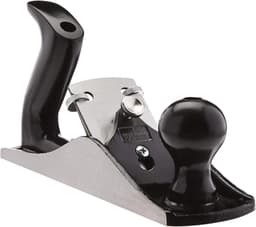
The two No. 4s with agreeing size lines are the Amazon Basics at £16.20 and the Spear & Jackson CSP4 at £17.20. The Basics has the adjustable mouth and the larger review file. The CSP4 is the heavier body, made in India, and reviews say hone it. The block plane in the bullets is the CBP65 at £16.20: 35 mm, low angle, fully adjustable mouth, single-handed. It does not print 12 or 20 degrees. The iron is the usual complaint. A 9 cm Jorgensen is a third thing, narrower than a door edge. The Suizan and the chamfer plane stay on what hand plane to buy.

Buy the No. 4 unless end grain is the reason

For faces and door stiles, buy a No. 4: the Amazon Basics for the review file and the adjustable mouth, or the CSP4 if you will hone first. Buy the CBP65 when the work is end grain and one-handed. A rub may still be hinges or swelling, so the sequence is how to plane a sticking door. A Stanley No. 4 around £68, a Record 04 around £70 and a Clifton No. 4 at £335 do not change the geometry. Section 9 of the Consumer Rights Act 2015 still judges each plane against its price.

Common questions

Can a block plane replace a No. 4?
Not for a face or a long edge you want straight. The sole is shorter, so it follows hollows a No. 4 would bridge, and you only have one hand on the tool if you use it as designed. It can take a local shaving. It is the wrong only plane if the job is a door stile or a board face. The reverse is also true: a No. 4 will trim end grain, more slowly, and it ties up both hands.
What does low angle change?
On a bevel-up plane the cutting angle is bed plus bevel. A bed near 12 degrees and a 25 degree bevel is about 37 degrees, which suits end grain. A bed near 20 degrees and a 25 degree bevel is about 45 degrees, close to a bench plane. A bevel honed towards 30 degrees spends the low-angle advantage. The bed and the hone are different numbers.
Is the Spear & Jackson CBP65 a 12 degree plane?
The bullets say low angle. They do not print 12 degrees or 20 degrees. This page will not add a figure the listing omitted. What the listing does state is a 35 mm cutter, a fully adjustable mouth, and single-handed use, at £16.20 with 4.5 from 728. The iron is the review complaint to plan for.
Which of the two No. 4s is in this capture?
The Amazon Basics at £16.20, with a 51 mm iron, an adjustable mouth and 4.4 from 4,007. The Spear & Jackson CSP4 at £17.20, 50 mm, 1.8 kg, made in India, with hone-first reviews. The Jorgensen at £56.99 is titled No. 4 and its width lines do not agree, so it is not a clean third.
Why is a 9 cm mini not the block plane in this pair?
The Jorgensen 70700 is about 9 cm and 250 g. That is a mini plane. Reviewers say it is narrower than a door edge and needs extra passes. One review says the iron does not sit square. The CTP3 is smaller still, at 25 mm and 220 g. The block plane in this pair is the CBP65, which is described as a No. 6½ with a 35 mm cutter.

Related pages

Sources

Sources from the research digest. Listing figures are from the amazon.co.uk files dated 19 October 2026.

  1. Consumer Rights Act 2015, section 9 (retrieved 19.10.2026)
  2. HSENI, products for use at work (retrieved 19.10.2026)
  3. GOV.UK, product safety A to Z (retrieved 19.10.2026)
  4. HSE WIS23, wood dust (retrieved 19.10.2026)
  5. Common Woodworking, Buying a Plane (retrieved 19.10.2026)
  6. Paul Sellers, setting a plane after sharpening (retrieved 19.10.2026)
  7. Wood Workers Workshop, hand plane buying guide (retrieved 19.10.2026)
  8. Checkatrade, how to plane a door (retrieved 19.10.2026)