Independent comparisons. We may earn from shop links. More info

How to plane a sticking door

Updated: 23 October 2026

How to plane a sticking door starts with the rub and the hinges, not with a shaving. A thumb-sized plane is narrower than the edge. Cap iron and grain are on [how to use a hand plane](/hub/hand-tools/hand-plane/sub/hand-plane-how-to-use). No. 4 or block plane is [block plane vs smoothing plane](/hub/hand-tools/hand-plane/sub/hand-plane-no4-vs-block). The listings are the [hand plane comparison](/hub/hand-tools/hand-plane). Peter F. used the 19 October 2026 listings and did not hang a test door. A qualifying purchase through our links can earn a commission at no extra cost to you.

How to plane a sticking door starts with the rub and the hinges, not with a shaving. A thumb-sized plane is narrower than the edge.

Our top picks

On this page

Find the rub before you buy a plane

Close the door and watch where the light disappears, or slide a card along the gap until it stops. Checkatrade starts there. A rub at the bottom after a new floor is often dropped hinges, and a plane cannot lift a sagged door. Tighten the screws and check the hinge is in its recess. If the door springs open, the hinge side may be proud, and planing the lock side makes the gap worse. If you do not yet own a plane, the buying split is on what hand plane to buy.

Damp timber and a fire-door label

A door that only sticks after a wet week is moving with the season. Wait through a dry spell before you cut. For a wet bottom edge, dry it, then prime and paint. Planing back to a summer gap can leave a rattle in February. A certified fire door is a different decision. Checkatrade says ask a professional before you take more than a small amount off. That is their caution, not a Building Regulations quote. A label, an intumescent strip or a closer is a reason to stop.

A plane that is as wide as the shaving you want

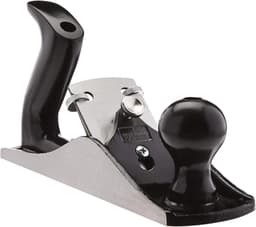
A No. 4 covers a stile in a way a 25 mm trimmer does not. The Amazon Basics No. 4 at £16.20 has a 51 mm iron. The CSP4 at £17.20 is the other coherent No. 4, and reviews say hone it first. For the bottom, which is end grain, a block plane such as the CBP65 is the better shape. Its bullets say 35 mm and low angle, without printing a degree. The Jorgensen 70700 is about 9 cm, and reviewers say it is narrower than the door. That body is not the CBP65.

Off the hinges, a little at a time, then seal

For more than a whisper, take the door off and support it. Work from the ends towards the middle so the exit does not split. Take a thin shaving, refit, and look. Checkatrade's aim for the gap is about 2 to 3 mm. That is their guidance, not a Building Regulations figure. Seal the bare edge the same day, including the end grain, or the next damp spell swells it again. A fire-door label, a hinge that will not tighten, or a frame that moves when you push is where a joiner takes over.

Common questions

Can I plane the door while it is hung?
For a whisper, yes, if the door is wedged and you can see the high spot. Checkatrade and Sandwich Handyman both move a real cut onto a bench. One Jorgensen mini review did plane a hung door, and the plane was narrower than the edge, so the pass count went up. A hung door also hides a dropped hinge. Fix the hinge first. A plane will not lift the door.
How much wood should come off?
Enough to stop the rub, checked by refitting, not a measured demolition. Checkatrade aims at about a 2 to 3 mm gap. That is a trade guide, not a regulation. Take thin shavings and close the door between them. A door that only stuck because it was swollen does not need a summer-sized gap cut in winter. On a certified fire door, ask before you take more than a small amount off.
What if it only sticks in damp weather?
Dry weather, or a dehumidifier in a wet room, may free it without a blade. If you do plane, seal the edge afterwards or the next wet week puts the timber back. DIY Extra's order for a wet bottom is dry, then prime and paint. Planing every autumn without sealing is how a door gets thin and still sticks.
Will this void a fire door?
It can spoil the door's performance if you remove more than a small amount, or if you disturb seals and the closer. Checkatrade's line is to ask a professional first. This page is not quoting a statute and it is not your fire-risk assessment. A label, an intumescent strip, or a closer is a reason to stop. An ordinary internal door with none of those fittings is the job a household can ease.
Block plane or No. 4 for the bottom edge?
The bottom is end grain, so a block plane such as the CBP65 is the better fit once the door is supported. A No. 4 is the better fit for a stile, where the longer sole covers the edge. A 9 cm mini can do either, slowly, and only in several passes. Hone whichever you use. CBP65 reviews complain about the iron. CSP4 reviews say sharpen before first use.
What do I do with the bare edge?
Seal it. Prime and paint the edge you planed, especially end grain at the bottom, so the next damp spell does not swell it back into the frame. DIY Extra makes that the last step, not an optional extra. Leave the latch side alone if the rub was at the hinge side. Refit and check that the door latches, not only that it swings.

Related pages

Sources

Sources from the research digest. Listing figures are from the amazon.co.uk files dated 19 October 2026.

  1. Consumer Rights Act 2015, section 9 (retrieved 19.10.2026)
  2. HSENI, products for use at work (retrieved 19.10.2026)
  3. GOV.UK, product safety A to Z (retrieved 19.10.2026)
  4. HSE WIS23, wood dust (retrieved 19.10.2026)
  5. Common Woodworking, Buying a Plane (retrieved 19.10.2026)
  6. Paul Sellers, setting a plane after sharpening (retrieved 19.10.2026)
  7. Wood Workers Workshop, hand plane buying guide (retrieved 19.10.2026)
  8. Checkatrade, how to plane a door (retrieved 19.10.2026)