Independent comparisons. We may earn from shop links. More info

How to use a wrecking bar

Updated: 23 October 2026

You already have a bar in the shed and a nail, a pallet board, or a piece of skirting that will not start. How to use a wrecking bar is a short motion: open a gap, put a fulcrum under the heel, hook the head, and pull. Stop if the bar slips or the timber will not move. The [crowbar comparison](/hub/hand-tools/crowbar) is the table of lengths and prices, from the amazon.co.uk files of 19 October 2026. Peter F. read the listings and the UK how-to notes. A qualifying purchase through our links can earn us a commission at no extra cost to you. Boards you hope to relay are on the [floorboards page](/hub/hand-tools/crowbar/sub/crowbar-for-floorboards), not in the steps below.

You already have a bar in the shed and a nail, a pallet board, or a piece of skirting that will not start. How to use a wrecking bar is a short motion: open a gap, put a fulcrum under the heel, hook the head, and pull.

Our top picks

On this page

Which end does which job

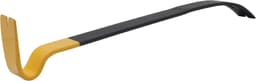
A typical wrecking bar gives you a claw or nail slot at one end and a chisel at the other. The claw hooks a head. The chisel starts a gap. Lever near the nails so the timber splits less. On these cards, the Roughneck bars and the Stanley Wonder Bar name a bevelled nail remover or nail slots. The Draper 08561 names a striking cap and does not name a slot. If your bar has no slot, it can start a gap, and it is the wrong tool for a proud nail head. That naming split is on the crowbar vs pry bar page.

A pad under the heel, then the pull

Put a scrap of wood under the fulcrum so the heel does not dig a crescent into the face. Set it close to the nail. The further the fulcrum sits from the head, the more the board wants to split. Stand so a slip sends the bar past your shin rather than into it. At work, the site method and PUWER cover the tool. To pull a nail, seat the V under the head and press the free end down, with the scrap taking the heel. A short bar runs out of leverage on a long nail in thick timber. The 610 mm Roughneck is the bar in this set for that pull. Do not bend a shaft back into a curve.

When a hammer is allowed, and when the tip chips

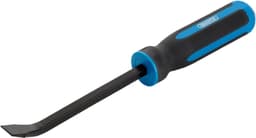
The Draper 08561 states a striking cap for hammer-through action. Milwaukee states a reinforced impact claw. The other cards leave a striking face as n/a. Reviewers of the 356 mm Gorilla bar say the polished ends chip when they meet a nail. If your bar has no striking cap, tap a bolster, then bring the bar in once the gap exists. Copy a heel strike only on a bar meant to take a blow.

When to stop and fetch someone else

BuildWiz’s practical stop is the board that will not move. A hidden screw is a common reason. Screws come out with a driver. Levering a screw bends the bar or splits the board. If you cannot tell a nail from a screw, stop and look, rather than adding a longer bar. A joist, a stair, or a cable you cannot see is the stop. Do not lever blind toward a cable. If the shaft has bent, retire it rather than rebending it. If the bar is the wrong length, the buying guide is the next page.

Gap, pad, hook, then stop

Start the gap with the chisel or the flat blade, put scrap under the heel close to the fixing, and hook a proud head only if the listing actually has a slot. Hit the bar only when it names a striking cap or an impact claw. Change to a longer bar when the short one has failed on scrap, not by bouncing on the heel. Stop for a screw, a hidden cable, or timber that is holding the building up.

Common questions

Which end pulls the nail?
The slotted or bevelled claw pulls the nail. On a Roughneck wrecking bar that is the nail remover. On the Stanley Wonder Bar it is the bevelled nail slot. The chisel or splitter end starts a gap. The Draper listing does not name a slot, so its curved blade is a pry, not a proven nail hook. Seat the slot under the head and press the free end down, with scrap under the heel.
Where does the scrap wood go?
It goes under the heel, on the face you want to protect, as close to the nail as the bar will allow. Wonkee Donkee and BuildWiz both use that pad so the metal does not print a crescent into the timber. On a pallet you are breaking up, the pad is optional. On a board you might reuse, a thin offcut is enough. A thick block raises the heel, so keep the scrap flat.
Can I hit the bar with a hammer?
Hit it when the listing says so. In this set that is the Draper striking cap and the Milwaukee impact claw. The other bars do not state a striking face. Roughneck reviewers report chipped or dented polished tips when the end meets a nail, so driving those tips into steel is how the claw gets worse. Start a gap with a bolster if your bar has no cap, then bring the heel onto a scrap pad.
What if the board will not start?
Check for a screw before you fetch a longer bar. BuildWiz treats a hidden screw as the usual reason a board will not move. If it is nailed and the head is buried, Wonkee’s method is to expose the head before you hook it, on timber you can afford to mark. If the short bar simply lacks leverage and the timber is scrap, the 610 mm Roughneck is the length in this set. If you cannot see the bearing, stop.
Do I need gloves and glasses?
DIY Doctor recommends gloves, a dust mask, and eye protection when nails or splinters can fly. That is advice for the demolition, not a British Standard for owning a crowbar. Glasses matter when you strike a cap or a nail lets go. Gloves matter when the bar slips. At work, PUWER and the site method cover the tool. At home, the same kit is still the sensible one.

Related pages

Sources

Public UK sources and manufacturer pages for this comparison. Listing prices and stars are from amazon.co.uk files dated 19 October 2026.

  1. HSE, PUWER overview (retrieved 19 October 2026)
  2. HSE, INDG291 Providing and using work equipment safely (retrieved 19 October 2026)
  3. HSE, Manual handling in construction (retrieved 19 October 2026)
  4. Prevention of Crime Act 1953, section 1 (retrieved 19 October 2026)
  5. CPS, Knife and other weapons offences (retrieved 19 October 2026)
  6. DIY Doctor, Using a wrecking bar (retrieved 19 October 2026)
  7. Roughneck, Gorilla bar (retrieved 19 October 2026)
  8. Estwing, lightweight I-beam construction bar (retrieved 19 October 2026)