Independent comparisons. We may earn from shop links. More info

Pry bar for floorboards

Updated: 23 October 2026

You want a board up, and you would like it to go back down. A pry bar for floorboards is a flat bar, a scrap pad, and a decision about the tongue before you lever. The long wrecking bar in the shed is the tool for a board you have already written off. The [crowbar comparison](/hub/hand-tools/crowbar) holds the flat bars and the GBP prices from the amazon.co.uk files of 19 October 2026. Peter F. read those cards. A qualifying purchase through our links can earn us a commission at no extra cost to you. The general pull is on [how to use a wrecking bar](/hub/hand-tools/crowbar/sub/crowbar-how-to-use).

You want a board up, and you would like it to go back down. A pry bar for floorboards is a flat bar, a scrap pad, and a decision about the tongue before you lever.

Our top picks

On this page

Salvage is a different job from a strip-out

A pallet and a floorboard ask for opposite results. On a pallet the claw can chew the timber, because the timber is going in the skip. On a floorboard the face, the tongue, and the neighbouring board are the things you are trying not to ruin. That is why this page starts with a flat bar. A gooseneck will lift a board, and it will also bruise the arris if you use it as the first lever. If the floor is fragile or historic, or you cannot tell whether the board is carrying anything, stop before the first lever. SPAB’s advice is to use a carpenter in that case. The naming muddle is on the crowbar vs pry bar page. Here the shape is already chosen: flat, with a pad, and the 610 mm Gorilla bar stays on the hook unless the board is scrap.

Which bars in this set belong near a board

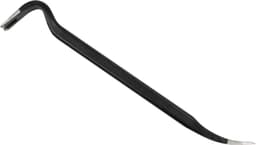
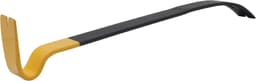
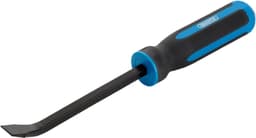
The flat reference is the Stanley Wonder Bar, 340 mm, £10.85, with 4.7 from 6,103 reviews. Reviewers use it on skirting and floorboards. They also say the paint comes off, and one says it is thick until a gap exists, so a bolster may have to open the first millimetres. The Draper 08561 is 300 mm and £9.01, with a striking cap, only 43 reviews, and no named nail slot. The 610 mm Roughneck, £16.47 and 2.01 kg, is the demolition length. Mention it when the board is already firewood. A shorter Roughneck is a second step, after a flat bar has opened a gap, if you accept the mark.

Tongues, the first board, and where the lever sits

Tongue-and-groove boards lock into their neighbours. DIY Extra and Ultimate Handyman both cut the tongue before they lever, so the board can rise without tearing the mating edge. Set the blade to the tongue you can see, and stop if you cannot tell what is underneath. SPAB’s note is about old butt-edged boards, and it says that method is not automatically right for tongue-and-groove. For those older boards they start about a third of the way along and protect the neighbour. Prying the middle of a locked board splits the tongue. If the board springs and does not rise, you have missed a nail or you are still on a screw.

Screws, cables, and the point where you stop

Ultimate Handyman’s order for screwed boards is to remove the screws first. If the head is a screw, a driver comes out before any bar. Levering a screw snaps the head or splits the board you hoped to reuse. If the slot will not seat, assume it may not be a nail. Cables and pipes run across joists. A saw set too deep is how a lighting circuit gets cut. Switch a known circuit off, and still do not treat that as a map of every wire. If you are at a stair, a hearth, or a partition sitting on the floor, a joiner should see it first. The buying guide will still help you choose a flat bar afterwards.

Flat bar first, long bar only for waste

Use a flat bar and a thin pad when the board should go back down. Cut a tongue-and-groove tongue only as deep as the tongue you can see, free an end, and work along the fixings. Take screws out with a driver before the bar touches them. Leave the 610 mm gooseneck on the hook until you have decided the timber is waste. Stop when you cannot see the bearing, the cable, or the pipe.

Common questions

Which bar in this set is for floorboards?
The Stanley Wonder Bar at £10.85 and 340 mm is the flat bar with the large review sample for skirting and boards. The Draper 300 mm bar is the short one with a striking cap, and it does not name a nail slot. A flat piece from a set can open a gap. The 610 mm Roughneck is for a board you are scrapping.
Do I cut the tongue first?
On tongue-and-groove boards, DIY Extra and Ultimate Handyman both cut the tongue before they lever. Set the saw to the tongue you can see, and stop if you cannot tell what is underneath. SPAB’s note is for old butt-edged boards and says that method is not automatically right for tongue-and-groove. Butt-edged boards need the neighbour protected, not a tongue cut that is not there.
How do I lift the first board?
The first board is the hard one. For old butt-edged boards, SPAB starts about a third of the way along, protects the neighbour with a block or a steel plate, and uses a crowbar from underneath only after an end is free. A bolster comes before the bar. For tongue-and-groove, cut the tongue first, then free an end, pad the heel, and work toward the other end.
What if the boards are screwed?
Take the screws out with a driver before any pry bar touches the board. Ultimate Handyman states that order. A SHALL review that mentions screwed decking is a comment on the bars, not a method for levering screws. If a head will not sit in the nail slot, treat it as a possible screw.
Can I use the 24 inch Gorilla bar?
You can, when the board is scrap and you want leverage. It is the Roughneck 64-407 at 610 mm, £16.47, listed at 2.01 kg, with 4.8 from 585 reviews. On a floor you hope to keep, that gooseneck is how the face gets chewed. Use a flat bar first.

Related pages

Sources

Public UK sources and manufacturer pages for this comparison. Listing prices and stars are from amazon.co.uk files dated 19 October 2026.

  1. HSE, PUWER overview (retrieved 19 October 2026)
  2. HSE, INDG291 Providing and using work equipment safely (retrieved 19 October 2026)
  3. HSE, Manual handling in construction (retrieved 19 October 2026)
  4. Prevention of Crime Act 1953, section 1 (retrieved 19 October 2026)
  5. CPS, Knife and other weapons offences (retrieved 19 October 2026)
  6. DIY Doctor, Using a wrecking bar (retrieved 19 October 2026)
  7. Roughneck, Gorilla bar (retrieved 19 October 2026)
  8. Estwing, lightweight I-beam construction bar (retrieved 19 October 2026)