Independent comparisons. We may earn from shop links. More info

How to use a drywall screwdriver on plasterboard

Updated: 23 October 2026

The board is up, the studs are behind it, and the first screws are either proud of the paper or torn through into the core. That is the usual start with a depth-stop gun, and it is also the usual start with a combi drill. This page is how to use a drywall screwdriver so the head sits in the paper without breaking it, using British Gypsum’s length and centres unless your specified system says otherwise. It does not rank products. The listings are on the [cordless drywall screwdriver comparison](/hub/hand-tools/cordless-drywall-screwdriver). Peter F., DIY and tools editor, wrote this on 22 October 2026 from British Gypsum’s fixing FAQs and the review notes in that comparison, not from a lab test. A purchase through our links can earn a commission at no extra cost to you.

The board is up, the studs are behind it, and the first screws are either proud of the paper or torn through into the core.

Our top picks

Makita Makita DFS251Z bare unit

Best overall

Makita Makita DFS251Z bare unit
6.3/10about £129.43
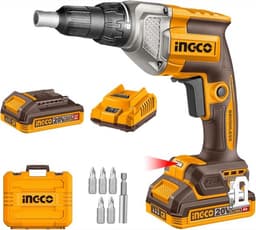
INGCO INGCO CDSLI204281 20 V kit

Best value

INGCO INGCO CDSLI204281 20 V kit
2.5/10about £76.99
On this page

The head has to dimple the paper, not break it

A sound screw sits flush. The paper face is unbroken, and the core is unbroken. British Gypsum’s site-book checklist puts it that way: the head should not break the paper. You want a shallow seat that joint compound can hide, with the screw still holding in the stud. A proud head prints through the finish. A torn head has lost the paper that was doing part of the holding. Set that depth on a scrap of the same board, screwed into an offcut of the same timber or the same stud, before you touch the wall you care about. On the Einhell TE-DY the manual says you drive a test screw until the stop meets the board and the coupling disengages, and that the plus direction sends the head deeper. Reviews of that gun say the same sequence works when you do it on scrap, and that the setting can wander later. BuildWiz mentions a dimple of about 0.5 mm as its own rule of thumb. British Gypsum does not publish that millimetre. Use the paper test, not a figure the board maker has not stated. If you are still choosing between a nose cone and the drill you own, the drywall screwdriver versus a combi drill page is the decision.

Length, centres, and edges

British Gypsum’s length FAQ is a split, not a single add-an-inch rule. The screw should pass through the board and then at least 10 mm into metal, or at least 25 mm into timber. On 12.5 mm board that is a minimum of 22.5 mm into a metal stud and 37.5 mm into timber. A 25 mm screw clears the metal sum. A 40 mm screw clears the timber sum. On 9.5 mm board the sums are 19.5 mm into metal and 34.5 mm into timber. Homebuilding, quoting Saint-Gobain’s plaster support, gives about an inch of penetration and examples of 32 mm for 9.5 mm board and 38 mm for 12.5 mm board. For 9.5 mm on timber, 32 mm is short of 9.5 plus 25. Prefer the FAQ’s split. Centres, unless the system overrides them, are 300 mm on partitions and 200 mm at external angles. On a ceiling they are 230 mm in the field and 150 mm at the board ends. Encasement is 150 mm. Keep screws at least 13 mm from cut edges and 10 mm from bound edges, paper face out. Standard collated screws on the British Gypsum sheet suit C studs under 0.8 mm and I studs under 0.6 mm. The site-book line puts a normal drywall screw up to 0.79 mm and Jack-Point over 0.8 mm.
Makita Makita DFS251Z bare unit

Testsieger

Makita Makita DFS251Z bare unit
6.3/10about £129.43

Driving the screw

Stand so the gun is square to the face. A screw that enters at a slant tears the paper on one side and misses the meat of the stud. Use a sharp PH2 if the screw is a cross-head plasterboard screw. A worn tip cams out and you lean harder, which is how the nose slips and the paper scuffs. Press the nose to the board until the bit turns. On a push-drive gun the silence before that press is the clutch waiting, not a flat battery. The Einhell’s coupling is built to disengage when the stop meets the board. If you ease off early, the head stays proud. If you have wound the stop too far in, the bit keeps going and the paper breaks. Work to the centres you marked. On a ceiling, 230 mm in the field and 150 mm at the ends is where a drifting stop shows up as torn paper. Collated strips do not change those centres. The feed is the collated drywall screwdriver page.

When the stop slips or the paper tears

Reset on scrap as soon as the heads change. Einhell reviews describe a stop that was right at the start of a run and too deep later. That is a known behaviour of that gun in the file, not a reason to keep going and fill every tear. Back the adjuster towards a shallower setting, drive two screws into the offcut, and look at the paper before you return to the wall. A weak magnet that drops the bit, which those reviews also mention, belongs in the same pause: seat a sharp PH2 and make sure it stays. If one screw has torn the paper, leave it and drive another into the stud, inside the edge distances. Homebuilding’s adviser and BuildWiz both say winding a torn screw out crumbles the core. A whole row of torn heads means you stop. On a fire or acoustic specification, a plasterer or the system designer should see the pattern before you fill. The same call applies to a ceiling or a stair you cannot board safely alone.

Common questions

How deep should the head sit?
Flush with the face, in the paper, without breaking the paper or the core. British Gypsum’s checklist is that standard. Set it on a scrap of the same board until the stop just seats the head and the bit stops. A 0.5 mm dimple is BuildWiz’s rule of thumb, not a British Gypsum measurement. A proud head will show through the joint. A torn head has lost its hold.
What length for 12.5 mm board on timber, and on metal studs?
Add at least 25 mm into timber, so 12.5 plus 25 is 37.5 mm minimum, and a 40 mm screw clears that sum. Add at least 10 mm into metal, so 12.5 plus 10 is 22.5 mm minimum, and a 25 mm screw clears that sum if the stud gauge suits a standard drywall screw. Homebuilding’s 38 mm example for 12.5 mm board is a different rule. Use the British Gypsum split unless the system sheet names a screw.
How far apart on a wall and on a ceiling?
On partitions, 300 mm centres, and 200 mm at external angles. On ceilings, 230 mm in the field and 150 mm at the board ends. Encasement is 150 mm. British Gypsum says the specified system can override these. Mark the studs and the centres before you drive, because a gun does not choose the spacing for you.
The gun does not spin until I push. Is it broken?
On a push-drive plasterboard gun the bit is meant to wait until the nose is pressed to the board. That is the clutch. Press squarely and the bit should turn, then stop when the nose cone meets the face. If it still does nothing with a charged pack and the nose fully home, then look at the battery and the switch. Silence before you lean on it is the design.
The stop was right, then screws went too deep. What now?
Stop the run and reset on scrap. Einhell reviews describe this drift, and the manual’s plus direction is the deeper setting, so a small movement of the adjuster changes the head a lot. Drive two test screws and read the paper. Do not compensate by leaning harder on the finished wall. A stop that will not hold a setting after that reset is a fault in the tool, not a technique you can tape over.
I tore the paper. Do I back the screw out?
Leave the torn screw and drive another into solid board and into the stud, within the edge distances. Winding a torn screw out pulls crumbly core with it and leaves a worse hole. That is the advice from Homebuilding’s plaster specialist and from BuildWiz. If several screws in a row have torn the paper, stop and get a plasterer, especially where fire or acoustic performance depends on the fixing pattern.

Related pages

Sources

Sources from the research digest, last checked on 22 October 2026.

  1. British Gypsum, screw fixing centres (retrieved 22.10.2026)
  2. British Gypsum, screw lengths for metal and timber (retrieved 22.10.2026)
  3. British Gypsum, Gyproc WallBoard data sheet (retrieved 22.10.2026)
  4. British Gypsum, collated drywall screws (retrieved 22.10.2026)
  5. HSE, hand-arm vibration regulations (retrieved 22.10.2026)
  6. HSE, noise for employers (retrieved 22.10.2026)
  7. HSE, PUWER overview (retrieved 22.10.2026)
  8. GOV.UK, Supply of Machinery (Safety) Regulations 2008 (retrieved 22.10.2026)